Monday, November 21, 2016

Jon Stewart for President

Democrats are refiguring what it means to be a Democrat.  It won't be another version of Hillary


There are a flurry of thought-pieces coming out of places where Democrats get their news.  A frequent theme is that Democrats mis-placed their faith in identity politics.   They conclude that Hillary gathered up and named the sub-groups of the disadvantaged (women, blacks, immigrants, Hispanics, disabled, LGBTQ), named them and gave them grievance and voice while simultaneously pointing to their oppressor: the deplorables (white racists, mostly men.)   In this view, it was a war of coalitions and with women voting in big numbers for Hillary it was going to be a wipe-opt victory for Hillary.   Meanwhile Trump was actually helping out by coalescing the Archie Bunker vote, openly going after the uneducated male bigots which helped her in her job of raising the consciousness of the oppressed.

Bill Maher criticizes identity politics
Theoretically, Hillary and Trump were playing the same game, each choosing sides and Hillary had the better team.

The election showed that Hillary's premise was wrong.  Trump was playing the white racism game but he was also playing the "it's the economy, stupid" game.   And he was generally criticizing the game of identity politics even as he was playing it, decrying precious political correctness.   When the results came in it turns out that white women voted for Trump, not Hillary.   They voted their race, not their gender, and they voted their sense of their economic future more than their identity.   More amazing still to pundits, some 30% of Hispanics voted for Trump--more even than had voted for Romney.    If Hispanics voted money rather than identity, voting for Trump for goodness sake, there was no question that Hillary's strategy of identity politics was flawed.

Trump had a clear economic goal that complemented his white-identity coalition:  fix the economy by fixing trade, immigration, and bad deals struck by the entrenched elites.   The plan was vague but the intention was clear: America wins with more manufacturing jobs for regular Americans led by a guy willing to knock heads and change things.


Face Reality Squarely:   She lost
The article illustration from fair.org with the Bill Maher photo summarizes the growing consensus that identity politics forces liberals to deny reason and reality, excusing or ignoring crime and terror when it is done by members of "our team."  People of all ethnicities resent this, even people who are on the team.   Law abiding blacks hate black crime, law abiding Hispanics understand the damage done by Hispanic gangs, and law abiding Muslims hate Muslim terror.   Click Here.


There are other interpretations to what went wrong, so the identity politics mis-step is in competition with other theories.

1. One is the "revenge of the flyover people", and that this was a culture war between the wine and brie elite snobs on the coast versus the beer drinking rural church goers who were tired of being sneered at.   The political correctness part of the Trump message won it for him; how else could a vulgar, un-religious, three-times-married playboy overwhelmingly win the evangelical vote?

2. Another is that it was in fact a campaign mostly about race and there are more whites than blacks.  With all the other talk obscuring things this campaign is really best explained by white backlash against Obama, Black Lives Matter, and the immigration of brown Hispanics and Muslims.  Whites rose up.

3. Another is that it was really just about "same-old" versus change and Hillary was pretty much stuck with being same-old and nearly any change-oriented Republican was fated to win what with the pendulum making its swing back and forth giving each party a shot at the White House.   Eight years in the White House and people want change.  It is simple.

4. Another is that this is the revolt of the "unprotected" versus the "protected", i.e. the swing voters were the people who feel themselves vulnerable to the economic tides because they have jobs in pure competition with others versus people whose jobs are protected by licensure, tenure, education, or some other monopoly force.   Hillary represented the privileged and Trump represented the vulnerable.

5. Another is that this is a revolt by the bi-partisan people against the elites of both parties and that Hillary lost not because of her gender or politics but because she represented the corrupted political class while Trump represented an outsider who would fight the political class of both parties, which meant it was not a partisan victory but a victory of "the people" versus "the whole system."  We have seen this before:  Andrew Jackson defeating John Quincy Adams and the educated elites and their proper cronies.

6. It was simply a failure of a rigged primary system in which Democrats picked the weakest possible candidate, Hillary, against Bernie or Biden, so she lost when any competent Democrat would have won, so the problem wasn't what she said or represented; it was just a really bad candidate.   Don't overthink this: Hillary was even worse than Trump, so Trump won.  

7.  It was about American pride and patriotism and Obama and Hillary represented an America which cooperates and fits into an international system, which makes us a party to foreign interventions and a patsy and pushover in"fair" trade deals.  Meanwhile, Trump represented an America that was looking out for Number One in a struggle where we are a contestant and we should try to win, not get along.  America deserves respect as a winner, not as the den-mother paying out of pocket to keep everyone else from getting into fights.

There are other interpretations.   I could go on and on.

As of late November, 2016, with two weeks of head scratching, a cluster of opinion is forming around the "identity mis-step" thesis:  too much identity politics, not enough focus on the universal concern over jobs and prosperity.

There is good reason to think this is the framework that will inform the future strategy, because it was the one consciously tried by Hillary and it failed so badly.   Hillary overtly appealed to the women's vote.  Millions of women donated $25 and got "The Woman's Card." Hillary appealed to the ethnic and racial minority vote and called them out by name.  It didn't work well enough.  Too many Hispanics voted for Trump.  Had the Hispanic vote been 90-10, Hillary would have won the electoral vote.  Trump was thought a lightning rod for alienating and energizing Hispanics and she still lost, thus discrediting the notion of the Hispanic bloc vote victory route to victory.

So Democrats will look a different direction.

New coalitions are not built by committees and pundits.  They are built by spokesmen--candidates and officeholders who represent the politics of a new coalition.   

Democrats need an attractive, well spoken, experienced but still young Joe Biden, or a Bill Clinton as of 1992.  Remember, Bill Clinton in 1992 was a redneck who got an education and pulled himself up with smarts and hard work and empathy with people who struggle.   Running against George H W Bush Clinton was mocked for having been poor "trailer trash" who had a horn dog past with big haired bimbos, who ate at McDonalds, who had an Arkansas accent when he wanted it.  He was poor, white, and southern.   This frame obliterated the snooty "flyover country" meme and it made him the voice of change, it put him on the right of the pendulum swing of parties, and he was an outsider running against the guy who was part of the political system.   And his focus was the economy, stupid.  Bill Clinton won the primary and the general election.   People like a redneck-makes-good story.
Positioning himself correctly for 2020

Somewhere there is a man or woman age 40 to 60.  He or she already holds a serious office--a governor or senator probably.  Or he or she is a national celebrity with a reputation for discussing policy seriously:  Jon Stewart, Oprah Winfrey, Ben Aflack, Mark Cuban, Eva Longoria, for example.  

That candidate will be on the correct side of the alternative thesis 1-7 above, but will overtly criticize the politics expressed by Hillary.   He or she will say that identity politics is wrong and dangerous.  

The candidate will say it is wrong to categorize by identity but instead by values of good and bad for America.  Law breakers of whatever color are bad.  Brave police and fire fighters whatever color are good when they do their jobs with honor.   He or she will identify with first responders.   People who go to work and support their families are good.  People who cheat the system, either by gaming their taxes or gaming the social safety net are bad.    This will mean calling out violence at BLM protests when they happen but praising peaceful protest.  It will also mean being critical of the areas where Trump will (likely--but it has not happened yet, and might not) profile people on the basis of identity not behavior.   He or she will be someone who has spoken thoughtfully about the media and been its critic for its failure to carry out its function of informing the public.   

That candidate is potentially out there, but I do not yet see that candidate for sure, but I know who is positioning himself for that:  Jon Stewart.   Click Here for the CBS interview
"America is tribal, Stewart said.   We have a multinational country and we need to make that work by treating people as individuals, not as tribal monoliths.  And some Americans, Stewart said, voted for Trump not because they were afraid of Muslims but because they were afraid of their insurance premiums.   Hillary could not say that back before the election and she didn't say it.   Jon Stewart just did.

And yes, there are others.  But he is saying what the successful Democratic will say.  He is saying it with respect for the people who voted for Trump and why they voted for him.

Sunday, November 20, 2016

Regaining coal jobs in Kentucky

Something is killing coal jobs in Kentucky.   It wasn't Obama or Hillary or "Climate Change" advocates. And Trump cannot fix it.


Campaign messages take place in an environment of economic reality.   Coal mining in Appalachia is being killed by natural gas, by oil, by automation, and by far more efficient mines in Wyoming.
Trump 63%.  Clinton 33%

Trump and Clinton both put out a message in response to that reality.   People don't want the truth.  They want hope.

Coal Country was the margin of victory in Ohio, Pennsylvania, and North Carolina.  Voters in Appalachia are angry.  The coal jobs in Appalachia are going away.    

Hillary Clinton said a lot of coal jobs were going away.  She talked about job retraining and coal as a dying industry.  Voters said she had thrown in the towel and abandoned them.    In a well publicized event a miner asked her: 

How you can say you're going to put a lot of coal miners out of jobs and then come in here and tell us how you're going to be our friend. Because those people out there don't see you as a friend."

Trump had a different message.

Trump said it was due to the war on coal, to Chinese "climate change" hoax believers, and to the EPA and he would bring the jobs back.  Voters liked what Trump said.

"Let me tell you:  the miners in West Virginia and Pennsylvania, which was so great to me last week and Ohio and all over, they're going to start to work again, believe me.  You're going to be proud again to be miners."   

There is an objective, factual reality that producing more energy than ever.   But it isn't coal, and it isn't from Appalachia.


CHART 1:   Coal Production 1984 to the present:   Generally up but steady, but now down sharply.

CHART 2: What is taking the place of coal recently?   Oil and natural gas.  Here are the production numbers 1980 to the present.

Chart 3:  Coal Country has moved.   Now Wyoming is "coal country" and they don't need many miners.     Surface mining Wyoming, using giant machines, does more with fewer miners.
As a Bloomberg news story put it, "Many utilities have replaced Appalaciand coal with cheaper fuel from Illinois and the Powder River basin in Wyoming and Montana, or switched to burning natural gas.   

Total Coal Production:   Million tons        Total jobs           Production/miner
Kentucky                           80,380                  12,905                   6.2
Pennsylvania                     50,870                   8,382                   6.1
West Virginia                   115,925                  20,281                   5.7
Wyoming                          387,924                   6,673                  58.1
Click here for the full data chart: Sourcewatch.org


Surface Mining in the Powder River Basin in Wyoming

Now the election is over.   The cycle moves from campaign to governance.   Republicans have the White House and the Congress.    Hope and dreams won.  Now it is time to be real again.   

Jobs in Appalachia are lost to automation, surface mining, and the oil shale revolution that has made natural gas less expensive than goal for generating electricity.  Not to Hillary.  Now Forbes and other media that supported Trump can report it and Kentucky senator and Majority Leader Mitch McConnell can say it:   Coal jobs are not coming back to Appalachia.   

People who want to live there and have good jobs need to retrain for the jobs of this century.  We heard this before, voiced by the person who lost.  It is what you say when you have to govern, but it is not what you can say when you campaign.   Forbes article: Jobs aren't coming back.  


Lexington Kentucky Herald Leader, November 11, 2016


Saturday, November 19, 2016

The Theater of Power: Don't Tell Them, Show Them

Donald Trump is sending a big non-verbal message.  Senator Jeff Sessions for Attorney General.


Donald Trump understands non verbal communication.   Hillary Clinton may have understood it but didn't know how to do it.   Donald Trump rallies communicated that a great man was ready to shake things up: booming music, grand entrances, the big man at the big lectern.    Hillary talked policy proposals.   

You had to listen to Hillary to hear the battles she expected to soldier through.   Trump projected that he would fix things, quickly, easily, and we would all be really, really happy winning so much.

Trump won the election.   He is still communicating.

An official photo released by the Trump transition team, his first meeting with a head of state, Japanese Prime Minister Shinzo Abe, shows Trump looking monarchical.   The room is big, lavish, gold encrusted, and Trump is accompanied by his daughter.  

What is communicated:  majesty, regal, wealth, dynasty--and by implication, the experience and competence to exercise great power.  Note what it is not communicated.  Trump is not communicating down home honesty, modesty, and virtue--he is not Jimmy Carter at his peanut farm.   He is king, he will rule his own way, and he says he will be benevolent to us and cruel to our enemies.  Lots of voters were comfortable with that.  We wanted a confident bully as long as he is our bully.

Some Trump supporters assert that the election can be explained by the rising up of the un-protected people against the protected elites, and that observations about race are an unfair slander.   They deny a racial component to Trump's victory, except insofar as blacks voted on the basis of racial identity and there are not enough black voters to win.

Rush Limbaugh said the election had "nothing to do with white people wanting their country back on racial concerns."   

This blog has commented frequently that a subtext of race consciousness was essential to understanding Trump's appeal--for a great many people although not for all people.  Some white voters did indeed perceive the racial dog whistles and voted for Trump despite them,not because of them.  Nevertheless, there was a dramatic split between the white vote and the votes of blacks and Hispanics.    Obama's victory in 2008 was both a milestone and a shock wave.  His election as president coincided with an economy in crisis then a slow recovery, plus long term trends in automation, in global trade, and in American demographic changes.   Globalism works well for people who can get graduate degrees in something requiring a license.   It works against people whose jobs can be put offshore.   The free movement of labor and capital works better for the 1% than for blue collar workers.   Trump captured their vote, but not all of their votes.   He won the votes of white working class people and lost heavily the votes of black and brown working class.

Why?  Trump accentuated the "Southern Strategy" and moved from hints and suggestions of white backlash thinking to language more overt than had been the GOP style.   This is not just the accusations of Democrats and progressive critics.  Paul Ryan called it "textbook racism."   Other Republican leaders said similar things.   Trump won anyway, and for many people because of what he said.  It was time for white people to vote their ethnicity in a struggle against immigrants, enemies from abroad with strange customs and religions, and from the criminal types who have infected immigrant communities here in the US. 

How does a leader communicate that he understands the white consciousness that pulled together a white voting bloc?  You don't talk about it, you show it.


There are a lot of people Trump could have appointed to be Attorney General.  He picked Jefferson Beauregard Sessions.  

Trump chose to pick someone noteworthy for his early and sustained support of Trump, for his long association with the southern tradition of opposition to racial integration, and to his vigorous opposition to immigration.

Jeff Sessions has a history.   He was born in Selma, Alabama.  He was not named for Thomas Jefferson, but for Jefferson Davis, the Confederate president.   Beauregard comes from the Confederate general associated with the Confederate battle flag.  Sessions was one of the rare appointees to the federal judiciary to be rejected by the US Senate because of racial comments he had made as a young man.   Now he is a senator in the very body that had rejected him.   He is a leader on the side of stopping expanded protections on voting rights, on immigration, on crime, on guns, against gays.

There are any number of people Trump could have chosen to be Attorney General--people with a reputation for virulent hostility to crime or terrorism or any of the other themes Trump projected in his call to make America safe from terrorism and crime.  Sessions is not just anyone.   Sessions is southern, white, and he communicates the tradition of opposition to northern, integrationist, equal protection values.   

Some significant number of people agree with that sentiment and they voted for Trump. Without saying a word Trump just communicated that he is with them, that he "gets" them, that he is in sync with their concerns.


Friday, November 18, 2016

Humiliate the Vanquished: the Theater of Power

We are watching scenes from the movie "The Godfather."   There is power in capricious cruelty.  It shows who is boss and who must be feared.


Powerful people and powerful nations need not be constantly employing violence and war.  Indeed, a mafia Don needing actually to do murder or a nation to send armies is proof that one's power is being tested, and maybe found weak.  Better is to have power so awesome and overwhelming that it is not challenged.

Neo-con journal:  The National Interest
Presidential candidates echo Teddy Roosevelt's "Speak softly but carry a big stick."  It is was a common thread in the GOP primary candidates, that America must be so powerful that no one would challenge us, that the way to peace was by having overwhelming power at our command.   Every candidate said it.  Conservative journals packaged Trump's rally comments about a huge military into a "doctrine", treated as previously undiscovered, and attributed it to him personally: The Trump Doctrine.   Peace through strength.


Trump carries this out at the personal level as well: the power of capricious cruelty.   It is the nature of politicians to want to be liked.  We hear the phrases "reach out" and "build bridges" and "common ground."  Voters want "reconciliation."   Can't we all get along?

First Humiliate
Indeed, Democrats at this very moment are busy working out areas of common ground with Trump on infrastructure and trade.   The blog post here yesterday said this was a potentially fruitful strategy for Democrats since Trump's policy positions on infrastructure and trade are closer to the Sanders positions than they are the traditional GOP/Chamber of Commerce positions.  Trump is voicing big-government big-spending deficit-growing put Americans to work policies that Republicans opposed when Obama suggested them.    Democrats said he was temperamentally unfit, they didn't say he was wrong on protecting Americans from bad trade deals.    Republicans had been the low-deficit, free trade party.  Let them oppose Trump--if they dare.

Then discard as trash
They will go along.  Why?  Because Trump scares them.   Trump knows how to use fear.  Trump humiliates the vanquished before he--perhaps--rescues them.

Trump openly humiliated a series of rivals using the tools of modern media as he dominated the debate. Trump understood he could brand Weak Jeb and Little Marco and Lyin' Ted and Crooked Hillary and the idea would stick.  Between Twitter and Facebook shares and his domination of the news his frame would set the arena for the debate.  No, I am not weak, said Jeb.  My hands are big and yours are little, said Rubio.   I am TrusTED, Cruz said.  I am not guilty, Hillary said.   Trump won the frame.

Part of the theater and optics of power is cruelty and the willingness to dangle and offer or withdraw salvation and demonstrate that the supplicate is weak and at the mercy of the victor.   Here is where Trump excels.   He is showing Republicans how to be the Godfather, how to frighten, how to use "peace through strength."    He humiliated Chris Christie, who served Trump but with insufficient loyalty after the pussy-grab tapes.  Christie was good, but not perfect.  He hesitated.

The Godfather knew how to punish
Christie had humbled himself standing behind Trump in midsummer then served this fall as his transition chief.  Then was conspicuously fired.   Christie had been a law and order prosecutor but had the bad luck to prosecute Trump's son-in-law, Jared Kushner's father, and when Trump had the pussy-gate mess Rudy Giuliani and Newt Gingrich stepped up and Christie stepped back a moment.

Trump noticed.  
Cruz came calling

A series of aspirants are coming to Trump Tower.   Their very presence demonstrates Trump's power.   Men he insulted, men who called him unfit, are now coming to pay respects and make nice.    The meeting creates media speculation.   Could Trump offer Cruz a cabinet position?   What does Cruz want, what will Trump grant, what must Cruz have said to explain away his previous comments?

What about Cruz's fury at Trump's suggestion that Cruz's father was part of the Kennedy assassination?   What about the open insult of Heidi Cruz?   Will Ted Cruz swallow every insult?

Cruz statement:  "Senator Cruz is pleased to have the opportunity to speak with President-elect Trump today. . . . The Senator looks forward to assisting the Trump administration. . . "

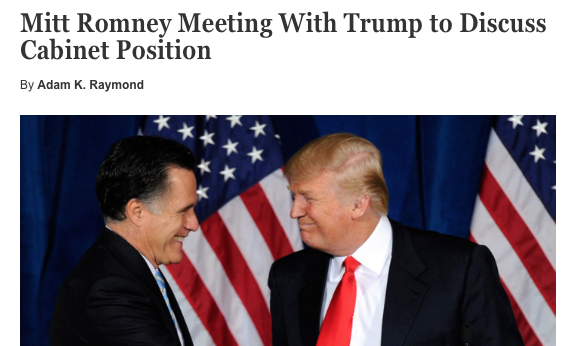
Romney comes to Trump
This summer Mitt Romney called Trump a phony, a con man, a fraud, and totally morally unfit to be president.  Trump called him a loser who "choked like a dog."   

Now Mitt Romney comes calling.   The optics of this are inevitable:   Romney is the supplicant.   Trump need not make nice.  Trump need not take anything back.   Romney has gone to Trump Tower.

Whether offered some position or rebuffed, Trump wins.   Either he hires the loser dog in some capacity, confirming his own seniority, or  he rebuffs him, confirming his own seniority.   Trump chooses, and rivals humble themselves.   Trump has the power to save or discard.   Look at Christie.  

Demand respect.
The final scene of Godfather I shows the succession of Don Corleone to son Michael to be complete.  The "family business" of killing off rivals outside and within the family is complete.  Michael is the Don.  Men from former rivals come to pay respects, to bow and kiss the Godfather's ring.   Better to bow, kiss the ring, have a future within the party than to have betrayed the man in power.  Chris Christie was an example.   Not of disloyalty but of hesitation amid a bad patch for Trump.


Thursday, November 17, 2016

Democrats are Working with Trump. Here is why.

Democrats are working with Trump.  Remember: except on matters of race and ethnicity Democrats did not say Trump was wrong.   Only that Trump was too crazy to be president.


Readers of this blog and listeners to the podcasts will not be surprised to read that Democrats are playing ball with Trump.   Trump is a big spending, big deficit, big government New Yorker.   He is not a conservative.   

He only pretended to be one.    He dressed himself in a few parts of the Republican costume as a Halloween disguise and Republicans bought it:
       ***Support guns big time.  (That cements things with rural people.)
       ***Oppose abortion. (That cements things with values voters.)
       ***Embrace the white Christian team by opposing Muslims and non-white crime.  (That cements the large white identity vote.)
       ***Oppose Hillary Clinton and Barrack Obama vigorously.  (This all by itself would almost have done it.   No policy promises here, just be anti-Hillary and you are a bone fide Republican.)

Notice that except for gun legislation (which was going nowhere anyway) and opposing abortion (which the Supreme Court protects for the foreseeable future) this really isn't policy.        Trump took over the Republican party with a bare-bones policy disguise and lots of team solidarity cheerleading. Trump guessed right that there were more motivated white people who wanted a retreat from politically correct and globalist embrace of outsiders than there were minorities.  Besides, as it worked out, he got plenty of votes from white women, Hispanics, and even some blacks.
Make no mistake.  Democrats are still dismayed by Trump.  They have spent a year telling the world and themselves that Trump is unfit to be president, and a majority of voters agree.  But a lot of them voted for him anyway.  They didn't like Trump.  They liked his message.  So it makes all the sense in the world for Democrats to adopt big parts of it.

Satirical Joke Headline, but funny because it is true

There was a lot of overlap between Trump and Sanders, and the Sanders insurgency forced Hillary to adopt some of those policies.   Democrats will reject the white identity cheerleading part of the Trump message but embrace Trump on the policies that were the core of Trump's message.  They are a bipartisan message, being voiced by Sanders as well as Trump.  Hillary picked them up and they have become mainstream Democratic ideas on trade, infrastructure, immigration, and opposition to elites.

Trade and protection:   Trump and Sanders raised the issue and used it to win the upper midwest rustbelt states.   Democrats learned you cannot just trade a Wisconsin machinist job for a Silicon Valley programmer job, and if you do you rack up votes in California but lose Wisconsin.   Democrats are now against the TPP and want to revise NAFTA, as does Trump.

Trump message throughout the campaign
Infrastructure:   Republicans are the ones uncomfortable with deficits and infrastructure spending.  Democrats love it.  Democrats may be the team that creates the infrastructure bill over Republican objection.  

Immigration:   Democrats reject Trump's harsh descriptions of their minority coalition members but the actual policy on immigration will move in Trump's way--just without the white resentment dog whistles.    Obama is already the Deporter in Chief.   Democrats will work with Trump to heighten border security and remove dangerous scofflaws and will position it as protection for their people.   Hispanic neighborhoods are the ones most hurt by gang activity and drugs.  Trump conflated immigration and crime which leaves room for Democrats to support legal immigration and oppose crime and still connect with their minority base.  

Reform Government to reduce power of the elites:   This is an issue that is better for Democrats than any other.   Democrats have more to fear of Trump failing to follow through on his "drain the swamp" message than by his doing so.  It will be easier for Democrats to shed the connection to the special interest billionaires than it will be Republicans.   As the parties re-align Democrats will want to ally closely with Trump.   Here is where Trump will get the most resistance--and primarily from Republicans.

But what about all the nasty, nasty things Democrats said about Trump.   Isn't he the devil?  Doesn't this empower evil?

Notice they don't say "wrong".  They say "unfit"
Democrats should chill a little.   Democrats would have demonized any Republican candidate.   They would have demonized Ted Cruz for being over-the-top conservative, a rigid self-righteous odious government destroying ultra conservative.  There would have been good evidence for this and Republican senators would have somewhat agreed even as they backed Cruz--just as they did with Trump.   Rubio would have been attacked as a mindless robot with canned memorized lines, utterly unready for office.   We would have seen the tape of him repeating "Let's dispel the notion that Barrack Obama doesn't know what he is doing. . . ." a million times.

Mike Pence is a conservative ideologue.   So is Cruz, only more so.  Ryan is a libertarian who wants to un-do the New Deal and the Great Society.  There are Republican ideologues. Trump is no ideologue.   

Democrats' big problem with Trump is not policy, it is temperament and if he blows up the world because he gets into a snit-fit with North Korea or China then this is out of the Democrats' control.   America took its chances with Trump and we will see what happens.  

Trump may well go farther in pushing a progressive agenda on jobs and the economy than would Hillary Clinton have been able to manage.  He can muscle and cajole the Republican House and Senate while Clinton would have caused them to seize up in righteous opposition.  Democrats can work with a progressive big government builder.   That is perhaps who they should have nominated themselves.   Trump, but without the white resentment piece.   Republicans would have opposed that person.  Instead they got Trump and they are duty bound and habituated to support their leader.   This is not a disaster for the Democrats.

Thad Guyer and I had predicted this in our podcasts.   We are beginning to see it played out here.  Guyer lays out his point of view in writing:

Guest Comment by Thad Guyer:

The Building of a Popular Bi-Partisan President Begins

As the UpClose post yesterday explained, the Steve Bannon controversy is classic media manipulation by the President-Elect, laying the ground work for normalizing his coming nominations and Congressional agenda. This post-Bannon period has already begun. Today’s New York Times headline is “Senate Democrats’ Surprising Strategy: Trying to Align With Trump”, NY Times (Nov 16, 2016, ).   
Click Here


The article states: “On infrastructure spending, child tax credits, paid maternity leave and dismantling trade agreements, Democrats are looking for ways they can work with Mr. Trump and force Republican leaders to choose between their new president and their small-government, free-market principles.” The article says NY Senator Chuck Schumer will lead Democrats out of the desert.

While this may be “surprising” for the Times, anyone who didn’t live in an anti-Trump media bubble would easily have seen this coming. All of the following is excerpted from the Two Left Eyes podcast on November 6, 2016:

We’re headed to an era of a popular President with bipartisan appeal in the electorate, like Ronald Reagan was, especially in his first term. It’s usually ideology that divides us, but Trump is non-ideological like most of the country left and right. True, Americans get angry and combative over certain things like economic malaise, tax increases, cuts to entitlements like Social Security. But regular people don’t protest tax cuts, everybody likes entitlements, and we’re all used to our great national credit card—the deficit—to pay for everything from wars to bailouts. There’s actually very little people won’t like with Trump on these bread and butter issues.

Trump's infrastructure projects, his love of bricks and mortar, they’ll be popular. Even New Yorkers and Hollywood will love him if he renovates La Guardia and LAX. He has no economic or ideological interest in war. If the left was right about one big thing regarding Trump, its that he's a wall building isolationist. Trump and Sanders exposed Americans for the popular isolationists that we are.

From the election, we learned that “globalism” is a bad word, its politically toxic and its now solidly linked to the political toxicity of open borders, exactly as it was with the Brexit vote in UK voters rejecting EU globalism and open borders. It’s not just the Trans Pacific Partnership under Trump that is dead, its NAFTA as well without major and symbolic modifications. We likely won’t see either party in the future doing anything other than telling voters they are against any global trade agreements that are perceived—rightly or wrongly-- as costing industrial job loss in the rust belt and mid-west. And we learned that our body politic is far less ideological and far more populist that we had known. Most of our history for the past 100 years has been electing ideological Republicans or ideological Democrats. Bush and the neo-conservatives on the right, Obama and neo-liberals on the left. Trump is literally an ideological agnostic, he doesn’t care about social or political ideology. Americans now want populism, and they want non-ideological progressivism

Bottom line, there is a strong chance that Trump is going to be a very popular president for everyone other than 2/3rds of Hispanics, 100% of our 3 million Muslims, the left establishment, and die-hard nerd Democrats like us. It’d be foolish to underestimate Donald Trump yet again. We should have learned that lesson after he won the primary when everyone said he couldn’t, and won the general election we were told that was inconceivable at 10 to 1 odds. Never, ever underestimate the Donald’s drive and effectiveness in winning, or his need to be loved as part of that.

Wednesday, November 16, 2016

Toying with the Left

We are watching Negotiation 101.   Trump is the professor showing how to do it.

The auctioneer holds up an item he knows will eventually sell for $20.  He says:  "Let's start the bidding on this lovely item.  Who will bid $500?  Let's start at $500!  No?  Who will grab this bargain at only $300?"

Donald Trump has started the negotiations over how he will staff his administration.

It is probably true that Trump would like to have Steve Bannon close at hand for advice.  There are a dozen ways he could get this, either with an official role or an informal one.  The informal roles would allow Bannon to make tons of money in the private sphere back at Breitbart or in some consultancy.  The formal roles put him in an office in the White House.  Either would work for Trump and Bannon.     Trump named  Bannon a "Chief Strategist" to be paired with Chief of Staff Reince Priebus.   Trump says he wants him right at his side in the West Wing.

Trump knows full well that Bannon is a big controversial choice. (If he didn't know it then Bannon told him.)  Trump did it anyway.  On purpose.   It is a red herring, a cape in front of the bull, a diversion.   It is a negotiation.

By naming Bannon Chief Strategist Trump has just re-set the standards of normal and acceptable.    Trump was the auctioneer who started the bidding at a ridiculous price.

The news is full of stories about all the unacceptable things published under Bannon's supervision.   Bannon says, sure, his websites attract white supremacists and homophobes.  Bannon says that the women who oppose Michelle Bachman and Sarah Palin are "just a bunch of dykes that came from the Seven Sisters schools."  Bannon calls the Occupy Wall Street people "dirty and greasy", and says that Paul Ryan was grown in a petrie dish at the Heritage Foundation, and says that conservatives should "bitch-slap the Republican Party."   

Democrats have risen to the bait.   Steve Bannon is too much.  Steve Bannon goes to far.   Fire Steve Bannon.  Steve Bannon.   Steve Bannon.
Democratic Senators Rise Up in Opposition

My Senators Wyden and Merkley have each emailed their lists.  Sign the petition! Send money!  

Wyden:  "It's outrageous the first announcement from the Trump administration is to announce the chief strategist will be a man who not only tolerated hate in every form, but actively courted it and fomented it.   I'n the son of German-Jewish immigrants.  My family fled Nazi Germany. . . ."

Merkley:  "Sign the Petition:  Call on Donald Trump to rescind the appointment of Steve Bannon, repudiate his horrific, racist, sexist bigoted views, and call for an end to violence, hate speech, and intimidation."

Democrats took the bait.  Trump just moved the goalpost on them.   Bannon is the new standard for "too far."   Trump just showed them how he negotiates.  The worse Bannon is, the more horrific, racist, sexist, and bigoted he is, the more normalized are the rest of Trump's potential appointments.   Trump has just made John Bolton, Newt Gingrich, and Rudy Giuliani look acceptable in comparison.   

By any standards of a Republican administration Bolton, Gingrich, and Giuliani would be uncharted waters of extreme and controversial choices for public office.   They have been aggressive political provocateurs on the leading edge of partisan anger and aggressive policy advocacy.   Trump has just made them normal and mainstream.

This early in the term Trump will no doubt prevail in keeping Bannon on as "Chief Strategist" if he and Bannon want him to continue in this role.   It is too early for Trump to appear to be bending or compromising.  He won the electoral vote.   He gets to pick his team.  Steve Bannon has just cleared the way for Trump to nominate as extreme a cabinet as he wants. 


Tuesday, November 15, 2016

Field Notes: Guest Post on European Reaction to Trump


A Guest Post Perspective:   An American in Europe finds "preponderance of people who like Trump."


I consider Thad Guyer to be a liberal populist.    I consider him fully "liberal" because of a lifetime of work on behalf of disadvantaged and legally mistreated people, including a decade's nearly fruitless efforts to protect the interests of jailed people from police abuse.   Plus he appears to me to have the usual suite of "liberal" attitudes toward equality for ethnic minorities, for reproductive rights for women, for access to justice for the poor.  He is a liberal.

But I consider him a populist simultaneously and his guest posts and podcast commentary reflect his impatience with excessive preciousness in political correctness, with the failure of liberal elites to defend the laws on immigration, and with their squeamishness about condemning violence perpetrated by people here and abroad in the name of Islam.   Readers who watch Bill Maher on HBO will recognize some of the same politics, to my mind.  Guyer--like Maher--voices a kind of muscular liberalism that says we should be unafraid to call out our own liberal side when we are being stupid.  Policies that ignore reality in an effort to be nonjudgmental cause voters to decide liberals lack common sense.   A liberal populist, for example, might admit aloud it is perfectly reasonable to want to avoid being shot or blown up.   It isn't racist or xenophobic to want to avoid being killed and for wanting dangerous people excluded from the country.   It is crazy to conflate racism with wanting laws to be obeyed.  Laws protect disadvantaged minorities, too.

[This is my characterization of how I interpret Guyer.   My words, not his.   If readers really want to get nailed down how best to peg Guyer--liberal, populist, whatever--they should listen to the podcasts and decide for themselves.]

The Democratic Party's style of liberalism as expressed by Obama and Clinton is polite and urbane and careful not to offend.  It has urban sensibilities.   It is anti-gun.  It is comfortable with globalism because it serves the needs of the educated information and health care and technology workers who were comfortable in the party.   

1992: Saturday Night Live parody of Bill Clinton at a McDonalds
Their style is liberal but it is not populist.  Populism accepts as completely valid the cultural norms of average people.  At its simplest, a liberal might consider a person who drinks a Budweiser and reads the NY Post a person who has not yet learned to appreciate the finer tastes of a craft beer and the NY Times, but education will fix that.  The populist voter resents the condescension and the populist candidate actually fully respects a man who drinks Bud and reads the Post.   He might genuinely prefer them himself, in real life, not just on a campaign photo shoot holding a shotgun.

Hillary is a liberal.  Bill Clinton--at least the Bill who got elected back in 1992--was a populist.   He was derided as a chubby McDonalds food eater--and he got elected notwithstanding "bimbo eruptions."  The wealthy and slender vegan of 2016 watched his wife lose.  They were out of touch, no longer rednecks, no longer having a southern accent, no longer poor, no longer populist, and no longer able to find 270 electoral votes.

Thad Guyer reports that Europeans he spoke with appreciated Trump's populism, if not Trump himself.


Guest Post by Thad Guyer

Thad Guyer

"I Thought I’d Be Embarrassed by Trump in Europe"


I’ve been embarrassed by our Presidents before during my foreign travel and work. I am lawyering in Geneva, Switzerland now, and was in Paris last week. I was ready for it again, the “what’s wrong with America” questions, this time about Trump rather than Bush. But I’m not getting it not now. 

Since 9/11, Europe has been repeatedly traumatized by radical Islamic terror, its borders overrun by millions of “irregular immigrants”, the loss of national identities and currencies as the EU and euro dissolved borders and sovereignty. On “the continent”, Britain’s Brexit from the EU was largely derided in these countries. Britain is not, and never has been, regarded as a world leader here, centuries old antipathies are still alive. But the USA was the savior in WWII, we broke up the Soviet Union, we launched the global anti-terrorism intelligence regime to track and thwart the perpetrators. Europe deeply values a big creative friend with muscle.


Donald Trump himself is not popular here, but “Trumpism” is. It inspires considerable awe and the spirit of self-determination. Trumpism is the story of American democratic grit, American power, the proof that Americans can innovate from moon shots to the internet to populist revolution. Europe remains steeped, and some here say trapped, in cultural and political tradition, but “those Americans” can just rise up one fine morning, say enough is enough, and cast off the political malaise and established political order. I am hearing that Americans are showing what “the people” can do if they want to do it. 


Americans can say enough uncontrolled migration, be politically incorrect in saying that obviously suicide bombers are Muslims, and proclaim that we won’t commit to war with Russia because they invade (“take back”) the Ukraine. People I chat with in the bars and cafes, on the trains, in the establishment venues I work in, say Trump is right to question whether NATO should get everyone into war over new members like Latvia and Estonia, who maybe shouldn’t have been let in in the first place. What matters is the confidence that America under Trump or any other president would never let Russia invade France, Belgium, Germany, Spain or Britain. 

I’m finding a preponderance of people applauding America for electing Trump, for proving that liberal elites and their media can be punished for their excesses.. They see a symmetry of Trumpism with the controlled immigration views of Europe’s new feminist nationalist leaders like Marine Le Pen of the French National Front, Frauke Petry of the Alternative for Germany, and UK Prime Minister Theresa Mary May of the Conservative Party. Women take the edges off nationalism, I suppose. The French like their now one year old “State of Emergency” allowing widespread raids on, and instant detention of, suspected Islamists, and close monitoring of mosques—these being the polices not of racist nationalists, but of established political parties. 


Trump’s calls to do the same sounds decisive, not radical here.  Trumpism is seen as getting a grip on what is happening in your own homeland and to your own jobs, your own identity, and who you are willing to go to war for. I expected a chilly reception from white Europeans in the wake of Trump’s election, as I did during Bush I and Bush II. But after Islamic bombing across Europe and streets flooded with migrants, I’m getting the opposite from white Europeans in 2016. Trump validates what white Europe is feeling. For better or worse, they see Trumpism as the new world order.

                         #    #    #
  Thad Guyer had reported that the data he found convincing predicted a Trump win.   I said that I thought the closing argument for Trump--the drain the swamp theme--gave Republican voters a good-government basis for electing him, and I said I thought it would be a narrow victory.   We were right, but we don't gloat.  We try to explain what happened and what is ahead for a Trump administration.