Saturday, March 23, 2019

Republicans: It isn't that Trump is so good. It's that Democrats are so bad.

We are going to hear a lot of Democrat bashing in the next two years.  It has already started.


There is no real consensus among Republicans except on one big thing: Democrats are vile. They are persnickety and snobby. They are hypocritical. They are crazy socialists. And they are out to get Trump.


This morning I awoke to Fox News' coverage of the Mueller Report. I expected a headline like "Trump totally vindicated!!!" or "Trump didn't collude!!!"

No.  

Here is what I saw: Democrats distraught.

Take a minute and read. It is unintuitive and therefore very revealing of the inner motivation of the GOP message.

They don't defend Trump. They attack Democrats.  There are eleven stories here, and every one is about Democratic disappointment, Democratic over-reach, Democratic attacks.


Trump is a divisive figure even within the GOP, but the attacks on Trump by Democrats are not divisive. Fox sees them as attacks on the team, as attacks on Republicans. Look at how they hate us!!!

There are a few lessons for Democrats embedded in this Fox splash.

1.  One is that the thing that most unifies Democrats--hating on Trump--may be backfiring. Republicans identify with Trump. The Democrat needs a positive message of political and social change--being for something popular. That needs to be a bigger message than Trump's behavior.

2. The second is that Trump will define the Democrat. Trump's record in office is not the sweet spot for getting Republicans to rally. Scorning Democrats is. He will demonize the Democrat. As this blog wrote yesterday, Trump is a master at branding and humiliating opposition. "Bolshevik Bernie." "Baby Beto." 'Pocahontas--'I don't know if I can listen to her shrill voice for four years, it hurts my ears.'"  Stuff like that.

Many of the most engaged Democrats are already helping with that process of Democratic demonization. For perhaps 20% of the Democratic primary vote, anyone except Bernie is a progressive fraud. Social media is full of Bernie-or-nobody. Those voters are engaged and persuasive within their group. They think this is the great opportunity to move the electorate to the left, and failure to do it is a sell-out.

I have an grim potential image of election-2020, informed by memory of 2016, not by invention. By election day Democrats will have to hold their noses to vote for their candidate, and Independents will split for Trump, who by then will be the only viable candidate. 


Friday, March 22, 2019

Trump has a trademark skill: revenge

     "Trump leaned back grinning."

Ilhan Omar and Alexandria Ocasio-Cortez are poking the same ones Trump pokes: John McCain and Jeff Bezos.


Goliath, the trophy.
Trump surely likes watching it, and for a moment the young Democrats and Trump have a common enemy. He likes having enemies and he likes to demonstrate how he destroys and humiliates them.

It is ancient practice. Make a trophy of the corpse of your enemy. Send a message.

The Guest Post below is long and dense, so this introduction will be short. Thad Guyer says that their temporary alliance is not based on agreement. It is based on Trump's unlimited appetite for revenge. Democrats need to be at the top of their game to compete with Trump in the arena of revenge.

Guest Post by Thad Guyer:


Trump, Ilhan Omar and AOC:  Revenge and the Enemies-of-Their-Enemies”

A Vietnam war buddy of mine in failing health exclaimed “I hope I live to watch the 2020 circus”.  

The racist called the Vietnamese “gooks”, sang “bomb bomb bomb” them, and made Sarah Palin his own. No, not my friend; I’m referring to John McCain, the war hero who according to Democratic firebrand Ilhan Omar’s retweet was anything but an honorable man. See, “Omar retweets attack on Meghan McCain's 'faux outrage' over anti-Semitism”, The Hill (Mar. 8, 2019, https://goo.gl/mu95Ja). 
Achilles drags Hector's body

Trump’s attacks on the dead senator have been considerably milder than hers but, still, Trump and Omar manage to share a dance on McCain’s grave. As to the living, damn be the “corporate greed”, “worker exploitation” and “power of the richest man in the world”, who can take his 25,000 high paying jobs and shove ‘em!  That’s what AOC said about Jeff Bezos, as she ran him out of NYC.  See, “Ocasio-Cortez Cheers Amazon’s Withdrawal as a Victory Over Greed”, (Bloomberg, Feb. 15, 2019, https://goo.gl/13rkrd).  

As when Omar savaged McCain, Trump leaned back grinning as AOC trashed the Washington Post owner, that purveyor of “fake news”, that “enemy of the American people”, or as she said, that enemy of workers.  It’s this adage now bonding Trump to both Congresswomen of color: “The enemy of my enemy is my friend”.   All three share the same political etiquette, and present the same example of bitter partisan leadership.

Nevertheless, Ms. Omar and Ms. Cortez may be too inexperienced to fully appreciate Trump’s most practiced art-- the art of revenge.  Mitt Romney and other fidgeting Republicans this week called public shame on Trump’s assaults on McCain’s flip-flop on “repeal and replace” and promotion of the Democratic funded “dossier” that helped launch Mueller’s “witch hunt”. These Republicans missed the point (or perhaps they don’t):  the President’s vengeance will follow GOP traitors into retirement, disability, and even death.  

Godfather message.
CNN and MSNBC think Trump’s vengeance against McCain’s reputation shows mental and moral derangement. Maybe that too, but this ignores Trump’s unflinching lifelong willingness to engage in the “game theory” and psychology of political revenge. See, “I Dare You to Punish Me—Vendettas in Games of Cooperation” (PLOS, Sept. 19, 2012, https://goo.gl/QN32RE), and “The Complicated Psychology of Revenge”, (Psychological Science, Oct. 2011, https://goo.gl/zqara9). It finds “Successful revenge is therefore about more than payback; it is about delivering a message.” 

Trump’s message to the GOP is that he will taint the traitor’s family name and humiliate his children (despite Art. 3 section 3 of the constitution normative value that a person’s treason shall not “work Corruption of Blood” on his family).  Nor is Trump’s assault on McCain merely a sign that he’s panicking over the forthcoming Mueller report. Trump has methodically used revenge for decades in his business and media life. See, “Vilification and Revenge Are Key to Trump’s Personal Values” (Truthout.org, Oct. 6, 2016, https://goo.gl/ou6EFY).

Trump will savage any “let’s play nice” or “when he goes low, we go high” Democratic nominee in the general election. Trump has vanquished politics as usual and political correctness. See, “How Donald Trump and Roy Cohn’s Ruthless Symbiosis Changed America”, (Vanity Fair, Jun. 28, 2017, https://goo.gl/FaM27G).

Democrats better not nominate anyone who’s not up to Trump’s knife fight if we want to change America back.

Thursday, March 21, 2019

The system is rigged

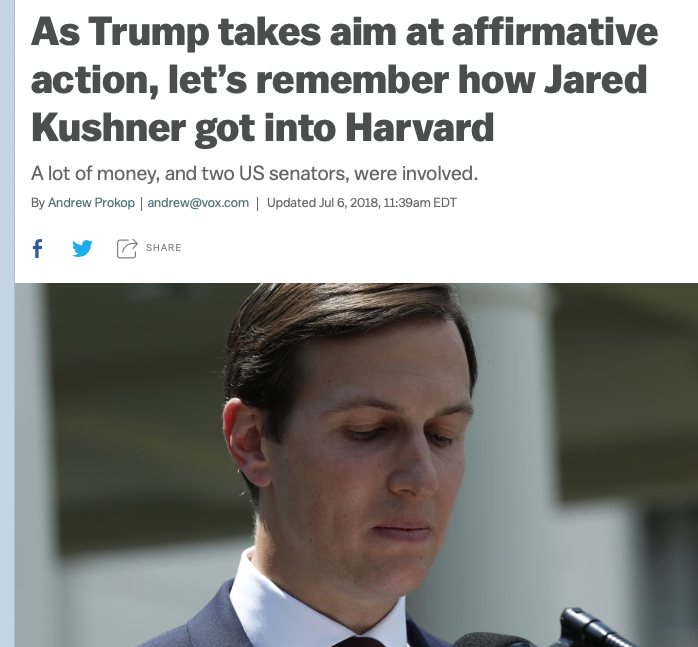
The College Admission scandal is a good opportunity for Democrats

Kushner affirmative action

Jared Kushner is the poster boy. 


It helps Democrats reposition themselves on elitism. 

The admissions scandal is a gift. Use it.

Hillary Clinton in 2016 tried to present herself as a pioneer of women, the underdog breaking the glass ceiling. True, but she also represented economic and social privilege. She got paid big bucks to speak to Goldman Sachs. She cashed in. Jimmy Carter built houses and lives in a small house; Hillary and Bill vacationed on Martha's Vineyard with billionaires. Her image oozed privilege.

This allowed an improbable result. 

Donald Trump, whose whole life exemplified privilege via inherited wealth and an extravagant playboy lifestyle, was the one who represented anti-elitism in the public mind. He said he opposed the elites. He said he would drain the swamp. 

He got credibility in this message by his low-class tabloid behavior. He spoke simple language in half sentences rather than an oratorical style. His isn't "presidential" or proper. He cheats on his taxes, goes bankrupt, and stiffs contractors--low class behavior. He brags about his money. He has gold toilet fixtures. He acts like a Rodney Dangerfield character in a movie about a fish-out-of-water working class guy from Queens who strikes it rich, gets entrance to a snooty country club, and who then offends the group decorum with his crass vulgarity. The audience finds that character genuine and likable, and we dislike the snobs.

It helped elect Trump, the "man of the people."

Democrats need to switch the polarity. Democrats need to be the anti-elite populists. The college admissions scandal is a vivid symbol Democrats can use.  

Americans have bought into the marketing of supposedly elite universities. Elite universities have big brands. They represent a short path to wealth and power because they represent meritocracy. They brag about how many people they reject--some 94% of all applicants. They must be special.

People criticize and mock them--"Haaaavahd"--because they symbolize something.

Democrats get a two-for with the admissions scandal. It allows them to condemn a rigged system undermining meritocracy, with the bonus that it involves Hollywood elites. Democrats need not be concerned they are attacking and hurting their friends and allies. Both elite universities and Hollywood can take the punch. Democrats can criticize the breach of trust, not the institutions themselves. By attacking the scandal they are actually defending the university and Hollywood brands.

Poor Jared Kushner. He is caught up in the mess, and in a way that Harvard cannot defend other than with vague, unpersuasive comments about "holistic" consideration of the applicant and supposed "leadership characteristics."

Elite universities know full well that admissions of sub-standard students in consideration of financial donations hurts their brand as a meritocracy and that it diminishes the brand value for its students and alumni. The admission of Jared Kushner to Harvard, in exchange for a measly $2.5 million dollar gift, is an embarrassment. It is too cheap. It looks low class. It breaks their brand. Harvard should have held out for $50 million, and made him go to a prep-school for a gap year, and then admitted him. That would have represented high standards. They would have covered their tracks.  Fifty million means deep generational wealth and power. Two and a half million is a bribe.

Shame on Harvard.

Hollywood people, too, know that the fraud committed by a couple of prominent figures diminishes its own brand. They--and their children--are supposedly celebrities because of their star quality, not cheating. 

Democrats can make Jared Kushner the symbol of Trump corruption and elitism. It complements the bigger story of the Kushner financing of their 666 Fifth Avenue property and the sweet bailout from the Qatar sovereign fund. What foreign policy considerations were involved in that deal?  We can never know, but we can wonder.

More generally Jared Kushner's college admission communicates financial corruption and cosy deals between between people with money and people with power. This is a Trump vulnerability, one in which there is documentation. Collusion is a complicated messy thing, but when money moves around it leaves tracks.

Democrats need not worry that they will hurt themselves criticizing elite universities for abandoning meritocratic standards. The public will love it. And in the long run it will help the universities' brands.

Win-win.


Wednesday, March 20, 2019

Electoral College issue has become partisanized.

Which party--or set of policies--does the electoral college advantage?


Neither.


How we elect a president is an interesting, important issue. It has become partisan, which destroys America's ability to consider the pros and cons.  Too bad.

Calls for popular vote for president.
Blue. Presidential candidate Pete Buttigieg advocated ending the electoral college system of electing presidents. We should use a popular vote, he said. Elizabeth Warren made the same suggestion. Other Democrats are talking about it. This is turning into a "Democratic idea."

After all, in the elections of 2000 and 2016 the Democrat won the popular vote but lost the electoral vote and therefore the election. The implication is that the process of electing president by electoral vote gives advantage to the Republicans. This is cross-checked by noting that the electoral vote system gives extra weight to states with small populations. Reliably red Wyoming and Idaho are cited as examples of states extra weight in an electoral college system, as was intended in the original Constitution.

Red. Donald Trump, who had earlier said the electoral college was a disaster is now tweeting that it is a great thing.

Trump: keep electoral college
This morning a Fox News commentator was praising the electoral college as another example of the divine wisdom of the authors of the Constitution.

The electoral college is becoming a "Republican idea."

I don't consider the matter partisan. 

The winner-takes-all system of allocating a state's electoral votes make it approximately as good for Democrats as it is for Republicans, maybe better. Currently Democrats tend to cluster in cities, and cities dominate states, as Trump notes. But he errs in how that effects the electoral college vote. In a winner-take-all state system, it means close states can tip to Democrats.

The 2000 and 2016 elections were very close. It would have been just as easy for Democrats to have won states narrowly as it is for them to have lost them narrowly. The butterfly ballot, which confused voters in Palm Beach County, Florida, in 2000 had more effect on the outcome than any particular advantage given small states in the electoral college.  All Florida's votes went to George Bush, not Al Gore. 

Democrats voted for Buchanan
But there are important consequences to how we elect a president. Let's examine two of them.


Stop-loss on partisan misbehavior by any one state. 


States try to stack the deck. Some states are sufficiently partisan that there is no political cost to gaming the system for ones team, and indeed there might be serious consequences for not doing so. Think blue California and red Wyoming or Alabama.

States have a great deal of control in how they allocate their electoral votes. It doesn't need to be "fair" or consistent.  

This can be gamed. In the run-up to the 2016 election Republicans in Pennsylvania realized a strategy was available to them. They controlled the governor's office and legislature. They had the power. They use a winner-take-all electoral college allocation. They fully expected the Democratic candidate for president to win the statewide vote, so all Pennsylvania's electoral votes would go to the Democrat. But since they had done a very successful partisan gerrymander of the congressional districts, packing Democrats into relatively few districts, it was plausible that about 13 of their 19 congressional districts would have Republican majorities in the presidential race if they changed state law to allocate by congressional district. The Democrat could win the state but only get about 8 electoral votes, instead of all 21. Republicans would get 13 votes, even when losing the state.

It turned out they didn't proceed with this, and lucky for Republicans they didn't, because Trump actually carried Pennsylvania.

Right now, some states--ones with Democratic majorities in their legislatures--are discussing requiring additional qualifications for a candidate to have access to the ballot, i.e. releasing ones tax returns. Managing to dis-enfranchise a candidate would have an effect on the whole vote count. If California were to manage to prohibit Trump's votes from being counted, it would be dispositive for the election, and it might well be soundly popular in California.

However, one could easily imagine a bright red southern state--Alabama or Mississippi perhaps--making an equivalent requirement, saying perhaps that a presidential candidate needed to prove American birth and that, in the considered opinion of their legislature, Barrack Obama's Hawaii birth certificate was unpersuasive, and therefore he was not permitted to be on the ballot.

There is a problem with a popular vote. 

States run their own elections and there are motives and opportunities to game the system. In the current circumstance, there is a stop-loss. Partisan games in one state only effect one state, but in a popular vote system, especially in a close election, one state can poison the entire voting number.

Ignored States and battleground states.

The current situation divides states into two categories, "safe" and "battleground." Smart strategists realize that some states aren't "in play" and therefore are essentially ignored. This makes the issues of the few close battleground states hyper-important. When the upper midwest is in the battleground then the issues of rustbelt manufacturing are addressed, and the issues of particular interest in California, perhaps housing affordability, are ignored. 

This skews the national policy debate and policy solutions. It matters. We have ethanol in unleaded gasoline--made from corn--not because turning food into vehicle fuel is great public policy, but because Iowa is a corn-producing state and it is an early decider of presidential candidates. Candidates go there and take the "corn pledge."

The fact that the battleground states in any one election come down to about  6 to 8 of the 50, mean that voters in the vast majority of the country are essentially ignored, with the effect that a message is delivered and received, that the votes of most people are irrelevant, hurting voter participation.

This would be an argument in favor of a popular vote. Your vote counts. Everyone has buy- in. You choose the president.

But wait.

A counter-argument would be that it is a big country, with some minority concerns that need to be given thought so that the entire country gets presidential buy-in.  In a popular vote system candidates will focus on the people easiest to reach, i.e. people in larger communities and media markets, but the current system requires candidates to pay attention to rural voters. Why? Because there are some rural voters in the battleground states. Those isolated minorities in a battleground state are stand-ins for similar minorities in the ignored states.

Prediction: 

Sometime in the next few years, a Democrat will win a close election thanks to the quirks of the electoral college, having won close majorities in battleground states, but having lost the popular vote. That will cause a switch in the polarity of support and opposition to a popular vote. People care more about outcomes than process.

At that point the general support for a popular vote will be de-partisanized briefly, and that will allow people once again to consider the pros and cons without blinders. There is a kind of logic to every vote counting equally, and of and directly electing the president. The direction of history is moving in that direction.

But it won't happen until then.


New Comments Procedure

Notice to people who may want to comment.


We will try something new.  Comments will be published immediately.

Under past and current new filters, anyone can comment, either anonymously or with a Google ID. 

Currently those comments get reviewed by hand by me, a slow and tedious process. Hereafter, we will try a policy of immediate publication.

This blog gets 25-50 blog comments per day from scammers and robots, which comments are identified in part by being intended for posts on posts from previous weeks, not the current one. I have introduced new filters to attempt to eliminate those automatic comments.

Now people commenting will need to maneuver through the photo id clicking ("Click on the traffic lights" for example) to be able to post.  This may--perhaps--eliminate the computerized comments.

Readers are warned that this opens the blog up to comments by real, life humans who may write offensive things. If readers will be amused by obscene comments,then click on the comments.  To avoid that, don't click on the comments.

To read the current comments, or to comment yourself, just click the Comments link at the bottom of any post, like the button there in the graphic.

Let's give this a try.


Tuesday, March 19, 2019

Trump is what James Madison feared

Madison understood that democracy self destructs.

James Madison

"We the People" are easily spooked. We stampede. We attach to a strong man of ambition who speaks of ends, not process, particularly when there is a war or invasion. A democracy becomes a dictatorship.

The Constitution was supposed to fix that.


The Founders predicted one branch or the other would flout the rules and say, in effect, "I can do what I want."

The expected ambition would check ambition. They thought the House of Representatives would jealously protect its power to initiate spending bills and that both House and Senate would jealously protect the power of the purse.

Trump declared a "national emergency" on a border wall. Congress said no, there wasn't one. Trump vetoed their resolutions denying the national emergency declaration. Neither the House nor Senate has the votes to override it. Congressional Republicans let the Trump precedent stand. 

Ambition did not check ambition.

The Courts will be reluctant to second guess the political branches on the question of fact--the prima facia observation that it is in fact not an "emergency--when the branch of government entrusted with that job, the Congress, was supine. Congress was expected to defend its own power.

This changes America. This and future US presidents can now ignore the Congressional power of the purse when sufficient members of his Party want the policy result more than they want to defend Congressional power, and when the President is sufficiently popular within the Party.

GOP officeholders do not dare cross Trump on a border wall to keep out migrant invaders from the south. Trump has a message that resonates with a big block of Americans: fear, distaste, and generalized opposition to immigrants across our southern border. He came down the escalator and opened his campaign with words that seemed shockingly blunt and impolitic at the time, that Mexicans arriving here are criminals, rapists, drug abusers, and job stealers.

The words did not destroy his campaign. They elevated it. It turns out that a lot of Americans agree.

The wall became a symbol of resistance to outsiders and an affirmation of a demographic and cultural history, the "good old days," when America was great--and white and Christian and men wore the pants and people didn't have to walk on tenterhooks for fear of someone claiming "offense." 

Thad Guyer wrote a follow-up comment to his Guest Post of yesterday on Trump's potential re-election. I recommend readers who missed it scroll back. American voters see-saw back and forth between parties, and it apparently takes eight years for the sentiments that elected one party to mature and create a reversal. Trump identified something big and real that got him elected in 2016, a fear in the hearts of many Americans of racial suicide, that white Americans are losing their country to dangerous foreigners. 


Boston
We have been here before because those ideas are deeply rooted in the American psyche.

In the prelude to the Civil War Millard Fillmore spoke the same message, one of resentments toward elites (via the Anti-Masonic Party) and then the open opposition to immigration by Catholics (via the Know Nothing Party.) 

Guyer writes: 

    "Historians just can't get their message across that in the American experience, Trump is not an aberration.  

     Apart from TV personality Ronald Reagan in 1980, in Millard Fillmore, the mid 1800s saw a remarkably similar bigoted conspiratorial Trump-like presidency.  The good news is  Filmore lost reelection. The bad news is behaviorism Rule #2-- he was vice-president in the prior administration and ascended to the presidency on Zachary Taylor's death.  See, BBC, "Is this the US president most like Trump?" (https://www.bbc.com/news/world-us-canada-44688337).

    Justice Oliver Wendel Homes wrote: "The life of the law has not been logic: it has been experience." This observation by Holmes has even stronger application to politics. Voters are driven by emotions, fear, greed, biases, intuition, superstitions, religion and family history. Psychology and sociology track our political history far better than logic and rationality."

Boston
Up Close.  Beginning shortly I will travel to New Hampshire and Iowa for up close observations of the Democratic candidates. Many Democrats think this election is "in the bag" and that they can pick and choose with an eye toward pleasing Democrats, not the general election voter, because 2020 will surely be a Democratic year. 

I disagree. This will be a close-run election, and Trump could well win. Trump will demonize the Democrat, whoever it is, and Trump speaks to a deep-set fear among many Americans, that "we" are losing our country to outsider who are infiltrating and corrupting our country. Trump positions himself as the leader of the resistance. 

That anti-outider sentiment persists, and not just in the South or among self-identified racists. I was up close to watch ethnic and racial violence in Boston, Massachusetts in the mid 1970s. American blacks were the dangerous interlopers to white ethnic neighborhoods. Meanwhile the neighborhoods were segregated by ethnicity, the Irish, Italians, and others.

Trump sentiments are close under the surface, now and in the past.


Monday, March 18, 2019

History suggests Trump re-election.

It isn't that the Democrats will blow it. It is just that after eight years of Obama it was the Republicans' turn. 

Warning. It could happen.


They get eight years.


WARNING TO READERS: My Democratic readers won't like this post.

Guest Post writer Thad Guyer reports on some historical "rules." He writes that American voters see-saw back and forth between Democratic and Republican presidents. Trump is slated--fated maybe--to win re-election, no matter whom Democrats nominate. The rules he cites are arranged to "fit" the data, so that it explains one-term presidents and can ignore the fact that voters gave Franklin Roosevelt and Harry Truman a long uninterrupted run, which is not predicted in a see-saw pendulum model. 

Still, It is an intriguing bit of history, and one that should give Democrats pause. 

The pendulum theory is not new, and it  conforms to what this blog observed repeatedly during the 2016 campaign: that Hillary Clinton needed to have a change message, not a continuity establishment message. Voter had Clinton-fatigue, and they sought something new. 

Aren't voters on the fast track to be sick and tired of Trump, making 2020 another change election?

Possibly, yes. History guides; it doesn't command. But presidents have the tools to make themselves look essential and make voters wary of changing horses midstream. We could be in the middle of a war or a negotiation with North Korea.

And remember that Trump's has a gift for opposition branding. By election day 2020 Trump, with help from Fox and social media trolls, a great many people will think the Democratic nominee is a dangerous fraud, utterly unworthy of the White House. Expect this.

Guyer is an attorney with an international practice, specializing in advocacy for whistleblowing employees. He has become accomplished in data-driven interpretation of the kinds of things that influence judges, hearings officers, and juries. 


Guyer
Guest Post by Thad Guyer

“Why We Aren’t to Blame if Trump Wins Reelection”


Historical data suggests that Trump almost certainly will be reelected, no matter what.  Stanford University professor Jonathan Bendor’s “A Behavioral Theory of Elections” (Princeton Univ. Press 2011, https://goo.gl/dPsDKj) is just one in a growing body of scholarship applying the science of “behaviorism” to voting and electoral trends.  Why do American voters so strongly favor incumbency and reelection, despite telling pollsters they want to “throw the bums out”?  Studies show that it’s not just campaign finance, but sociology and psychology driving aversion to the risks of change, the aphorism “don’t change horses in midstream”. 

Americans embrace a nice and steady eight-year pendulum swing of alternating two-term presidencies where one party follows the other turn for turn, eight years each.  Our history since 1885 overwhelmingly favors Trump’s reelection because two term presidents of one party have always—100% of the time since then absent death, resignation or declining a second run-- been followed by two term presidents of the other party.  

There are two historical empirical rules at play: (1) The only presidents who didn’t win a second term did not follow a two-term president from the other party; and (2) former vice presidents who buck historical trends and manage to win a first term as president never win a consecutive second term.  Going back to 1885, only the following six presidents lost reelection, and none who had not been a vice president followed a two-term predecessor from the opposite party:

1.  George H. W. Bush (R) succeeded a two-term president from his own party, Ronald Reagan (R).   Rule (1) eight-year alternating pendulum and Rule (2) VP’s don’t win reelection both applied.

2.  Jimmy Carter (D) succeeded Gerald Ford (R) rather a two-term president. Rule (1) applied. 

3.  Gerald Ford (R) was never elected in the first place, since his predecessor Richard Nixon (R) had resigned before completing two terms. Rules (1) and (2) applied.

4.  Herbert Hoover (R) succeeded Calvin Coolidge (R), and Coolidge became president only because Warren Harding (R) died in office. Rule 1 applied.

5.  William Taft (R) succeeded Teddy Roosevelt (R) of the same party.  Rule 1 applied.

6.  Benjamin Harrison (R) succeeded Grover Cleveland (D) after Cleveland had served only one term.  Rule 1 applied.

Alternatively stated, these rules mandated that Bob Dole, Al Gore, John Kerry, Mitt Romney, and Hillary Clinton would be defeated no matter what; and that if former VP Joe Biden is nominated, he will lose under both rules just like former VP Al Gore did no matter what

When political parties lose elections they thought they would win (or were sure they would win as we were for Reagan’s reelection), they launch self-critical “lessons learned” and even self-loathing “political autopsies”.  We should stay hopeful of breaking the historical mold, but we should decidedly avoid blaming ourselves and each other with should’ve or could’ve dones in preventing Trump’s reelection. We have enough strife among ourselves.