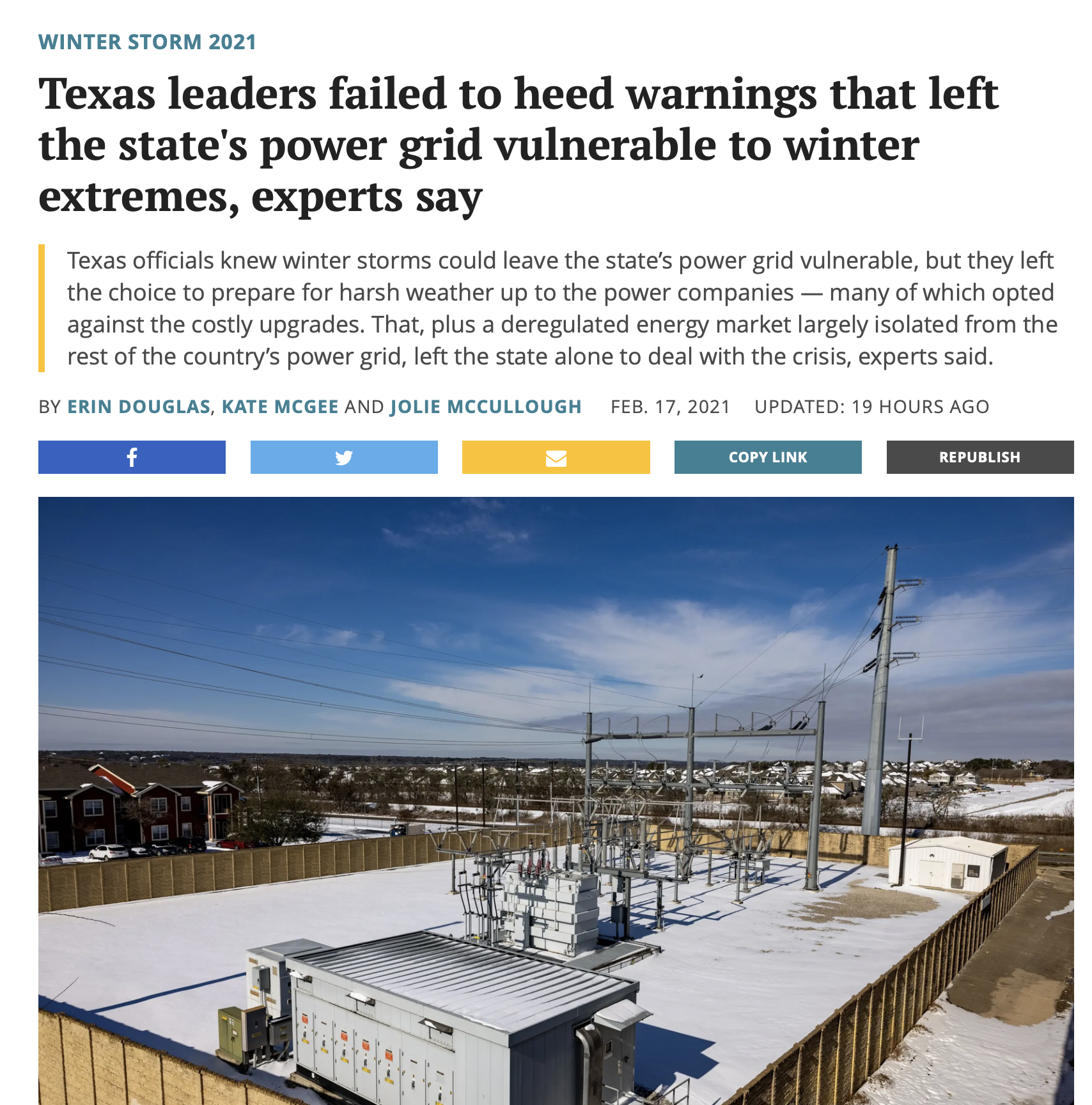
Parts of Texas went dark.
We count on electricity for our food, water, heat, sewerages, communication. Things got miserable fast.
Early in my career as a Financial Advisor, utility stocks were safe, steady investments in a highly regulated "natural monopoly." Utility companies generated power and distributed it to consumers. A state Public Utilities Commission approved their plans and costs, then approved an amount that consumers--called ratepayers--were charged to cover the costs of the facilities, plus guarantee a respectable rate of return, typically seven or eight percent, plus a little growth to match inflation. Much of that profit got distributed as dividends to the stockholders.
By 2005 everything had changed. Utility companies were wheeling energy in the spot market and gaming the system when they could, going off-line for maintenance in order to drive up the price, then selling at high prices to desperate buyers. Utility companies were players. They were Wall Street hot shots, buying and selling one another. Some flew high, some went bankrupt.
John Flenniken is a retired safety engineer at an Oregon utility. He had a close up view of the industry, and has a perspective on what happened in Texas. He lives in Portland, Oregon.
Guest Post by John Flenniken
Crises seem to come out of nowhere. This one didn't. There is a history of events leading to this moment in Texas.
 Over recent years electric utilities went through a “consolidation" by merger and acquisition. For example in Texas, Houston Lighting & Power became Reliant Energy, and is now GenOn (a holding company) serving Texas, Pennsylvania, New Jersey and Maryland, headquartered in Houston. The consolidation was a net positive for investors, giving economy of scale.
All states maintain their own utility boards (Public Utility Commissions) for oversight. Bigger companies usually mean greater efficiency. PUC boards set and monitor service standards while allowing a utility to have a guaranteed service territory and return on investment to keep serving it. Companies centralized manpower, rolling stock, and stockpiled materials when they can. Service centers closed in towns that used to have a small local footprint. Call centers replaced local customer service personnel. Utilities used to be the reliable sponsor of Boy Scouts and local civic clubs. No longer. Now it is all about cost cutting.
Consolidation was well under way as early as the late 1980s. Texas is a special case, however. Texas has a Public Utility Commission of Texas, but it doesn’t coordinate with the Federal Energy Regulatory Commission (FERC). FERC came into existence when back-to-back blackouts affecting eastern Canada down to New York in the 1960's made it painfully clear that how the system was managed affected everyone connected to the transmission system. However, rather than linking their transmission to the rest of the U.S., Texas' electric utilities installed breakers at their state lines. These devices operate to isolate the state. This isn't an accident. It's a feature that allows Texas to avoid regulation by FERC.

Texas is unique in being a state with its own system and regulator. To over-simplify a bit, Texas' handpicked board, the Energy Regulatory Council of Texas (ERCOT), operates and manages its deregulated market. FERC's regulations are just advisory to Texas. The benefit for Texas is from selling to the highest bidder the unregulated portion of electricity on the interstate transmission system. It creates a spot market where the price at the moment can go from almost nothing to whatever the market will pay.
The rate any customer pays is set by the state PUCs, with utilities generating power to sell to their own customers. PUCs also allow a pass-through of more costly power from electricity generated by other utilities and purchased when needed. All utilities have some or all of their own generation to meet their customers' demand, and that was the tradition: Produce power for your own monopoly customers. Deregulation changed this arrangement turning local utilities into both producers and shoppers in the wholesale market, getting and selling energy where they can, through long-term energy delivery contracts and in that spot market. Electricity was turned into a commodity.
Electricity is different from every other commodity. Uniquely, the moment electricity is produced it is consumed. The job of scheduling the amount of energy required at any given time becomes extremely important in this new arrangement. The prices paid for a unit of electricity, the megawatt, vary by the generator that produced it and its price at the moment it is created and delivered.
Enter renewables--solar, wind, hydro pump storage--into the mix of thermal from fossil fuels (coal, oil, natural gas) and nuclear. Costs associated with serving the utilities' customers are calculated mostly using thermal and nuclear generation figures. This is the number PUC boards use to set the amount you can be billed for their regulated return on investment. Now, by separating generation from delivery to customers, the risks and costs of providing the generation are shifted to the generating company.
The deregulated spot market functions like any free and unregulated market. If there is high demand there is no limit on the price of a megawatt. But if the demand is low or cannot be sold, the megawatt is lost and the cost is absorbed by the company that produced it. There is strong incentive to get the amount just right, no more, no less. It is efficient but fragile.
Renewable sources of energy are recent additions to the pool of energy that companies sell into the wholesale market. They are a small part of Texas' winter electrical generation, but they were a handy target to criticize to divert attention from what was a policy and management problem. While wind turbines can be built to function in all kinds of weather, specific modifications must be built into the wind turbine to withstand extreme cold and icing conditions. Cold weather modifications add maintenance and labor costs. Operators of wind energy farms built with investor money in Texas did not add a cold weather package to each unit. As a result, some turbines iced up and quit generating.
What happened to the thermal generation? Here a cascade of events overtook their system. Texas uses more electricity in the summer for air-conditioning and petroleum production so they schedule plant maintenance in the winter. Knowing they can buy on the spot market made this smart in normal winters. In Texas, thermal units and pipelines are not built to run in extreme cold. As a result these units could not get back into operation. Had ERCOT followed FERC standards for their system Texas might have been in a better position to keep the lights on. They didn't.
The lessons in Texas are clear. We need a North American standard for interstate electric transmission. The “smart grid” that Obama proposed in his infrastructure plan to stimulate the economy would have supplied resiliency to the system. A smart grid would help balance out the system by linking the entire country, allowing power to be shifted instantly. Since commodification of energy created a more fragile system, we need to implement a better grid system to replace the reliability that the modern system lost.
The lack of electricity isn't just an inconvenience. People freeze in the dark.