Tuesday, December 7, 2021

Who gets abortions?

The CDC reports 630,000 legal abortions done in 2019. 


Abortion is a center stage issue in American politics. It might be useful to have some facts.


Today's post is a summary and highlights of the annual report on abortion statistics compiled by the Centers for Disease Control and Prevention. A link to it is at the end of this post. The report is dense and is presented as narrative and tables, not as graphs. I round the data a little, so that readers have an easier time seeing the broad outlines. For example, the precise number the CDC reported was 629,898.


1. One out of six pregnancies in the USA is terminated. The abortion rate was 11.4 abortions per 1,000 women 15-44 years of age. For comparison, there were 195 abortions per 1,000 live births in that broad group. 

2. Abortions are declining in absolute numbers over the past decade, from 766,000 in 2010 to the 630,000 in 2019. The rate is the number of abortions per 1,000 people. The ratio is the number of abortions per live birth. Both rate and ratio are declining as well.

3. Women in their 20s are the primary group obtaining abortions. The age groups 20-24 are 28% of the total and women 25-29 make up 29%. Teens make up 9%; women 30-35 make up 19%; women 35-40 make up 11%

4. Women at the extreme ends of the age spectrum are outliers. The oldest women, 40 and above, were only 4% of the total abortions, and had an abortion rate of only 3%. The youngest girls, under age 15, had 0.4 abortions per 1,000 girls age their age, but the highest abortion ratio of 853 abortions per 1,000 live births. Few girls under age 15 get pregnant, but when they do, 46% of pregnancies are terminated. 

5. Teen girls abort most frequently. Among older teens, the abortion ratio drops to less than half of that of the under-15 group, down to 344, 358, and 294 abortions per 1,000 live births among 17, 18, and 19 year olds. However, this is still three times the average for all women of childbearing age.

6. There is substantial difference in abortion rates among different ethnicities. Non-Hispanic White women and Non-Hispanic Black women obtain most of the abortions, 33% and 38% respectively. Non-Hispanic White women had an abortion rate of 6.6 per 1,000 women and 117 per 1,000 live births. Non-Hispanic Black women had an abortion rate of 23.8 per 1,000 women, and a ratio of 386 abortions per 1,000 live births--nearly four times the abortion rate of White women. 

7. Most abortions happen early in a pregnancy, with 92.7% taking place at or before the 13th week of pregnancy, measured from the time of the last period; 79.3% take place at or before the 9th week of pregnancy.

Chart by Kevin Drum: https://jabberwocking.com

8. Early abortions are primarily "medical," i.e. done with a two-pill procedure that results in what most women experience as a "heavy period" with some cramping. Surgical abortions are 52% of abortions at 7-9 weeks gestation, 93% of abortions at 10-13 weeks, and 97-99% of those done after 14 weeks.

9. Adolescents delay abortions compared with other age groups. About 95% of abortions happen by the 14th week, but  20% of adolescents under 15 and 10% of 15-19 year-olds obtain an abortion after the 13th week. Only about 7% of older women waited that long. There was little difference between racial/ethnic groups on timing of the abortion.

10. There is little mortality from legal, induced abortions, with a rate of 0.41 per 100,000 abortions. 

11, Women travel to get abortions. There are substantial differences among the states shown by the abortion rates per 1,000 women. Some states have low numbers. Wyoming's is 0.3 and  Missouri's is 1.2 per 1,000 women, but Missouri's neighbor, Kansas, reports a rate of 12.3 per 1,000 women. Out-of-state women constitute 49% of the abortions done in Kansas. The District of Columbia is an outlier with 24 abortions per 1,000 women, but 69% of those are from out-of-state women. Nearby West Virginia's rate is 3.8 per 1,000 women.

12. Abortions are primarily done by single women; 14.5% of abortions were done for married women; 85.5 for unmarried. The ratio was 46 abortions per 1,000 live births for married women and 395 abortions per 1,000 live births for unmarried women, an eight-fold difference. 

I invite readers to consult the CDC webpages and accompanying tables:

https://www.cdc.gov/mmwr/volumes/70/ss/ss7009a1.htm


Monday, December 6, 2021

Your gun? Your fault.

Mother to alleged school shooter:
     "Ethan, don't do it."


Too late.


Gun control: a modest proposal.


Strict liability is a theory that imposes legal responsibility for damages or injuries even if the person who was found strictly liable did not act with fault or negligence. This theory usually applies in three types of situations: animal bites (in certain states), manufacturing defects, and abnormally dangerous activities.

Isn't a handgun, kept where it can be stolen or brought to school by a troubled teen, an abnormally dangerous activity?

A college classmate from Connecticut suggested I consider a proposal he presents in all seriousness. Why not treat the owners of guns the same way we treat the owners of dogs? In his state dog owners have strict liability for injuries caused by their dog. 


There are places where the government places certain burdens on people, and the risk of lawsuits and the cost of insurance place additional ones. People may be allowed by zoning to build homes in fire and flood zones, but then they pay more to get insurance. Drivers with multiple traffic tickets pay more. Teenage drivers pay more.

Liability risk and the cost of insurance has an effect on behavior. Licensed professionals bend over backwards to avoid client complaints. Homeowners clear firebreaks, because their insurance would be voided if they didn't. Teenagers get Drivers' Ed certificates.

The classmate wrote me: 

There is something we can do about getting better control of guns. Whatever the course of Second Amendment jurisprudence, I don't foresee a judicial conclusion that the Constitution prohibits legislation regarding safe storage and use of firearms and liability for failure in those regards. 

Connecticut, by long-standing statute, imposes strict liability on the owner or keeper of a dog for damage caused by the dog, with only a couple of defenses. How about we impose strict liability on an owner of a gun for injury caused by one of his or her guns? This would include if the gun is stolen or sold or given away without full compliance with transfer laws. Why not? The number and severity of injuries from guns today dwarfs the number and severity of injuries from dogs. Connecticut seems to me to be a good place to start a nationwide movement.
Keep track. Secure them.

 Responsible and prudent gun owners would want liability insurance, and I presume Insurance companies would welcome the business--for a price. Companies would want to know their risk, and so would presumably require disclosure of the number and type of guns sought to be insured, as well as documentation on where and how they are stored--just like they do now regarding automobiles and their drivers. (Finally, guns would be registered and accounted for.) 

If insurance companies refused coverage, or more likely simply priced the risks and charged a higher premium to insure certain kinds of weapons or storage situations, the law would have a salutary effect. AR15s might have a higher cost to insure, so people might think twice about having one sitting in the closet. Safe storage would become a higher priority for gun owners. Perhaps, the cost of insurance (or the risk of liability) would slow the rate of growth of the number of guns, something I would favor. At the very least, it would assign the financial cost of gun risks to the gun owner, and not to the general public or the innocent people who are victimized by gun violence. Bit by a neighbor's dog? The neighbor (or his insurance company) pays. Shot by a neighbor's gun? Same thing.

Damages aside, the elements of the civil statute I contemplate are just two, making court cases that come out of this simple: 1) Did the defendant own or keep a firearm, legally registered or not? The mental state of the defendant would be irrelevant. 2) Did that firearm cause injury or loss to the plaintiff? The burden of proof in civil cases is, with rare exceptions, proof by the preponderance of the evidence. It would be the defendant's burden to prove facts showing the defense of self-defense or justification of lethal force applies if the gun is used to shoot somebody. 


Is this hard on gun owners? Yes, and it should be. Dog owners know they can't let their dogs run loose and bite people, or even run into a street and cause an accident, without--at least in Connecticut--strict liability for the resulting injuries. Gun owners should exercise the same caution.

I can imagine an objection to this. If the gun is misused by someone else, without the owner's knowledge, why should the owner pay the price? The owner didn't have intention. We don't require proof of intention when a pipeline spills oil or a demolition company blows up a building with TNT. Some things are known to be dangerous so the people who have the power to be careful must do so. Only the gun owner has the power to maintain control of the gun. With ownership comes responsibility.

Sunday, December 5, 2021

Nick Kristof: Request for proposals.

Nick Kristof is a celebrity and a curiosity.  

Let's help him.


Back on November 21 I wrote here "Nick Kristof is screwing up." I said his campaign was biographical mush about his good intentions. Click  One's critics are what define a candidate. I said that if people like what you say more than they like what the critics say, Oregonians will change from being observers of you into supporters of you. That is how you make the transition from journalist to politician.

Kristof telephoned me and we had a pleasant talk after he saw my post. I told him it was "tough love."  He said he understood that. He told me he welcomed good ideas, but couldn't propose half-baked ones. 

Kristof addresses some Oregon problems in his Subtack series. He praised Square One Villages, a Eugene program to address homelessness. He praised infrastructure spending, both in the New Deal and now. This week he added a strong position on abortion saying the real principle involved was the woman's own will and body. Her decision. 

Good sentiments, but cautious for a Democrat, and none distinguish him from the other Democratic candidates for Oregon governor. They aren't stated as policy changes he would try to implement over the forces of inertia and opposition, including some Democrats.

Kristof has the craggy looks of a guy who spent time in the sun, and he owns a farm well away from Portland. His electability would come by bridging the rural-urban divide, because he is not associated with the current Democratic governing team, and because he would represent change. He is a plausible way to push "reset" without electing a Republican governor. 

So let's help Nick Kristof. This post is a Request for Proposals for Nick. What wouldn't Oregon Governor Kate Brown do, or what might she have wanted to do, but couldn't? What could he propose that Oregon leaders including Tina Kotek or Ted Wheeler or the Oregon Education Association would not?  What is something great for rural Oregonians?

To be meaningful it has to be big enough that some group of people will positively cheer it. Expect opposition. It needs to be big enough so that when people think "Nick Kristof" they don't think "New York Times." They think of a brave politician making changes.

I am asking readers to propose something specific which we will publish here and pass on to Kristof. Put it in the comments or send it to me directly: peter.w.sage@gmail.com.  

If Kristof doesn't get more specific I expect to hear more comments like the one made by Kevin Stine. Stine is an astute observer of local politics. Elected to the Medford City Council in 2014, Stine is a Democrat who has voiced progressive positions on issues while maintaining his connection and popularity with working people. He received over 75,000 votes when he ran against Ron Wyden in the Democratic Primary in 2016. I consider this observation from Stine to be more "tough love."


Guest Post by Kevin Stine


Stine

Nick Kristof is a wonderful writer and storyteller, as anyone can tell by reading his Substack articles about his campaign. In those articles he writes about homelessness, drug overdoses, and how Biden's Build Back Better bill is an investment opportunity. What he never writes about is anything specific about what he would do as Oregon's next Governor.

His message accompanying his introduction video contains, "A quarter of the kids on my old No. 6 school bus in rural Oregon are dead from drugs, alcohol, suicide, and there are No. 6 buses all over the state and country. So I've made the leap. I'm running for governor and here's why." He provides some facts throughout, and then just leaves it there. Unspoken is how anything would be different for his old classmates, if Nick Kristof were Governor.

Kristof's interview with Willamette Week is much of the same. You can read it here. Very generic answers, with no specific policy solutions or suggestions. He does try to compare himself to the legendary Governor Tom McCall, saying they are equal in experience. This falls flat since McCall was living, writing, and creating stories about Oregon compared to Kristof's 30+ year professional career writing for the New York Times. McCall was also the Secretary of State of Oregon before becoming Governor.

There's an obvious benefit to being a political outsider. Nick Kristof has never held any elected office, so any negatives about the state he would like to point out, he can freely do without having any culpability. When asked about House Speaker Tina Kotek, Kristof mentions the amount of homeless kids. Kristof has also mentioned people sleeping in tents in the streets of Portland, not enough drug and alcohol rehabilitation services, slowness of Oregon government in providing rental assistance, housing affordability, and much more. What would a Governor Nick Kristof do about any of these problems? As of now, we don't know. We will need to elect him first to find out.


Saturday, December 4, 2021

Abortion rights "The heart of liberty is the right to define one’s concept of existence, of meaning, of the universe."

     "Peter, a couple of corrections."

                               Alan Weisbard


The right to an abortion is in the Constitution by inference. That isn't enough for this Supreme Court.


Yesterday's post was about the Supreme Court contradicting itself, if its goal were the principle of letting democratically elected legislatures, not courts, decide issues that are essentially political. They say abortion should be up to legislators, but bearing guns is a constitutional right. Both are hot potato political issues. There is a distinction, though, between the issues. Firearms are mentioned by name in a strangely written Amendment, even if it is being construed so as to ignore the first half of it. Abortion isn't mentioned. 

Abortion rights needed to be discovered and inferred. Some would say they were invented.  My memory had been that they were a logical extension of the "right of privacy" which was another inferred right. The Court in 1965 struck down a Connecticut law prohibiting the use or sale of contraceptives to married couples. (Yes, that was the law then.) The Supreme Court inferred that surely the prohibition against unreasonable searches included what married couples privately did in bed together. Roe v. Wade took privacy to the next logical step, from condoms and birth control pills to abortion. 

I got a head's up email that the legal justifications for Roe v. Wade had evolved. I am delighted to be corrected and updated. The need for it documents the bigger point, that while Roe v. Wade is good, enlightened public policy in the eyes of many, abortion's Constitutional basis as a right, was not ironclad. Its basis needed finding, and where it was found evolved, to somewhere in the notion of women as a full and free humans. Thanks to that head's up, I located this article from the Center for Reproductive Rights, which fleshes out the evolving jurisprudence. Fact Sheet

The heads up came from Alan Jay Weisbard, another of my college classmates. He is a retired professor of law, bioethics, and Jewish studies at the University of Wisconsin. He held senior positions on bioethics commissions at the Presidential and state levels. He now lives in Bethesda, Maryland, close enough, he tells me, to "detect the stench of Supreme Court politics."


Guest Post by Alan Jay Weisbard


Peter, a couple of corrections.
First, in the current lingo of the Court, the abortion right is grounded in 14th amendment liberty interests, not in equal protection (although it should be that too). The original Roe decision talked about a right of privacy (following earlier decisions on contraception, which used that language). The origins of a right to privacy in a particular constitutional provision (or emanations from several provisions) was much debated and scoffed at by many, then and since. The right of privacy language was renamed as an autonomy interest, and that is now treated as a liberty interest.


Chief Justice Roberts is unlikely to be the swing vote, since there are five others ready to trim or overrule the Roe and Casey precedents. He may have some impact on the shape of the decision—as Chief, he can assign writing the decision to himself so long as he is in the majority.

My guess is that Roberts will favor discarding viability as the standard in favor of a lesser protected period, perhaps the 15 weeks in the Mississippi statute.

I should note that the viability standard established by Roe came out of the blue—it was apparently not briefed or argued, just announced by Justice Blackmun. I personally don’t think that viability per se makes much sense, but it comes at a reasonable point in the middle of pregnancy, allowing a decent amount of time for many or most women to make a choice. Those less familiar with pregnancy or in various forms of distress may have trouble getting things together in that time.

I don’t think there is any non-arbitrary standard to substitute for viability that falls at approximately that time in pregnancy, making for a decent balance of rights and interests of the pregnant woman and concerns of the state.

I presume that some provision for advanced pregnancies that threaten the life or health (however defined) of the pregnant woman will survive the decision, but there are likely to be few clinics or ob-gyns providing this service. I am not sure what will happen with serious fetal abnormalities that are discovered only late in pregnancy.

Friday, December 3, 2021

Abortion and Gun Control

     “You’re arguing that the Constitution is silent and, therefore, neutral on the question of abortion. . . but leaves the issue for the people of the states or perhaps Congress to resolve in the democratic process?”

           Justice Brett Kavanaugh, looking for a "yes" answer. He got it.


The Supreme Court majority has a policy: Dance with the one that brought them to the dance.


The abortion case tops this week's news, pushing out the gun control case of a month ago. In the gun case, New York State Rifle & Pistol Association Inc. v. Bruen, the Justices' questions pointed in the direction of voiding a New York State law that required permits for people to carry concealed weapons. Although the Court noted there might be justification for stopping people from carrying concealed weapons into courtrooms like theirs or crowds at Yankee Stadium, their questions implied that they thought the right to bear arms trumped the interest in states to regulate guns. The 2nd Amendment reads: A well regulated Militia, being necessary to the security of a free State, the right of the people to keep and bear Arms, shall not be infringed. The Court focuses on the second half of the Amendment. Rights are rights.


The abortion issue appears to be heading in the opposite direction. By a 6-3 majority, the Court may preserve some constitutional right to an early-term abortion, but it will modify Roe v. Wade to allow states to choose their own cutoff date on abortions. Alternatively, by 5-4 majority, the Court may outright reverse Roe v. Wade. Chief Justice Roberts is the swing vote.

The American system gives authority to both states and national government. The Civil War and subsequent Amendments brought more power to the central government. The 13th, 14th, and 15th Amendments established rights which, imperfectly, created national standards bearing on equality of all citizens. The constitution does not address abortion directly. The constitutional right to have an abortion was found in the 4th Amendment rights of privacy and in the 14th Amendment's equal protection clause. Some questioned that such a right exists. Unlike most Supreme Court rulings that settle in with time, this one got more contentious.

Without the issue of guns, the Supreme Court might have started a multi-decade movement toward greater federalism, with the intention of pushing more hot potato issues toward the states. It would be part of a long-term effort to re-establish the credibility of the Court as a non-partisan, non-political institution.

Guns confound that project.

Permitless carry in Oklahoma
The conservative movement that put the current members on the bench sometimes hides within the principled language of federalism and state's rights. The gun issue reveals the reality of the Supreme Court majority's compass. The conservative agenda reflects policy goals on the particular interests of its component parts. Gun rights advocates have a "not one inch" policy. This means open carry of AR-15s, bought without records, possessed by people even with adjudicated mental disease, and carried openly nearly anywhere, It is their litmus test. Uncompromising gun rights are best defended by making it an absolute right locked into the Constitution. Ending abortion is another policy goal of a huge constituency, but this one is best defended by letting conservative legislatures have their way making laws banning it.

The Supreme Court is not rudderless. They are following a path. It isn't principle. It is loyalty. They are dancing with the team that brought them to the dance.

https://www.youtube.com/watch?v=wcBplbfXgSY

"Don't let the green grass fool you
Don't let the moon get to you
Dance with the one that brought you and you can't go wrong."

Thursday, December 2, 2021

Republican disaster. Roe v. Wade may be reversed,


For 50 years Republicans promised to end abortion, but they couldn't. Soon they likely can.

They have a problem.


The problem for Republicans comes from the fact that Americans are more nuanced and moderate on the issue of abortion than are the activists in the anti-abortion movement. Abortion opponents have had fifty years to nurture a body of single-issue voters with a sacred duty to end abortion.


Their goal was to put in place judges who would reverse Roe v. Wade and then to enact laws banning abortion, perhaps at conception, perhaps at six weeks when a form of fetal heartbeat can be detected, even for pregnancies resulting from rape and incest. 


The anti-abortion movement had a hothouse environment to define its principles, free of real-life consequences. The movement proposed "personhood" laws, which defined the fertilized egg as a person. The movement proposed an Unborn Child Dignity Act requiring death certificates for miscarriages at any point after conception. The movement proposed murder prosecutions for women having an abortion. The cause went beyond important. It was God's will. This takes it out of the realm of politics and compromise. 


There is a large squishy middle ground on the issue among the broader public. They want what Bill Clinton urged, that abortions be "legal, safe, and rare." With Roe v. Wade in effect they could largely ignore the issue. Now they cannot. 


Republican politicians have overwhelmingly pledged their support to the anti-abortion movement and united the GOP to the "right to life" cause. They could preach to the activist choir without need to satisfy moderates in the broader public or bother with nuance or moderation, because the laws were for show, not implementation. States with Republican majorities enacted activist-pleasing measures and put them on the shelf as "trigger laws," that would be operational the moment the Supreme Court ends Roe v. Wade.
States with  "trigger laws" in place already


Ending Roe v. Wade will put abortion front and center in elections in every statewide and legislative district. In some places abortion bans will be popular. There will be news stories coming out of those red states about botched abortions, about women struggling to travel, of problem pregnancies, of bans on certain contraception systems. These will serve as red flag warnings to voters in the swing states and legislative districts. 

The Virginia gubernatorial contest in 2021 reveals the problem  Republican candidates will face. Glenn Youngkin won a narrow victory by casting himself as a reasonable moderate, not an ideological extremist, and someone at arms length from Trump. Democratic candidate Terry McAuliffe claimed Youngkin would "ban all abortions" and used the GOP party line on abortion to hammer Youngkin. Youngkin understood the peril and denied he opposed all abortions. Still, he refused to be pinned down about his position. He would not say whether he supported or opposed the Texas "fetal heartbeat" abortion ban. 

He was trying to finesse this. His website had no comment on the abortion issue. Virginia Public Radio, VPM, reporting on the election, wrote:
Youngkin avoided giving the activists details about his anti-abortion agenda. He told them that focusing on the topic could alienate independent voters that he needs to win the election. Youngkin assured the activists he is not “squishy” on abortion and that, ”When I’m governor and have a majority in the House, we can start going on the offense.”
In Virginia and around the country, the fear of what Youngkin might do was theoretical. Nothing much could happen. It was just signaling tribe, not policy. Post Roe v. Wade, GOP candidates like Youngkin are exposed. Most are on record. If someone defines abortion as murder, how can one compromise? 

The anti-abortion crowd expects results. "End abortion" is the GOP version of "Defund the Police." It is the kind of phrase that sounds good to people deep in their own bubble, and it motivates single-issue people, but it is toxic for politicians trying to win broad support. 

Chief Justice Roberts understands that the Court is about to give Democrats a potent weapon against GOP politicians. Five of his colleagues don't care. 


Wednesday, December 1, 2021

Asymmetric Intensity. Biden Sucks!!!


"The best lack all conviction, while the worst
Are full of passionate intensity."

                        Yeats, The Second Coming, 1919 


People wonder how a freedom-loving people decided to vote in Prohibition. The answer was asymmetry. The people who wanted to ban alcohol really cared about it. They were a single-issue voting block. 

The gun rights issue is asymmetric. The people who love guns are motivated and intense. Most people who tell pollsters they are OK with gun registration and restrictions care about a multitude of issues. Polls deceive Democrats on this issue because polls miss the intensity of gun owners. The gun issue hurts Democrats.

Democrats are deceived by the polls on abortion, too. Abortion rights poll well, but Roe v. Wade made abortions generally available to highly-motivated people, so there is a relief value for the desperate.  Democratic politicians understand there is a single-issue abortion rights constituency with party activists and gatekeepers, but the abortion rights constituency on the ground with voters is a leaky and diffuse. Women--including ones who tell pollsters they support abortion rights--vote their race or political party or their attitude toward taxes rather than their abortion rights sentiment.

A year ago COVID generally worked as a positive for Biden and Democrats. That is changing, again due to asymmetric intensity. The vaccinated and unvaccinated have sorted themselves. People in politically red social and political enclaves get social cues to oppose vaccination. They define it as "losing" and they feel so intensely about it they risk hospitalization and death. They have dug in their heels. The people who approve of vaccinations and vaccination mandates have gotten theirs and are grateful. The issue is largely off the table for them personally. 

Republican politicians and thought leaders have worked out a way to thread the political needle. Most say they are "not anti-vax," a double-negative, thereby insulating themselves from accusations that they are kooky fringe. You can get vaccinated if you really want to. They also say that vaccination mandates are tyranny, that asking a person's vaccination status is an invasion of privacy, and that businesses and government cannot discriminate against the un-vaccinated.  No passports. No asking. It prioritizes freedom and autonomy over public health. They immunize the message against the concern for public safety by asserting that COVID is generally an overblown fear hyped by Democrats for partisan advantage and pharmaceutical profit. 

This is another area where polling will deceive Democrats. That Republican message addresses the asymmetry of intensities. Democrats hear the message that vaccination is a good thing for people who want it--a vague and minimally satisfactory message for multi-issue voters who generally want everyone vaccinated. Vaccination resisters are the ones with intense feelings and they hear what is essential to hear, no mandate. They can stay unvaccinated and interact fully in the community. 

The New York Times reported that asymmetry was key in the Virginia governor election, quoting a spokesman for a Monmouth University poll.  
The numerical majority may not be enough. Nearly all the 40 percent who are against mandates say it's very important to them. The 60 percent who support mandates, they say it's not their top issue.

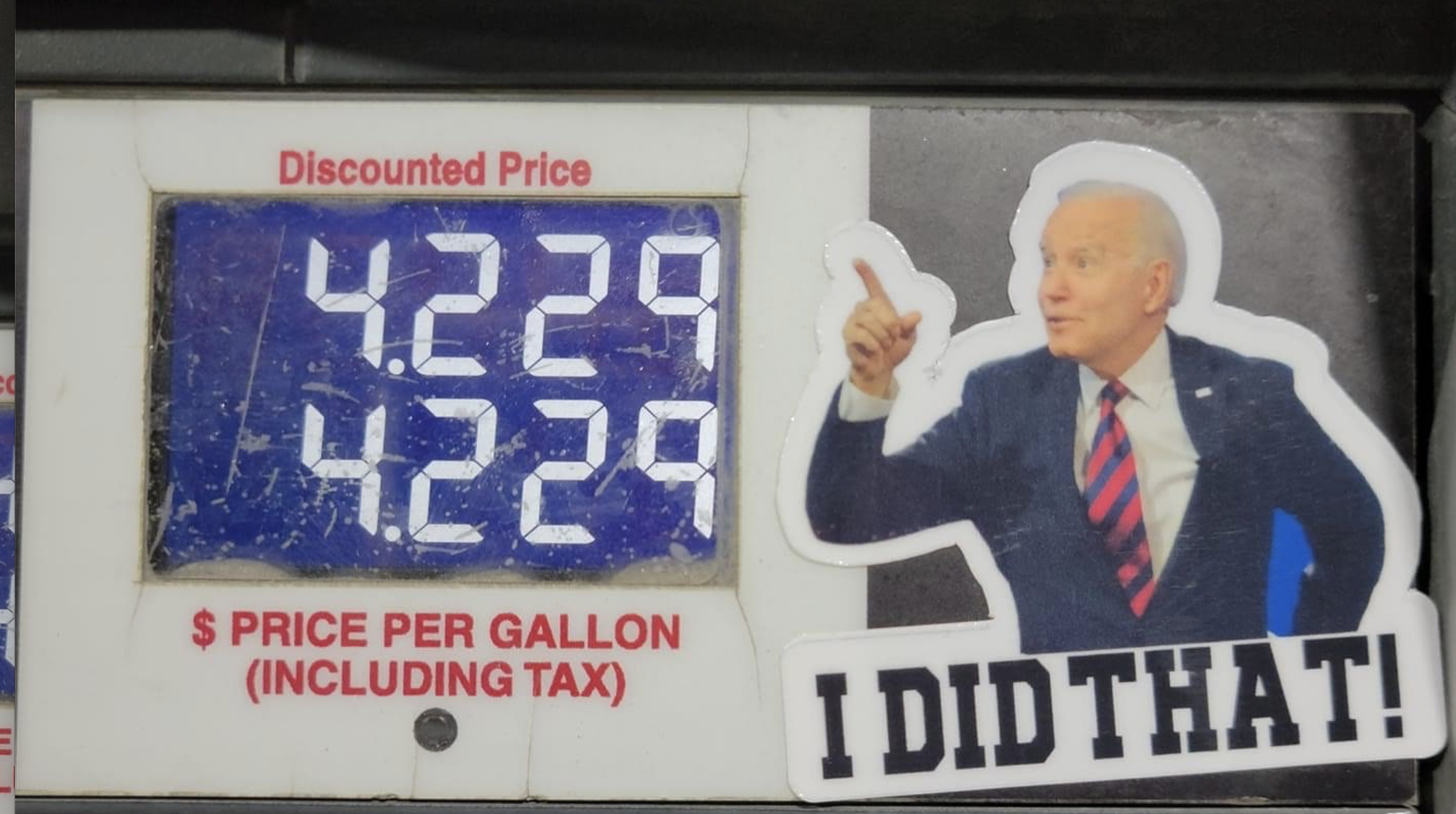
Gasoline prices play a special role in America, and this, too, is working against Biden. No other consumer product is marketed so singularly on price. Gasoline prices are in our faces and can create intense feelings.

We are following a short period of extraordinarily low prices coinciding with the collapse of demand during the early COVID shutdowns. The price rise is conspicuous and coincides with Biden's presidency. It tends to define the public mindset regarding inflation. Official explanations, longer term charts, the prices several years ago, and Fed comments are almost irrelevant. It costs me about $80 to fill up my tank yesterday--20 gallons at $4.00/gallon--and my tank wasn't even empty.  Eighty dollars is anchored in my mind as a lot of money.

Sticker added to gas pumps

I do not expect a bumper sticker to read: "Gasoline Prices are back to pre-pandemic levels!" We see and respond to what is in our faces. This, too, is a problem for Biden


All is not lost for Democrats. Trump appears to insist on staying center stage. He is a single-issue that motivates Democrats. He brings out Republican voters but he brings out a great many more Democratic and Non-Affiliated voters, too. Trump back on the ballot is a high-risk proposition for Democrats. He might win, and in that case it would validate his post-election efforts to overturn the election. But in a single-issue world, the fact of consequences to losing appears to be what motivates voters. That will be how Democrats can frame their case to the voters in 2024: Do you really want Donald Trump back in office taking revenge on the people who didn't cave into his demands to overthrow our government?