Monday, February 12, 2018

Path to Victory in the Second District

Democratic activism is pushing the party to the left.


Democratic activists represent the resurgent left.  Bernie people, and Hillary people who liked Bernie, but wanted to be practical and supported Hillary.  

Not Portland
If Trump is for it, it must be wrong.   Democratic candidates are in a straitjacket of acceptable Democratic orthodoxy.  

Maybe there is a way out of the trap.

This blog has an up close look at the campaign for Oregon's 2nd Congressional District, the bright red primarily rural and suburban part of the state that is geographically and politically part of the Mountain West.  

The incumbent Republican congressman Greg Walden repeatedly wins with 70% of the vote.  Trump, too, won big.

Yet all seven candidates for the Democratic nomination for Congress for that bright red Congressional District voice views that would be perfectly orthodox in bright blue Portland.

Is this self destructive madness?  No.  It is a response to what the candidates believe, and where the campaign energy and money is.  

Every candidate has one of these.
All seven candidates decry the influence of money in politics. They are referring to "dirty" money, i.e. PAC money from drug companies and money from the Koch Brothers, etc.  Meanwhile, they seek "clean" money, money from regular people, concerned citizens, people active enough to show up at rallies and forums and who write campaign checks--i.e. the people they are talking to.

It is clean money.  Those people don't want financial favors from government.  They want government that represents their views. That is democracy. 

But there is a grave problem.  Those people represent a point of view apparently very different from the voters who show up to vote on election day in this bright red Mountain West district.  Democratic activists are liberal, environmentalist, feminist, dovish, inclusionist, pro-immigration people.  Among this group Bill Clinton, even Barrack Obama, and certainly Chuck Schumer have been criticized or even rejected, sometimes harshly.  

So what if they were electable? They were too conservative, too accommodative of business, too cautious.  

Meanwhile, the voters voted for Trump and Walden.  There is a disconnect.

What to do? 

Three choices in strategy come to mind.

Democrats at "Our Revolution" Forum.
1.  Popularity contest.  Keep the campaign a choice among seven varieties of the same basic flavor, and hope that people like your personality and biography the best.  Raise the most money, get your name out there the best, knock on the most doors, ignore or praise your opponents and say that we all get along great. 

It is a crowded field and someone might win with some plurality of the vote.  Hope you will be the most famous or popular.  

At this moment all seven are apparently trying this approach. I suspect this is Jamie McLeod Skinner's strategy, and it is a good one. She has a niche.

It makes some sense for all the candidates.  All are appealing to niches within the same activist/donor group for campaign tools. That group of people are locked into a tight orthodoxy of acceptable thought  Anything that sounds vaguely "Trump-like" is understood to be bad.  Racist. Vulgar-By-Association. Don't rock the boat.

No one dare say anything of the kind that got the overwhelming majority of votes in the District.  

2. Try voicing some things likely to appeal to rural Mountain West voters.   Be the outsider.  There is an untapped market there.

This starts with the premise that any of the candidates want to break outside the orthodoxy of the liberal Bernie-Hillary-Portland-Berkeley-Cambridge suite of opinions.  Candidates should speak their conscience and values.  The race was a long shot on day one.  The race is personal. If the candidate is, in their heart of hearts, a Portland liberal, then be one.

But still, possibly, one of the candidates will voice something startling and non-orthodox.  That might well get them excluded from the seven person choir, but now they would have a separate niche. They would get criticized, but if they cannot handle criticism best to know now. The criticism is essential to the strategy.  Now they would attract attention, be courageous, and would have a niche. Maybe a big one.

What might be something out of the box? What is a progressive not supposed to think?

**Maybe say a border wall is something people seem to want, that borders are important, and the key is to save DACA kids and move toward a sensible comprehensive reform of immigration. The candidate need not praise the wall and could even criticize Trump for linking the issues.  I recognize that the wall is primarily a symbol for borders, not an effective barrier, but in fact a great many American like the notion of borders, the idea that America has definition and identity.  

Trump understood that desire.  Democrats seem not to understand it or want to validate it, because they associate it with Trump and xenophobia and racism.   My recommendation: accept the wall.  Say what matters to you is something else, that it makes progress on real reform.  Democrats might howl "sellout" and "compromiser", but the candidate could say as a progressive he/she cares deeply about real reform of immigration and that it is a step in a negotiation with Trump, and the candidate's eyes are on that prize. 

Crossings take place where a wall is near impossible.

**Maybe say Democrats failed to address the impediments to assimilation and the integration of immigrants into America.  Say that you love immigration, but that immigration's public support relies on smoothing cultural friction.  Advocate greater expectations on language acquisition, i.e. speak English. Democrats would howl about this being quasi racist and xenophobic, but the candidate could say that ignoring friction doesn't respect immigrants, it retards their becoming full participants in America, which is your real goal.

**Maybe say that you support wide support for higher education but that you are adamant that students pay part of the tuition.  Bernie supporters would see this as red-flag dead wrong headedness, and would howl, but the candidate could say that he or she wants student buy-in, and that free devalues it. Say you are pro-work and pro-buy-in because you value education so much.

Note that in all three cases, one does not need to be conservative or to reject progressive thought.  One defends a border wall because it would get a benefit to vulnerable DACA kids and because illegal cross border travel devalues legal immigration which you support. Argue that you are actually the friend to immigration because you are the only candidate working to create the political environment in which it is acceptable to Americans.  Same with assimilation.  Argue that you fully accept the progressive goal of inclusion and you are fighting for inclusion that works, not inclusion that retains enclaves.  You are a friend to higher education.

Mean spirited conservatives and racists have argued for a border wall, for English only, and against higher education.  A Democratic candidate risks sounding like them, which is not all bad.  Voters in the 2nd District like that kind of talk, which is why xenophobic racists and opponents of higher education say it.    A progressive Democrat need not accept that premise.  State progressives reasons for your policies.

That would distinguish the candidate as a sensible Democrat representing the sensibilities of the District, not Portland-Berkeley-Cambridge.  That is your niche.  A big one.

3. If the Democrat simply cannot bear to offend the activist consensus and be an outsider by disagreement on anything, then be noteworthy by talking about jobs, jobs, jobs.

There is room for a Democratic candidate to stop virtually all talk about the issues that Democrats fuss over, including immigration and health care.  Talk about money and jobs.  Everyone is interested in money and jobs.  Distinguish oneself by being the jobs candidate and speak of jobs in every answer.  

Dare to look silly.  Candidate Jim Crary risks it by talking repeatedly about campaign finance reform, and maybe that is a good strategy.  A different candidate could talk about job programs, repeatedly.  Endure the criticism that you are johnny-one-note.  It would help, not hurt, to be famous for bringing every answer back to jobs and money. 

**Speak for rural redevelopment.  Criticize the Bushes, Obama, and now Trump for ignoring rural America.  Complain about money for Amtrak and urban stuff and say that the cities get all the money.  You want money for roads in rural America, where they will do some good.  Say we need federal tax incentives for factories to be built in towns outside of large cities, including Portland. Nike should be building in Bend, not Beaverton.  Rural America elected Trump and we want our share of federal taxes.

**Speak for solar energy and wind farms.  Say Oregon can and should be a great energy producing state. You want money for that. Advocate for all the high skilled jobs that would create.

**Say the tax bill is bad not just because it rewards the wealthy but because it hurts jobs.  The new deficits at a time of full employment are already raising interest rates and will disadvantage employees in favor of more rewards for capital, i.e. stockholders.  Channel the views of progressives from the 1910's and speak of job killing economic concentration.  Voters are ready to think that maybe Google and Apple and Facebook are a danger, not a gift, and they have believed for decades that the drug companies and telecommunications companies are a danger. Argue that those companies and that concentration are dangerous and they are killing jobs in rural America through their monopoly power and concentration in urban hubs.

Summary:  The 2nd District is different from the rest of Oregon.  It votes for Senator Ron Wyden because he puts in the time and because he risks and endures the sharp criticism of  the Bernie-compliant activists in the party.  He is the 12th most liberal member of Congress but he simply is not good enough for a great many of them. The result is he can win elections, not just statewide but in that District.  Dare to risk their criticism.

It will be OK with Nancy Pelosi for the candidate to win without toeing a perfect progressive San Francisco compliant line.  The people you will actually disappoint will be those activists right in front of you--your friends, your pool of activist progressives in Indivisible, in Our Revolution, the Democratic Party precinct committee people.  

You won't be compliant enough to please them. It is OK.


There is a path to victory by being known for something that has appeal to the rural voters of eastern and southern Oregon, people who voted for Donald Trump by high margins.  Walden's money will tell voters the candidate is a Nancy Pelosi style liberal clone.  He won't try to run against the real you.  He will run against the caricature of you, the caricature that says you are a perfect compliant liberal. There is a lesson there.  They know a Bernie-Hillary Portland-Berkeley-Cambridge liberal would be rejected.

So don't be one. 

The Democrat needs to replace that image with something big and indelible and surprising and clearly agreement with something important to the District.  

Being criticized for disappointing liberal activists is OK.  Indeed, it is essential. Otherwise people won't believe you are sincere.  Welcome the criticism. It is the path to victory.


Sunday, February 11, 2018

"Bernie-crats" look at Democrats

"Our Revolution" Progressives hold a forum for the seven Democratic candidates to replace Greg Walden.


The questions asked if the candidates were pure and Bernie-consistent.  All the candidates were.

Photographer Allen Hallmark gets all seven candidates in one view.
An overflow crowd packed into two meeting rooms at the Jackson County Library on Saturday.  The forum lasted a full two hours.  All the Democratic candidates for Congress were there.

There are a variety of left/progressive/Democratic organizations.  The 200 year old Democratic party holds the ballot access status of a Major Party, and they held two forums two weeks ago.  This forum was organized by "Our Revolution", an independent group of progressives that is a continuation of the Bernie Sanders campaign.  The group leader referred to themselves as "Bernie-crats", not Democrats.  They oppose Trump and conservative trickle down economics, but they also condemn "neoliberalism" within the Democratic Party, i.e. an accommodation between Democrats and the corporate power.

Sign at event
There are also large, active groups that label themselves "Indivisible", which connect via Facebook and other social media to rally, march, and advocate for progressive causes and resist Donald Trump.  There is a lot of overlap of politics and membership, but the groups are separate.

The format was for a moderator to ask questions and there to be two minute responses.  Typically the candidates were asked to respond to a statement of Our Revolution position.  Hearing it, they were then asked if they agreed.  For example, we support widely expanded access to health care, do you?  Empathy and understanding of people in distress is very important, so can you tell us your experience with these people and situations?  We want to reduce the power of money in elections, so what would you proposed to do about the problem?

Over the next days this blog will give a more detailed report on each candidate, but here is an overview.  The most interesting things were what did not happen.

1.  No comparisons.  No candidate attempted to describe him or her self in comparison to the other candidates.  Not only was there absolutely no criticism of one another, there was no contrasts articulated, and indeed there was no comparisons described, indeed not even gentle, complimentary distinctions drawn. Every candidate has essentially the same political positions, and all of them are Bernie-compliant, and no one disagreed about anything.  
Sign at event

2.  No Hillary.  I never heard the word "Hillary Clinton" uttered in two hours.  There were occasional references to Bernie Sanders having succeeded with vast numbers of small dollar contributions, but no candidate addressed Bernie/Hillary disagreements and the moderator's questions never required them to do so.


3.  No foreign policy. There were no questions about foreign policy, and no comments by any of the candidates about it other than general brief statement that nuclear war should be avoided.

4.  No immigration controversy. I have been reminded that there was in fact a question asked regarding immigration, which corrects an earlier version of this post.  One candidate made a brief criticism of Chuck Schumer having sold out DACA, but there was no explanation of an alternative, nor any memorable or specific policy positions on paths to citizenship, immigration numbers, family unification, or any of the other issues that are in current controversy.

Sign at event
5.  No race, no ethnicity, no Muslim, no me-too.  One candidate made a brief mention of having a mixed race child from an earlier marriage, but aside from that there were no questions that addressed issues of diversity and identity, nor of ethnic tensions, nor police shootings, nor the revelations and response to sexual harassment.

6.  No "prosecution" of Greg Walden. There was very little direct criticism of Greg Walden, the incumbent the candidates hope to replace.  All the candidates oppose the repeal and replacement of the ACA and all the candidates criticized the tax bill as unjustly favoring the rich, but no one pointed a prosecutorial finger at Greg Walden and contrasted himself with Walden directly.  

No one said the equivalent of:  "Greg Walden was wrong to support repealing the ACA, which would throw tens of thousands of our neighbors off of a lifeline of access to healthcare. Elect me and I will do the opposite, and try to expand health care.   Greg Walden is dead wrong to support tax cuts for the wealthiest. Elect me and I will do the opposite, and support tax cuts for the struggling working and middle income people."

Greg Walden was there, as a silent watermark, but always in the background, but no one stood as a direct accuser of Walden.

7.  No justification for voters to re-think Walden.  No one offered an explanation for why people who had been voting for Greg Walden should change their minds about their votes.  There is an implied insult to people if a Democrat says that Greg Walden's tenure in office is a mistake, since, after all, they had been voting for him.  No Democrat can win without having people who had voted for Walden instead, this time, vote for the Democrat.  No candidate noted Walden's "promotion" into leadership. No one said Walden had changed.

8.  No description of Walden as archetypal swamp dweller.  No candidate looked at Walden's money raised and defined it as anything other than a huge electoral challenge.  It is a given that Walden will have much more money than the Democrat.  No one called it evidence of swamp-dwelling.  No one attempted to change the polarity of the import of Walden's money. Instead, when it was addressed, the candidates said they hoped to even the score with "hard work" or "showing up" or Bernie-style small dollar contributions.

What did happen?   Candidates continued to flesh out their unique biographies and interests.

Burnette

Eric Burnette 
He described his maritime regulatory work, and his observations of Greg Walden's un-moved truck, while observing that Democrats should have a clear message of wanting actual health care, not health care access or health care subsidies.


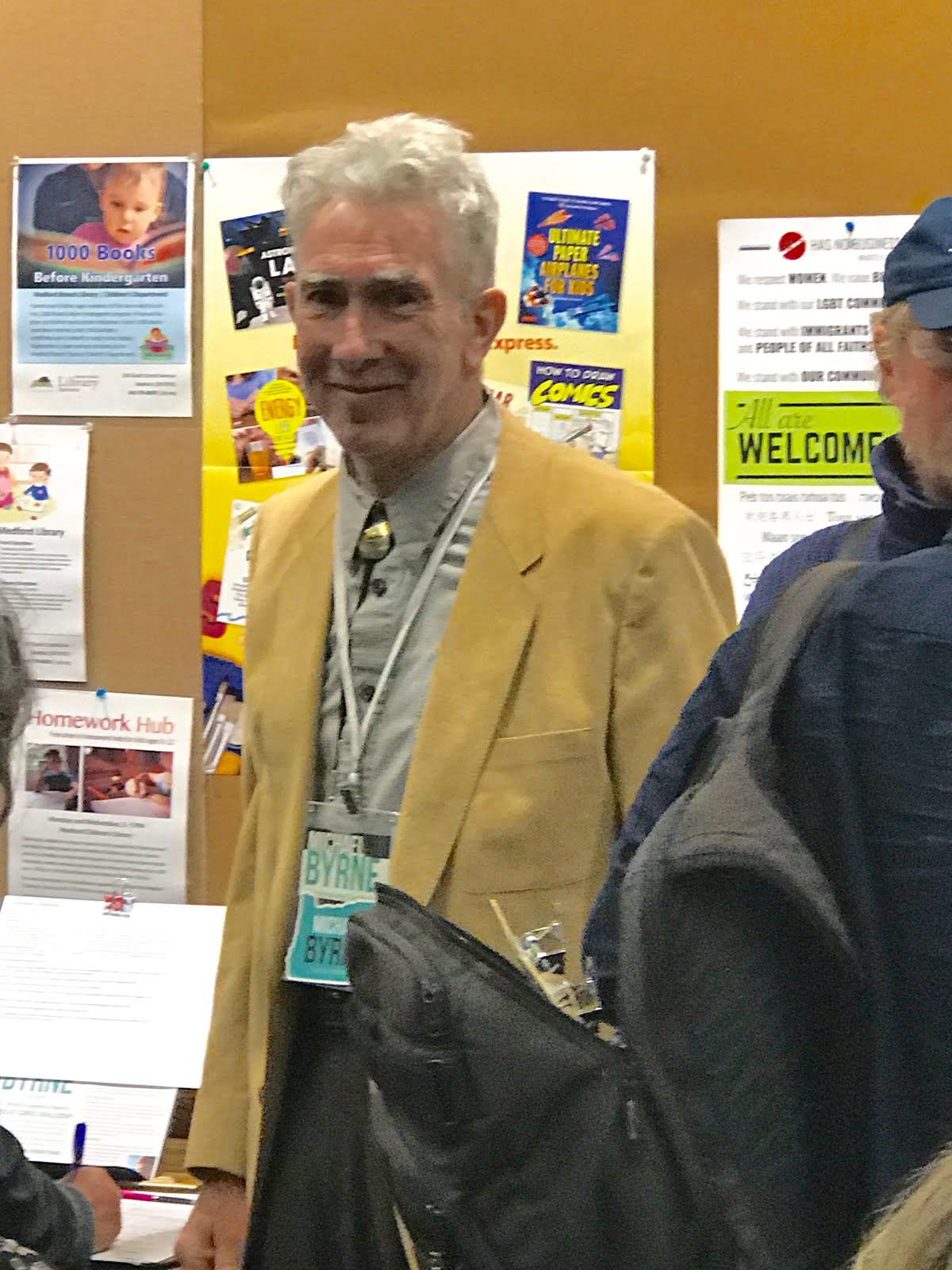
Michael Byrne 
Byrne
He remained humorous and self effacing, an active volunteer in his community, defining himself as qualified by his similarity to working class people, people he understands well by having lived among them for the simple reason that he is genuinely one of them.


Jim Crary 
 Crary
He offered his educational and career biography then brought his description of multiple problems back to the corrupting effect of campaign money on our politics, the problem that drives the unjust and foolish policy choices made in this country.


Raz Mason 
Mason
She said that good politics grew out of having a good personal mental space and urged the audience to be calm, confident, to shed our anxieties, and to feel the chair under our bottoms and the floor under our feet and know that we are grounded and therefore prepared to make positive and lasting change in America's politics.


McLeod-Skinner


Jamie McLeod-Skinner 
She spoke of her professionalism, her commitment to integrity in public service, her direct history doing good work here and abroad, and her genuine roots in the lives of the people of the District, which is why she shows up, listens, and wins votes.


Jennifer Neahring 
Neahring, from Facebook
She described her career pathway to this moment--a physician running for Congress--her love of medicine, her commitment to bringing the physician's fiduciary concern for the patient to the work of the Congress where she can deal with sophistication and confidence on health care and other issues.


Tim White 
White
He described his career in finance at Chrysler, his compassionate and respectful advocacy for labor while being a manager, his progressive politics, and his understanding of the other people in the district, rural Republicans, and how with a message of jobs and economic revitalization he can be a credible ambassador to those people in the 2nd District who currently distrust Democrats.


Saturday, February 10, 2018

Intimations of Personality. A look at Web Pages

Seven Candidates for US Congress are in Medford Today for a Joint Appearance.


They will try to impress us with their readiness to be in Congress, and distinguish themselves among the other candidates.   Let's look at their web pages.


Website: Click Here
Eric Burnette.    Burnette's web presence is bare bones.  He has the splash page shown here, with headline, photo, and tabs for "About", "Join Eric", "Events", "Contact", and "Donate."

The "about" is some 150 words of biography--California maritime academy, volunteer firefighter, helped build a children's park, likes unions and worker safety.  That is it.  The "join Eric" is a sign-up page.  The "Contact" gives a place to ask a question.

The website makes no effort to "sell" his candidacy, i.e. share his view on issues, describe the person's character or background. The "Events" tab is empty.  It is clear that the direct web page is intended simply as a pro-forma web presence plus a place to sign up or donate.  Burnette's real web presence is on his Facebook page, Eric Burnette for Congress, which is searchable within Facebook. His Facebook page is active, with updates every couple of days:   https://www.facebook.com/EricBurnnetteOR2/


Website: Click Here
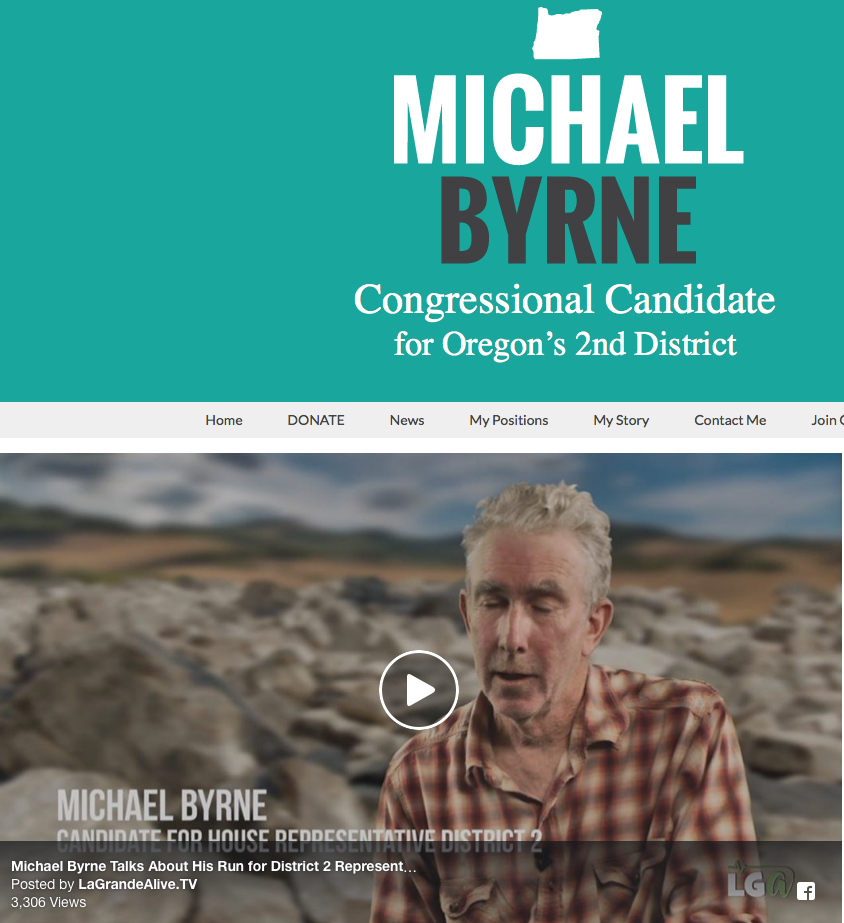
Michael Byrne.   Byrne has a professional and serviceable web presence.  It's home page has very competent navigation, with clear tabs for "My story", "Positions", a Contact Me form, and a good clear "Donate" button.

There is a good "Ask me a question" form.  There is a "News" tab, that gets updated every day or two.  There is a place to click to get onto an email list.   Administratively, the site does everything right.

It's content reflects my impressions of Michael Byrne: a likable sincere guy who has been active in direct service to his community, and oddly without pretension or airs, given that he is a candidate for congress.  He represents himself as a working man, a stone mason.  His opening introduction video is 51 minutes long, him speaking to the camera, which is a lot to ask of a curious voter.   His explanation of his views is clear and not surprising.  He is a liberal progressive.  Medicare for all.  No more war.  

He is very general about federal lands, saying in his entirety:  "Wise Use of Federal Lands.  We are blessed with incredible natural resources and they belong to all of us."  "Wise Use" is code for use rather than leave-untouched; belong to "all of us" implies federal control.  What he doesn't say is more important than what he says.  He does not say "these lands are pristine examples of unique legacies. . . ." or otherwise imply that the lands controlled by the Forest Service and BLM are to be highly protected from human use.

Byrne's campaign has an active Facebook presence, with timely comments on current events, firm expressions of opinions ("No tax cuts for the rich.  No rush to war.  No desecration of the environment", comments on student debt, denunciations of Mick Mulveney as head of the CFPB, etc.     https://www.facebook.com/congressmanbyrne/


Website: Click Here
Jim Crary.  Jim Crary has been doing this a long time and is fully up and running with both an active website and active Facebook presence.

Crary has positions listed on some twenty items, including Campaign Finance, Guns, Women's reproduction, Net Neutrality, Environment, etc.  Crary has thought this campaign through.  He communicates it in his public presence and it shows in his web presence.  His preparation and sure-footedness with the issues is part of his appeal.  He does not surprise in the positions he takes.  He is a progressive, environmentalist, with a multi-part program to deal with immigration ("For the record I am adamantly opposed to the wall.")


Activities every day
He has all the right tabs: Contact, Donate, Volunteer, and also includes a Calendar that is updated in detail. 

He links to his Facebook page, which is active and current, including comments on national events which clarify Crary's political views.   There appears to be something added every day.  He shows over 2000 likes.
https://www.facebook.com/crary4congress


Raz Mason is a new candidate to the race. Her website was up and running quickly and it has all the essential elements of a legitimate campaign website: tabs for "Meet Raz", "Vision", "Values", "Contact", and "Donate."  The website has ample photos and videos; it is also very general in text descriptions of her political positions.  She has headlines like "Moral Courage, Rural Dignity."  


Website: Click Here
She describes her values:
"Calmness is Courageous."
"Everything is Connected."
"Service above Self."
"Idealism + Realism."
"Always be Learning."

She observes in text and in a video that "If we start with anxiety and division, that's what we will get more of."

She suggests, "Let's work on calmness and courage.  We will always face challenges, some of them major.  Our strength of character, built over time, is our greatest form of security."

In late January she saw an email by Greg Walden that attempted to raise money by criticizing Democrats for "playing politics with children's health."  She responded:   "This is a divisive email.  Each communication that builds enmity, rather than mutual understanding and shared positive endeavor, weaken the foundations of our democracy.  We can disagree.  The honorable way is to do so agreeably."

The content of her website suggests a very different campaign focus than any of the other candidates, one on the fundamental psychology of humans and governance.  Good governance comes from good internal values, free of self destructive impulses.  

She has an active twitter feed with some 2100 tweets and 477 followers, and a somewhat less active Facebook site that has occasional updates on mindfulness, disrupted learning, trauma-informed practices by police.  https://www.facebook.com/razfororegon/


Jamie McLeod-Skinner  McLeod-Skinner has an active web presence, slightly different in design than Crary's, fewer photographs, less text, a less extensive calendar.  I describe it in comparison with Crary not because it is worse or less effective, because it may not be.  It is smaller.  McLeod-Skinner has about 1,000 words on her policy goals.  McLeod-Skinner has two sentences on campaign finance reform (stop foreign influence, overturn Citizens United) while Crary has multiple paragraphs.  What McLeod-Skinner says in a sentence of goal and sentiment, Crary explained in policy detail.  Her comments may well be enough for most voters.  Both McLeod-Skinner and Crary express essentially the same world view.  I do not discern clear policy difference between those two candidates, or for that matter, any of them.

Her website has relatively few photos,
Website: Click Here
which could be added easily.  

The website may be exactly long enough, but it is a different way to talk policy and issues than does Crary or Tim White.


Candidate Facebook update.  Support solar.
Her Facebook page is easily found within Facebook search.  The page has about 1,500 likes and followers and it is updated daily, with comments on current issues.  Her Facebook page--like that of every other candidate--shows evidence of ongoing candidate and staff involvement.  Facebook--not her webpage--is her primary vehicle for voter outreach, an inference I make because of how much more current is her Facebook page.  https://mcleodskinner4or.org   


Jennifer Neahring.   Dr. Jennifer Neahring has by far the least web presence of the various candidates.   

After a diligent search using search tools I concluded that either she does not have a campaign website, or that it is unsearchable, which means the same thing. She does have a Facebook presence.  One needs to search for "Dr. Jenni Neahring for Congress" to find it.   A search for "Jennifer Neahring for Congress" brings you to a page with comments and photos by friends, but no introduction by her.  She can probably fix that.

She is now beginning to bea very active poster on Facebook, with photos of her various campaign activities. Jenni in Pendleton.  Jenni in The Dalles.  Jenni at a bookstore.  

The site has only a tiny bit of access to her biography and point of view.  Navigating to the right side one can find a long paragraph on her thoughts on "Working for a Healthy Oregon" with comments on the Affordable Care Act.  But that is it.

I found no pages whatsoever that described her positions on issues, points of view regarding Walden, taxes, immigration, campaign finance, BLM land practices, or anything else.  Back in time into the Facebook posts I found a link to a campaign website, one that didn't appear in search engines. 
https://www.drjennineahringforcongress.com

Warning when I clicked on the link.
I clicked on it and got a warning that the site was unsafe.

Summary:   Dr. Neahring has not yet worked out the bugs on the internet portion of her campaign.  There is time to fix this, but she starts way, way back of some of her opponents.  She brings strong skills to this campaign, but does not yet have the campaign itself up and running.


Tim White 
Website: Click Here
Tim What has an active web presence.  It is fully functional, with tabs for volunteering, contributing, signing up for emails, and for learning more.  Clicking on "Learn More" brings you to issues.  They have 100 word summaries and then a "read more" option that brings readers to a full description of his point of view.  It is very similar to Jim Crary's in its thoroughness and far, far greater than the other candidates.   This White has thought about the issues.  His orientation is progressive environmental.  He differs from his Democratic opponents in  one way that I see from reading his website.  His tone is different from the other candidates.  He is a bit more direct.  No pussyfooting.  Greg Walden is wrong.

Compared to the other candidates, his website is oddly text-rich and photo poor.  He could easily have illustrated his long position papers with photos, but did not.

The emphasis of the website is on White's positions on issues, not his engagement with the people of the district.   That, too, could be changed easily if he chooses, but the website may well be a window into White's orientation, as if to say we are electing a political fighter, not a community schmooze.  What is important is what he believes and how he says it, not whether he is meeting a store clerk in LaGrand or standing in a bookstore in Ashland.

He has an "Events Calendar" which has a few events listed, including the one this afternoon in Medford, but February has a total of eight meetings listed.  Either it is not up to date or his schedule is very relaxed.

One item in this website is unique among the candidates, a tab for "Blog".  These blog posts include approximately weekly comments on items that capture his interest.  The blogs have a different, more combative tone than does his website or the public speeches he made in the Rogue Valley two weeks ago.

He has a link to his Facebook page, which does have photos, although relatively few compared with the other candidates. https://www.facebook.com/TimWhiteforOregonCD2/


Friday, February 9, 2018

Russian Footprints on this Blog

The Russians read this blog.


 Yesterday there were an extra 200 Russian readers.  I wrote about GOP disfunction.


A lot of Russian readers yesterday.
There are about 120 daily subscribers and about 300 to 500 additional page views per day. About 500 Americans read this blog every day.


Subscribers. There are also some 1,200 additional daily subscribers, but a close look at the email addresses suggest that they were automatic robots who signed up. Those emails may then forward to real people, but I don't count them.  I only count as "real" subscribers email addresses that I recognize, i.e. an email address that includes the name of a person I know.

Direct readers. There is a big daily swing in the number of people who go directly to the blog website, from 250 to 1000 people a day, sometimes on their own, sometimes referred from Facebook.  A post on familiar personalities (Alan DeBoer or Kate Brown) get more readers.  A post describing a Greg Walden weakness gets more readers.  Posts on marijuana get reposted and circulated.

A big source of readership fluctuation is Russians readers.  For some reason Russians look at this blog.

How do I know?  Well, I don't know anything, but I see evidence.  Readers are tracked by country. Normally 98% of my readers are from the USA.  From time to time Russia shows up, with maps and specific numbers. 
   
Yesterday's post was on the disfunction of our Congress and the picture it gives the world of democratic governmental systems. The Russians and Chinese consider their authoritarian systems to be superior.  I cited the wasteful irrationality of a GOP controlled Congress refusing to pay for infrastructure improvements back when Obama was president and America was in recession with idle construction capacity, but passing it now, with full employment and contractors working overtime, to please a president of their own party.  This blog wrote that the world noticed American political hypocrisy and disfunction.  Apparently--possibly--Russians noticed too.

Normally about 85% of America readers look at this blog on a mobile device, either a smart phone or tablet.  Americans have moved from their desktops.

Two things were different yesterday. 

A big spike in Russians, and an unusually high number of people read it on a desktop yesterday.  The proportion using a Mack was lower than usual.  The new readers were all using Windows on a desktop.

This strongly implies workers, not people sitting at home drinking coffee in a living room.

I am guessing Russians employees noticed the blog and circulated it, for whatever purpose they found useful.  Were they government employees or contractors?   I don't know for sure, but that is the evidence.

Conclusion.  Trump is an experiment.   Chinese leaders speak endlessly of harmony and prosperity as their chief policy goals.  Putin squelches religious, gender, and political dissent, and defends cultural conformity. Their countries have unified government with strong political control of the media. Leaders there are in control.

In America, the politics succeeds by division, scapegoating, and siloing ones base. Blocking Obama's jobs bill and supporting Trump's makes no sense as economic or public policy.  It makes total sense as a tactic in political warfare and sabotage.  It worked politically.

There is a global credibility crisis in the forms of government.  People worldwide are questioning whether American self government actually can deal wisely with the issues that face any government.  They are watching us.  

We do not need Russian trolls to invent stories of American disfunction.  We do it to ourselves. 

Thursday, February 8, 2018

Infrastructure Spending and Democratic Credibility

The theory is that Governments are supposed to borrow and spend during times of recession and excess capacity.  


Then, during economic booms, to pay down the debts, restore future borrowing capacity, and reduce inflationary pressure.  


Maybe democracy does not work anymore.

Except we are in a boom, not a depression.
Take a moment to recall the world of 2007-2010.  In 2007 the banks were announcing huge earnings. Home prices were high. The stock market was at a record high.  TV ads for banks and mortgage companies urged people to borrow 110% of the value of their homes.  Citigroup's president said that things might crash and burn but not yet, and while the music played you had better be dancing.

Then in 2008 it all fell apart.

People realized loans that were the assets of banks were not worth their face value.  Why?  Because--surprise!--the mortgages were not collateralized by the underlying value of the homes.  As homeowners in distress rushed to sell their homes, prices fell further.  

Banks were insolvent.  This meant insurance company AIG which guaranteed bank loans was insolvent.   

I was there, up close, a financial advisor at one of the failing banks.  I helped clients withdraw their money from banks and money market funds while they still could.  

That was then, in a recession.
Obama was elected in the midst of this crisis.  He seemed calm and confident and he wasn't in the party in power.  

There was in a panic and recession.  Unemployment skyrocketed.  People wanted cash, not long term assets.  A business that wanted a new building could buy one cheaply from someone in distress, so of course building stopped.

There was huge excess capacity in the construction industry.  

Obama attempted an infrastructure bill and was blocked.  Bids for infrastructure would be rock bottom.  Republicans blocked an infrastructure bill.   Roads and bridges didn't get built.  Contractors and workers stayed home and drew unemployment.  Newt Gingrich called Obama the "food stamp president." 


Obama
The GOP Congress did not say they were intentionally sabotaging the recovery to hurt Obama.  They said they were protecting us from deficits.  It wasn't cynicism and politics.  It was principle.

Things slowly got better: 2010 to the present.  We recovered. Unemployment fell from 10% to 4.5%.  Home prices recovered. Stock prices recovered. Contractors are busy.  People who want projects done are put on waiting lists.

Meanwhile, the infrastructure got ten years older and ten years worse.

Trump was elected. There is a Republican House and Senate.  Now, with full employment and at full capacity, with inflation starting to rise, but with Republicans controlling the House and Senate, now there is political capacity to do what was sorely needed back in 2009 and 2010.  Repair infrastructure.  

They stood and applauded Trump.

State of the Union
The GOP deficit hawks are still complaining, but they aren't digging in.  They will pass the bills they should have passed eight years ago. Between tax cuts and  an infrastructure bill, America will create a pleasant sugar-high of prosperity and inflation. 

The GOP has a president of its own party. It is good politics.  It can lead to another crash and burn, but that is later probably, after the midterm election.  Dance when the music plays.

Russia and China and the Middle East Monarchies watch America and the democratic system.  Out of the rubble following World War Two there had been a bipartisan consensus in America that democratic government had "won".  Free elections, political freedom, economic freedom, capitalism: they were proven the effective way to create happy, prosperous people and sound government. There was talk of the "end of history", because the question of whether capitalism and political freedom and democracy was best was answered definitively.  Yes.

China expressed a different vision: a Chinese benevolent dictatorship led by a party of the people, one that could plan and operate for the long term good, making sensible economic decisions, free of the manic excesses of boom and bust capitalism and free of the short sighted political selfishness of electoral politics.  It sought harmony and thrived under it, in contrast to democratic elections where politicians thrived by creating division and enemies.  There was state TV--China's version of Fox--telling people that the leaders were wise and reasonable.  

Trump represented a challenge to a bipartisan, free trade, pro-immigration DC consensus, pro-diversity consensus.  Clinton, both Bushes, and Obama were more alike than different.  

Trump, though, is different. Trump is testing whether democratic norms still work and whether the pushes and pulls of checks and balances still serve to block  excessive power in any one person or institution.  Nixon and Clinton bowed to prosecutors and the judiciary.  Trump has discredited the prosecutors and judiciary and may well spurn Mueller, and if he does he will get away with it. He prepared the groundwork and the GOP will have his back. We are testing checks and balances.

We are also testing sound policy, and whether a democratic system can work to smooth an economy or to damage it.  An infrastructure program that was impossible in 2009 may well get done in 2018. The world is watching.