Thursday, November 22, 2018

Be Grateful

https://m.youtube.com/watch?v=dqrDWSlkOIU#fauxfullscreen

Count your blessings.  Worst forklift accident ever

Big Error by Chief Justice Roberts

"We do not have Obama judges or Trump judges, Bush judges or Clinton judges."

                                      Chief Justice John Roberts

Attorney Thad Guyer:  "Ludicrous."


On this day of Thanksgiving the pundit world and mainstream media are giving thanks to Chief Justice Roberts. It is something nice to talk about over dinner.


He stood up to Trump! He reminded Trump that the Judiciary is an independent third branch, with its very own Article Three! Democratic institutions are safe!

Maybe not.

Guest post writer Thad Guyer has a different take. He says Roberts got seduced into engaging with Trump and has therefore been diminished by him. The way you be an independent branch is to be independent, and that requires ignoring Trump, not disagreeing with him.

Thad Guyer starts with a premise that of course the federal courts are political. Trump knows it and John Roberts knows it. The issue here is what to say about it. 

Thad Guyer is an attorney practicing primarily in the federal courts, specializing in representing whistleblowing employees. Some of his cases have significant political consequences for shaping case law.

Guest Post: Thad Guyer 

“Chief Justice Roberts Further Degrades the Judiciary by Answering to Trump-- Like Everyone Else”


Thad Guyer
Trump wants government rearranged.  First he summoned Paul Ryan and Mitch McConnell, and they came.  Now he’s summoned Chief Justice John Roberts and he too came.  The worst part is not that Roberts asserted a ludicrous defense that the courts are not political.  The worst is he answered Trump’s call directly, i.e., Trump trashed political “Obama judges”, then the Chief Justice answered that judges—no matter who appointed them— don't rule based on politics, to which Trump then replied that civil rights lawyers routinely forum shop by filing their cases in California whenever possible.  That’s the institutionally harmful part— that John Roberts politically engaged one-on-one with Trump knowing full well that Trump’s immigration case would in short order be before his court.  That is, Roberts and Trump are already adjudicating a profoundly important case in the media rather than in the courtroom.  

It’s one thing for justice “the notorious RBG” to trash Trump, after all, she’s a media star.  Forced by backlash to apologize, she effectively answered to Trump after he hit back on her “very dumb political statements”, noting “her mind is shot - resign!” See, “The Notorious RBG apologizes for interview comments (again)”, Washington Post, Oct 16, 2016 (https://goo.gl/V8dT86).  So why not break tradition, retired justice John Paul Stevens must have thought, when he publicly attacked Trump in a media interview. See, “Retired Supreme Court Justice Criticizes President Trump's Response to Travel Ban Cases”, Time, Jul 5, 2017 (https://goo.gl/NBYpF6).  He got the media bug, too.

And now, without the effective quarantine provided by the court’s ‘no political comment’ tradition, the Chief Justice himself has become infected. Roberts, being unable to learn from RBG’s apologies and the hyper-political fiasco of the Kavanaugh hearings , jumped onto the political stage with a patently farcical defense against Trump:  “We do not have Obama judges or Trump judges, *** we have an extraordinary group of dedicated judges doing their level best to *** [maintain] an independent judiciary *** we should all be thankful for.”  See, “Chief Justice Defends Judicial Independence After Trump Attacks ‘Obama Judge’”, NY Times, Nov 21, 2018 (https://goo.gl/AHdRSs).  To any civil rights lawyer like me practicing in the federal courts, Trump stated the plain reality that if you want partisan Republican judges, you file in Dallas.  But if its partisan Democrat judges your need, then file in San Francisco.  Texas courts struck down Obama’s executive orders, and San Francisco courts are doing the same to Trump.  Control of the Supreme Court and the Kavanaugh civil war energized the bases in both parties explicitly because everyone knows the judiciary is now overtly political.  

Other justices on the court are undoubtedly irritated with Robert’s political foray using the court’s public relations department.  Legal scholars are disappointed.  This means that when Trump’s immigration asylum case lands on his desk, all cameras will be on a rebuked and regretful Chief Justice.  That’s a big tipping of the scales Trump’s way before the first legal brief is even submitted.  To have the Chief Justice dialoging with Trump outside the courtroom on a pending case is, ironically, a major degrading of judicial impartiality and independence.  Everyone, it turns out, answers to Trump.

Wednesday, November 21, 2018

In praise of long campaigns

Author. Celebrity.

Americans want to see celebrities. Fame is power.


Long campaigns give people who aren't famous a chance to get traction and become famous.

Tom Hanks, movie star and short story author, drew a capacity crowd at the Portland Book Fair last week.

His book has been out since October of 2017. It ranks about 54,000th in sales. Getting in to see him was tied to buying the book. His event sold out early. He isn't running for president but he was hoping to be taken seriously as an author. And he is famous. He is Tom Hanks!

He drew a big crowd. 

There is a lesson here. It is obvious but needs to be noticed. Celebrity matters.

The very first event Donald Trump held in New Hampshire was in September 2015. He had  begun communicating details in his campaign message after the world watched him come down the escalator and announce that Mexican immigrants were mostly criminals, drug dealers and rapists. Three thousand people entered a hot gymnasium in Rochester, New Hampshire to see him. 

He came to New Hampshire a famous man, and how he handled a question about Muslims that evening made him more famous. He went low. He didn't correct a question that came with the premise that Obama was a Muslim. The media talked about it for weeks, but they missed the big story, which was that the audience was OK with what Trump did. Call Obama a Muslim? No problem.

Meanwhile, Trump got more famous. Celebrity begat celebrity.

Tom Steyer is doing what people do to run for president. He had established a national brand by spending $40 million dollars on ads calling for Trump's impeachment, plus another $15 million in ads relating to the mid-terms. Viewers can look into his blue eyes and think they are taking the measure of him, the soft spoken ultra-sincere man saying that Donald Trump had offended American values. People who watch any cable news know his face and voice and manner. Earnest. Not overtly a self-promoter. He presents as a billionaire do-gooder. Maybe that is what America wants.

Now he is onto the next step, expanding his message to a bigger analysis of what is wrong with America: "A hostile takeover of our democracy by large corporations and their enablers in politics has eroded that promise, and we must act to reclaim that power and put it back in the hands of the American people."

Steyer sounds like Bernie, but without Bernie's history. He is California rather than Brooklyn. Clean cut rather than ragged. Soft spoken rather than angry. Like Bernie, he says corporations have screwed the little guy. Like Bernie, he doesn't want corporate money in politics. He is famous enough to be an alternative. He will draw a crowd. He has been on TV.

Getting noticed
Senators and Members of Congress have a platform to gain fame. They hold office and are therefore are legitimate news maker. Sherrod Brown is the subject of the current buzz. People are saying he can communicate blue collar credibility and Upper Midwest appeal. He isn't handsome, but he is scrappy. He is being re-positioned right now by the punditry, from Senate nobody to maybe the guy!

Now maybe he will draw a crowd.

Democrats have figured out the policy sweet spot: universal health care, tax the rich, condemn racism but don't accuse Trump supporters of being deplorable--except ones that really blow it, like Hyde-Smith in Mississippi. Support women and reproductive rights. Say we need comprehensive immigration reform.

It is possible that policy nuance will differentiate the candidates within the Democratic scrum but I think it unlikely. It will be personality driven. Biography driven. Who will Democrats trust and like? 

At this moment Bernie, Warren, and O'Rourke can draw a crowd and raise money from the internet. They have a big installed base of supporters. 

The other way is to have money. "I'm too rich to need to be beholden to the swamp" is an idea that is generally acceptable to Democrats. That may work for Steyer, Delaney, and Bloomberg.  Currently there are some 2,200 billionaires in America.

There is one other path to celebrity:  Sweat equity. Showing up in Iowa and New Hampshire in living rooms and meeting halls and having people decide they like you and your message.

Tuesday, November 20, 2018

"By continuing to emphasize race in the public forum, liberals deepen our national divisions and thus play into the hands of the monied class."

                                           Herbert Rothschild, Oregon Peace Activist

Herb Rothschild

Today a guest post by Herb Rothschild.


Steve Bannon, a political strategist to Donald Trump, famously said "The Democrats, the longer they talk about identity politics, I got 'em. I want them to talk about racism every day. If the left is focused on race and identity, and we go with economic nationalism, we can crush the Democrats."

Democrats have been reluctant to take that advice from the Rothschild quote above and to avoid the bait that Trump puts out. Trump trolls on race and gender and Democrats respond because they feel they must. Democratic messages focused on identity, not economics. Democrats following the Third Way path of the Democratic Leadership Council and Bill Clinton made peace with corporate America. It seemed to work for them. They stopped being badly outspent on television ads. They began winning national elections. It was socially liberal and inclusive; it was economically centrist. There was visible prosperity, especially for people who embraced education and who moved to increasingly prosperous cities.

Plus they got votes and the polls looked great. All good, supposedly.

The places where they weren't popular had names like "rustbelt" and "flyover" and "Appalachia." Things weren't working well for those people but liberals who were doing fine could conclude it was substantially their fault. They had poor lifestyles. They didn't move to where the jobs were. They dropped out of school. They worked in dying industries. They used meth and opioids. The states sorted themselves out. In West Virginia 28% of women smoked during pregnancy compared to 5% in California. West Virginia had coal; California had Silicon Valley. 

Democrats made what they thought was the politically sound and moral choice, to embrace the future, embrace education, embrace diversity, embrace globalism. Everyone can be prosperous. Everyone can be a coastal success story.

There was a deep flaw in Democratic thinking: there are a great many "West Virginia" people hiding out within all parts of America. Some of it was visible on the political map, with prosperous people living in coastal cities. The Third Way worked for college graduates, but not for a vast swath of Americans. On election night of 2016 Americans saw those forgotten Americans were there all along, feeling neglected by Democrats.

Herb Rothschild grew up in deepest part of the old South which practiced both legal and day to day practical racial segregation. His perspective is that Democrats can re-establish sound policy and political success by refocusing their attention back on economic opportunity, and he writes openly about that idea which makes Americans uncomfortable: class. 

Working people--white and black, male and female--have a common interest. This Guest Post contains excerpts from an article he wrote in the Ashland Daily Tidings in March, 2018.


Guest Comment by Herb Rothschild.


A Class Act

Cornel West often says that, in the U.S., we look at class through the lens of race. Despite assertions I’ve heard here, it’s perfectly acceptable to talk about race as long as we don’t sound racist. What’s not acceptable is to talk about class. In many situations you won’t object if I tell you I’m white, but I can’t imagine a situation in which you wouldn’t be offended if I claimed to be upper class. Not so upper class or lower class. In the U.S. we can’t identify ourselves as the former because by mutual consent it doesn’t exist.
One rubric under which we now talk about race in places like Ashland is White Privilege. I doubt that such discussions are occurring in Youngstown, Ohio or Huntington, West Virginia. Not many white people in the Rust Belt or Appalachia feel privileged.  Nor would it cheer them up to be told that the average African American is struggling more than they are struggling. Would we want it to?
A poll released last October by the Robert Wood Johnson Foundation, NPR and Harvard reported that 55% of U.S. whites feel discriminated against by race. 
Even though they are mistaken, it’s worse than useless to try to convince them otherwise. By continuing to emphasize race in the public forum, liberals deepen our national divisions and thus play into the hands of the monied class. 
Only by emphasizing economic inequality can progressives redirect to its proper cause the sense of victimization that now cuts across race and ethnicity, and forge the solidarity that can change U.S. politics. That was the vision of Jesse Jackson’s Rainbow Coalition, but not the Democratic Party of the last 50 years.

Beyond political practicality, realizing the role of class would amend our analysis of the role of race, because the two are interrelated in complex ways. For example, Ashland is overwhelmingly white not because it has remnants of its racist past (though it helps to take cognizance of those), but because lower income folks simply cannot afford to live here. If we want to promote racial and ethnic diversity, we must promote class diversity, which means building affordable housing. 

Monday, November 19, 2018

2020 Contenders raise their profile

The 2020 primary is happening now. Right now.

2015: Big Campaign up and Running

The invisible primary.


This isn't "starting early." To be where the candidate wants to be this summer the candidate needs to be doing things right now. 

Getting famous. Getting money. Staffing up.

By August 2015 Hillary Clinton had a big campaign up and running. She had a staff. She had a jet. She needed one because the event I attended in Portland was preceded by one in Salt Lake City that morning and was to be followed by one in Atherton that afternoon. 

In New Hampshire in September of 2015 every candidate had a staff gathering contact information and handling scheduling and communication  plus a big travel vehicles to get them all around.  

Three takeaways from observing 2015: 

1. A presidential candidate either has to have money or be able to raise it in vast quantities because a real campaign is expensive. 

2. Fame matters. People show up to see people they have heard of and are excited about. Trump, Bernie, and Hillary drew crowds. 

3. Being on the Sunday shows didn't help. Lindsey Graham was on Meet the Press every other week for years and he could not fill a conference room.

Here is an update on what candidates are doing to get visibility. One thing is write books, then promote them on TV

Kamala Harris and Cory Booker were front and center during the Kavanaugh hearings. Harris' new book is The Truths we Hold.  Booker's book is United. Thoughts on Finding Common Ground and Advancing the Common Good.

Mitch Landrieu will be one of the speaker/instructors at the Harvard Institute of Politics 3-day program for newly elected Congressmen on December 3-5. This won't make him famous but it will buff up his resume. His book is about racial reconciliation: In the Shadow of Statues.

Martin O'Malley is also at Harvard Ash Center, serving as a Senior Visiting Fellow speaking next week on "Assessing the Results of the Governors Races." Many events of this kind require tickets, but this one does not. Plus Harvard will serve pizza. He does not yet draw a crowd.

Eric Swalwell was on Bill Maher this Friday. He is talking with his family. He is a frequent guest on cable news. No book yet.

John Delaney keeps traveling to Iowa and New Hampshire. He just hired a Communications Director, someone fresh off the Andrew Gillum campaign, and he told Politico he plans to have 30 full time staffers in Iowa and eight offices, all by January of this year. Who is John Delaney He was the 3rd richest guy in Congress, a self made entrepreneur with a net worth of $240 million according to Open Secrets, so he can afford to self-finance for now. Gary Wills just wrote about him--the first national recognition I have seen but he has already been to all 99 counties of Iowa. His book: The Right Answer. How We Can Unify our Divided Nation.

Michael Bloomberg just made news for making Johns Hopkins essentially tuition free thanks to a big contribution, and he is busy talking with party leaders about his own run for president. He told a Mississippi Democratic financial bundler he thinks the biggest problem isn't his wealth or his age. Voters show they like rich New Yorkers who can self-finance, he said; he thinks his problem is that he is Jewish. His book: Climate of Hope. How Cities, Businesses, and Citizens can Save the Planet.

Elizabeth Warren writes and promotes books and sounds decisive and fiery. She attempted a counterpunch on the Pocahontas taunt. Her books: In 2014, A Fighting Chance.  In 2017, This Fight is our Fight. Warren is a woman, slender and small of stature. She knows she needs to project strength. Fighter.

Bernie Sanders was on Al Sharpton's show yesterday. He's "looking at it," he said, and says he only wants to run if he is really certain he is the strongest candidate to replace Trump. He has a huge base of former volunteers ready to go and unwilling to accept any substitutes.
Beto O'Rourke proved he can excite people and raise money via the internet. 

Kirsten Gillibrand was on Steven Colbert, talking about 2020. Her new book is: Bold and Brave, Ten Women who Won Women the Right to Vote. It is a children's book, short and non-controversial. 

Sherrod Brown won an election in Ohio and he talks about working people, not identity. Democrats are turning their attention to him. He has not written a campaign promotion book, but does have two policy books out. Congress from the Inside and Myths of Free Trade; Why American Trade Policy has Failed. His position on trade, dating from 2004, gives him credibility as a free trade critic.

There are other Democrats--and of course John Kasich a Republican, and Ben Sasse, the GOP Nebraska Senator who will be on Colbert next week. Most of the activity is on the Democratic side, but Republicans are wondering if Trump will falter, at which point it will be a free for all on their side, too.


Sunday, November 18, 2018

Raking leaves

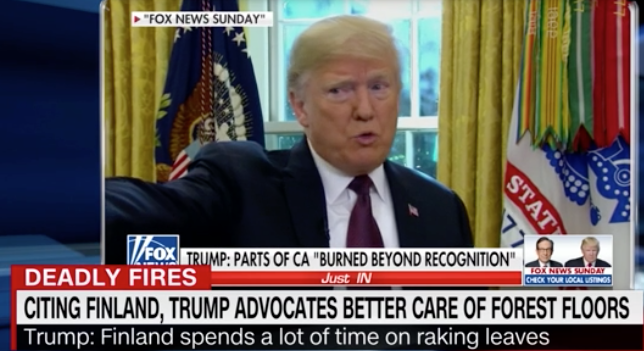
    “I was watching the firemen the other day and they were raking areas, they were raking areas where the fire was right over there."

                                       Donald Trump, on the California fires

Don't laugh.  

Sure, he's an ignorant know-it-all, but instead of scoffing, let's use this to deal with a real problem.

Donald Trump is getting mocked for this comment, said first on Fox News to Chris Wallace and then repeated in California when he commented that they don't have a big forest fire problems in Finland. 

"He thinks this is Central Park," one commenter said. 

"He thinks California is Finland. Duh!," another one said. 

People eager to mock Trump have their opportunity. His comments do imply a fundamental misunderstanding of the realities of managing federal forests versus suburban back yards. And, to state the obvious, Finland is cooler and wetter then California.

But the better path is to take Trump seriously and encourage him to keep doubling down. Thank you, Mr. Trump, you are a genius. You are exactly right. 

Many Americans are so accustomed to thinking that whatever Trump says must be wrong that they are blinded to this opportunity. Trump just said--admitted--that our federal forests are under-managed and that we should do something about it. Good. Let's appropriate some money and hire some maintenance crews now. Let's go to work.

In fact there are two related problems. 

The first is the now-well-known "forest urban interface." California and southern Oregon are in the Mediterranean Climate Zone, producing dense scrub oak and brush, underlaid with grass. The vegetation is very flammable in the dry summers and early falls. Many landowners like it untended, which is easiest, free, and saves water. There is the moral value that it preserves wildlife, and the aesthetic sensibility that it is natural and therefore good and beautiful as it is. The idea is to avoid moving to an area and then trying to change the landscape into some lush green Martha Stewart Connecticut. 

Natural is a fire hazard, when there are people around to start fires, and when wooden homes and cars with gas tanks and propane barbecue tanks are next to other homes. Homeowners are advised to create a "defensible space." Many do not. 


Under the scrub oak and brush
Trump is actually correct. Suburban landowners can and should reduce fire hazards by cutting grass, raking up dry material, thinning brush, and creating fire breaks. Fire marshals and local governments have a role here with ordinances to reduce hazards.

Forest management.  This is where Trump is most easily mocked. The notion of raking leaves out of the millions of acres of timbered forest lands is laughable, but the concept of managing significant areas of our forests to reduce forest fires is good public policy. Currently the federal forests have areas that would immediately benefit from thinning, and Trump is the executive in charge of those forests. Of course, we aren't going to hire crews to rake out all the forests and turn them into Central Park. Federal forest lands have multiple overlapping and conflicting goals, but one of those goals is public safety and reducing fire hazards, and we have Trump on record saying that under-management of forests is a problem. 

He is right, they are under-managed. They have been starved for resources to do that work. Let's hold him to doing something about it. If appropriating money and signing legislation to reduce excessive fuel loading in targeted areas works to make Trump look smart, then it is a worthwhile tradeoff.

It is going to start raining, finally, in Southern Oregon beginning this Wednesday. Let's hire a few thousand people and put them to work. The marijuana harvest is wrapping up and there are people available.


Saturday, November 17, 2018

Demographic changes won't bail out Democrats

Democrats think they have a secret weapon: the changing electorate. 


It isn't a secret and it is still under development. 


We hear it often by Democratic pundits. The electorate is changing: the gender gap, more blacks voting, more Latinos voting, more Asians voting, more young voters--all people inclined to vote Democratic. Republicans are the party of whites, the pundits say, or more harshly, they are the party of old white men and non-college men, and they are losing their power because they are losing their plurality. 

Demography is political destiny and Democrats are on the right side of the big historical trends. 

Not so fast.  A couple of things are wrong with this thinking, starting with the actual data.

Women. White women vote their race, not their gender. Exit polls showed that 75% of white women voted for Brian Kemp over Stacy Abrams in Georgia. In Texas, a 59% majority of white women voted for Ted Cruz, and 59% of people who cared one way or the other about the Kavanaugh nomination supported Ted Cruz. There is a gender gap in voting but the stark evidence is that "women's issues" cut both ways. The reproductive rights issue motivates anti-abortion voters as well as liberal feminists. White women derive social power from white supremacy just as do white men, and they benefit both from white ideals of beauty in skin tone and hair, as well as from criminalizing men of color. Donald Trump expressly spoke to women being the beneficiary of blocking those dark skinned caravan invaders. Trump said he would protect white women.

Click: Catalist

White majorities still. There is a trend underway of growing black and Latino populations and whites being a smaller percentage of the total vote, but it shows up over decades rather than from year to year. Democrats need to integrate into their thinking the simple reality that 76% of the electorate is white. Democratic policies and messaging that appear less concerned about white people's problems than of the injustices to nonwhites in the past and present are likely to backfire politically.  Whites need not be racist in order to want representation.

In 2012 Obama told voters in the Upper Midwest that he saved the car industry while Mitt Romney had said to let them all go bankrupt. Obama had a message of jobs. Hillary did not. Obama won the states. Hillary did not.

White anxiety
White anxiety over displacement. Educated Americans, ones with the tools to thrive in a global economy, may see the trends in college admissions as a healthy sign of 


the arc of history trending toward justice, but many whites will see it in another way, as a threat and a report card on a bad trend. As evidence that affirmative action is working against them with blacks and Latinos, and that Asians are outworking or outsmarting whites and that whites are losing out.

Culture war messages of competition and rivalry between races hurt Democrats, which is why Trump intentionally provokes them. Messages of equality and color blindness work better for Democrats.

The youth vote. If only.
In the 2018 election 63% of the votes were cast by people 50 years of age or older. only 5% of the electorate was aged 18-24 and another 5% were aged 25-29. That 10% total compares with 15% in the 2016 election, but it is better than the 8% of the 2010 and 2014 midyear elections.  There is a youth vote, and one or two percent matter in a close election, but the simple reality in America is that young people aren't yet engaged in voting. The electorate consists primarily of older Americans. 


Click

The Latino vote. The vote is not monolithic, with different interests for Cuban-Americans in Florida, Puerto Rican Americans in New York and New Jersey, and Mexican Americans in Texas and Arizona. Even with Trump's hostile language, Democrats only get 65% of the Latino vote. And in any case, the Latino vote is not yet huge nationwide. Only 7% of the electorate is Latino in 2018, compared with 9% in 2016 and 6% in the midterm election of 2014. There is a noticeable trend, but the reality is that the numbers are small. A big majority in the fractured Latino segment still moves the needle only one or two percent.  Click

The College Education vote.  Bottom line, fewer people graduate from college than do not. White college graduates represent 14% of the electorate, but white non-college men (the group Democrats lose by big margins) represent 22% of the vote.  This helps tip the balance in those formerly-blue states in the upper midwest which voted for Trump in 2016.


The Democratic coalition has settled into being the opposite of the Nixon Southern Strategy and now Trump strategy. Democrats are a coalition of whites in the progressive left, plus their presumed allies among the growing people of color in America, plus those people in groups that have traditionally suffered from discrimination: women, the LGBTQ community, Jews. Trump's language toward immigrants, blacks, and women--plus his actions against transexuals--have hardened the opinions of Democrats. Trump is anathema. If Trump says it, it must be racist, xenophobic, and misogynist. 

Democrats leap to oppose Trump, but in doing so inadvertently communicate not that they oppose prejudice but that they are unconcerned about whites, especially white working class men. The result is that they lose elections. Democrats can fix this with clearer messaging on jobs and economic opportunity.

Democrats can win. A Democrat who can succeed needs to be able to re-assure white Americans that he or she understands and cares about their problems, too. Trump profits by making this either-or, a race war. Democrats need to reject that frame, and do so in a way that has real credibility for white Americans.