Tuesday, July 24, 2018

Should Democrats stop doing fundraisers? Seriously.

The wine and cheese fundraiser may be dangerous for Democrats. The Bernie Sanders wing of the progressive left is skeptical of them.


Golden
A fundraiser is a signal that the Democrat is comfortable with the financially comfortable. 

Does it suggest the candidate is not really progressive enough?

A goal of this blog is to notice the things that are so obvious they are un-noticed.  We have taken the wine and cheese fundraiser for granted as a source of good, clean money. The best money. 

Now it is being noticed, and not everyone on the left likes them.

There has been a division between clean money and unclean money.  Unclean money comes from people or groups with an obvious self-interest in policy. We understand that a group, say the Oregon Gasoline Dealers Association, might have an agenda of reversing rules monitoring gasoline spill runoff. They give money to politicians based on who agrees and disagrees with penalties on spills into nearby waterways.  People consider this distasteful, but legal campaign financing. Dirty money.

Then there is clean money. Call up people who generally share your party and point of view and ask them for money for your campaign. There is no implied policy commitment, just general agreement. Candidates call people with capacity to give, perhaps inviting them to an event where a certain amount of social affirmation takes place.  There it is: the wine and cheese fundraiser.

Click.
In the local State Senate race between Democrat Jeff Golden and Republican Jessica Gomez, the distinction between these two forms of campaign financing is shaping up to be a major issue. Gomez is receiving money from PACs. For example, the Oregon Business and Industry PAC just gave her $25,000. That PAC itself aggregates money from businesses around the state. Oregon has an excellent, easy to navigate system for looking at contributions and expenditures. Try it yourself. Go to Oregon Secretary of State's Orestar system.  Here is a link to the 
"Transaction Search" screen: 
https://secure.sos.state.or.us/orestar/gotoPublicTransactionSearch.do

Just Click on the Link for PAC. It shows who donates to them.
On the second line, for "Filer" 
type in either "Jessica Gomez" or "Jeff Golden." Then click "Search." Bingo!  Up comes the transactions for expenditures and contributions. 

If the contribution comes from a PAC you can click on the PAC name and get a detail of who gives to them, like this one from the Oregon Business and Industry Candidate PAC.

A point that is instantly apparent when one compares the two candidates is the simple fact that Gomez gets lots and lots of business and industry PAC money, and Golden does not. Golden has money from familiar local names who have made contributions of $250, $500, and $1,000, plus some out of state people (marked in red). Don't trust my observation. Look for yourself.

"Clean money" and "dirty money."  Voters can decide for themselves if the distinction between the sources of money is important. Many will not. Still, the difference is transparent thanks to the reporting system Here is the main link to Orestar. Click: Main Page. Look on the left for "Transactions"  

I think voters notice the content of the ad not the source of the money. If the source is to move up to voters' consciousness, it will be because media in its various forms bring it to light. 

That includes this blog.

The source of money is important because it reflects what kind of people and political interests support the candidate. It reveals who the candidate really is.  Gomez gets money from business PACs.  Golden gets money from prosperous politically involved people.  Gomez also gets contributions from prosperous politically involved people, but the overwhelming majority comes from PACs. Look for yourself.


So, is this a big winner for Golden. Maybe not. For one thing, lots of people want a pro-business candidate.

Getting so-called "clean money" from individual donors has become controversial within 
progressive Democratic circles. Bernie Sanders just sent out a fundraising appeal titled "A Tale of Two Different Meetings." He spoke of his own well attended rally in Kansas City, that headlined both him and Alexandria Ocasio-Cortez. He contrasted and condemned a Democratic event elsewhere. "There was quite a different event in Columbus, Ohio. Two hundred and fifty wealthy invited Democratic donors" attended a event. Sanders' enemy? Democratic "Party members and fundraisers."

Click: Esquire
People writing in Facebook's various progressive sites had condemned Kate Brown's event in Medford last week, one I helped host. How dare she hobnob with the donor class? Sellout.

Charles Pierce, writing in Esquire, says that Democrats need to be bolder, more progressive, and to choose between the "millionaires and billionaires"--i.e. the comfortable people who have succeeded in the current economic structure--and the working people who have been squeezed by the system. The people who show up at wine and cheese fundraisers for people like Jeff Golden are people who are financially comfortable enough to write a campaign check. 
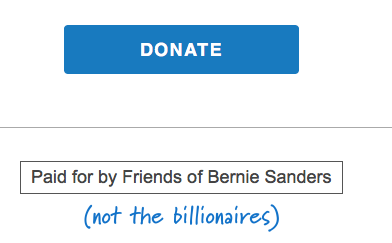
Bernie Sanders' way to raise money.
Bernie Sanders has a different fundraising technique: emails to a national audience that likes and supports him. People click a donate button and send $10, $25, $40. It is nice clean money--donations from people with a general amorphous agenda of support. It works for him. It won't work for everyone, and certainly not new local candidates.

The distinction between two ways of raising money by Democrats relates both to potential policy direction--incremental change vs. big change now--and to the tribes within the Democratic Party, Hillary vs. Bernie. Wine and cheese fundraisers imply moderation. The people who write $250 checks are not struggling working people waiting for payday to buy groceries. Bernie Sanders says the future of the Democratic Party is to abandon those people and to embrace a real, large, motivated constituency of working people who understand that those comfortable physicians and lawyers and business people at the wine and cheese fundraisers are part of the problem.

Both Jessica Gomez and Jeff Golden have campaign finance problems they will need to negotiate. Gomez's is that she is inundated by money from business and industry PACs and will need to explain it. How can she be independent of them? She has plenty of money but it will look "dirty" to some people who look closely at it. Who will she represent?

Golden's is that the only plausible way for him to compete is to get lots of local money from individual contributions, money sufficient to get his own message out. He will need money from some version of the wine and cheese fundraiser, and the people who can attend those and write checks are the "donor class”.  In the current environment some people on Golden's left will wonder what is wrong with him, that so many prosperous Medford and Ashland liberals seem to like him.


Monday, July 23, 2018

Democratic Division

Democratic messages: "opportunity" vs. "inequality."  Hillary vs. Bernie.


In card games and in political struggles, at some point people lay down their cards. Someone wins. Someone knows they lost.


Articulate. Forceful. Socialist, without apology.
Currently there is pundit buzz that suggests a potential direction for Democrats. Some politicians are talking the language of "opportunity." Such messaging is now defined as "centrist."  Talk of "opportunity" means progressive reform--which is understood to mean keeping the current social and economic structure in place--but becoming more progressive. 

The electoral goal of opportunity-Democrats is to regain the trust of those moderate Americans who were put off by Hillary, and therefore didn't vote or took a chance on Trump. They want to maintain her policies but change her message. Talk opportunity and jobs. And no one is deplorable. 

Electorally, they want to re-establish the 2008 and 2012 Obama coalition.

Remember, that coalition won the upper midwest. Obama had saved the auto industry in 2009 while headlines noted Romney had said "Drop Dead" to GM. Democratic messaging was to protect American jobs, philosophy and ideology and "discipline of the marketplace jungle" be damned. Republican messaging was that the GM bailout helped those terrible unions, not the bondholders. The bailout was wrong. GM should have gone broke.  Chrysler, too. 

Democratic victory in 2012.

Democratic centrists understand an opportunity message to be a bridge that can re-connect the coasts and the manufacturing states. Opportunity--with its implication of variable results due to individual talent and work ethic--takes some of the punch out of the racial resentment issue that works in the opposite direction on behalf of Republicans. The resentment is there to be mined. People naturally resent free riders--"takers," as Mitt Romney called them. The US is a multi-ethnic mix, and it is easy--perhaps inevitable--that people profile and project. We are the good guys, they are the bums.  We are provident and hard working; they are lazy, drunk, and criminal. We deserve; they are undeserving.

Opportunity-Democrats think they learned the lesson of 2016. 

Click: NBC News, with video clip.
Meanwhile, the activist left learned a very different message from the 2016.  They learned the lesson that Democrats--the kind of elected Democrats who served as super delegates and who supported Hillary rather than Bernie, and who are associated with the DCC--are corrupt sellouts. They get PAC donations, both from businesses and "good guy" groups. Leftist Bernie supporters perceive "opportunity" as simply another shuffle of a still-stacked deck.  People with privilege and power will arrange to assist their children get onto a fast track, to the disadvantage of the working poor who lack that access. Businesses will arrange to preserve their own wealth and power, with Democratic help. Opportunity means working hard for less and getting nowhere because the system is rigged to keep them in debt paying student loans and health care costs. Opportunity in the status quo means continuation of jobs that pit the American worker against the worker in Mexico and China.

It is fake reform. It keeps the rich in place, still rich, and the working people still working for peanuts.

Bernie--and now with the charismatic young voice of Alexandria Ocasio-Cortez, speak of a very different electoral success, and a division of the country between "working people" versus the "millionaires and billionaires" that Bernie Sanders condemned in his 2016 campaign. They perceive a division between the poor and middle class versus the comfortable and rich. 

Ocasio-Cortez: "Wherever there are working class people there is hope for the progressive movement."   She, like Bernie Sanders, openly uses the words "class." The enemy is the system, the stacked deck. Theirs is the progressive version of the Trump message, but with a different target. Trump punched down at the immigrants and blacks and people of color. Bernie punches up, at the beneficiaries of the current economic system.

Facebook post  in progressive group.
This blog, and a fundraiser I described, briefly became a source document, revealing the division in the Democratic party. The blog gave a field report on a Kate Brown fundraiser I helped "host." I included an invitation that had been widely circulated, one which suggested various donation levels, including $2,500. 

The campaign asked me to remove the post. 

Progressive Facebook groups were full of disapproving comments about the Fundraiser, learned from the brief time it was up. Look at the privilege; people who donate to Kate Brown get to talk and eat cheese with her. Leftist Facebook writers did not consider the event an occasion for good, clean, disinterested, good-government money, providing a fighting chance for the underfunded progressive Democrat struggling against the millions being raised by the Republican opponent. 

No. It was perceived as affirmation of Kate Brown's connection to people who could and would write $1,000 checks on behalf of her campaign.The bad guys. The people who are the apparent sufficient winners in the economic struggle to write those checks. The oppressor class.

1972.  There may simply need to be a cleansing showdown and a general election vote. A Democratic candidate who brings anything less than a social class based policy analysis may simply lose the left and re-elect Republicans. The left may need Bernie Sanders to run. Lay down the cards, see who wins.  

Democrats did this in 1972, picking George McGovern, not Hubert Humphrey, then lost big. The 1972 election results moved the country to the right, but it pushed re-set in the Democratic Party. It led to electoral win in 1976 with a Democratic Party that would chose a pious, moderate southern governor as its nominee. A 2020 election will be different. Nixon in 1972 was the establishment in the midst of liberal anti-war and racial turmoil. In 2020 a Sanders presidency would be seeking "leftist populist turmoil" as an alternative to "Trump-style ethno-nationalist turmoil."  Turmoil vs. turmoil. Pick your favorite.

Trump stirs up anger. He doesn't make the political activists long for quiet or "normalcy." He makes people want to hit back. The people who are put off by the turmoil don't vote. So voters are divided into three groups, all people who are engaged and in some form of turmoil.  There is the Trump 40%. Then there are two bodies of Democrats whose numbers have not yet settled out. Some of those are opportunity-Democrats. The others are Bernie class war Democrats. 

I don't currently see a common denominator between the two Democratic groups.


Sunday, July 22, 2018

More information on the Push-Poll in Southern Oregon

What makes you hate? An ugly poll is circulating in the Medford-Ashland area.


"No sooner had I read your blog than I received a call from Survey Sampling International. Wow. Just wow . . . The statements and questions were ugly."   Cathy Watt.


Jeff Golden
A picture emerges: the poll was seeking to discern what messages might sway committed voters. Four readers of this blog have added their reports.

The company doing the sampling appears to be attempting to determine what messages or issues might motivate local voters in the race for State Senate between candidates Democrat Jeff Golden and Republican Jessica Gomez

The polling company, Survey Sampling, International, website www.surveysampling.com, operates under at least two brands. It has a headquarters in Connecticut and offices and call centers in many cities across the US, plus in Europe. They aren't teen age pranksters. They aren't Russian meddlers. They are a real, professional American polling company. Somebody paid them good money for this. We don't know who, yet.

Jessica Gomez
I was contacted by four local citizens, in response to yesterday's blog request. All four respondents are very familiar with political campaigns and are personally visible in civic life. Cathy Watt is Chief Financial Officer of  a public affairs consultancy. Casey Stine has been a candidate for public office herself and is the wife of Kevin Stine, Medford City Council Member and former candidate for this office. Gayle Lewis is a public spirited retired Nurse Practitioner who publishes columns in the Jacksonville Review. The fourth is a man who asked to be identified simply as "an active Democratic Party leader."

All four poll respondents objected to the poll. It was either not really a poll at all, or it was a bad one.

One informant, Gayle Lewis, said the questioning and poll discipline broke down almost immediately. It turned into a conversation. "It was my pollster's first call. Poor thing. My take: within a few questions it was clear this was not a poll. I challenged the pollster about the questions that could not be answered.  At the end, I was being asked questions with wording that disparaged Ms. Gomez. I had answered a question responding with a favorable opinion for her."

The conclusion of this voter was that "the 'poll' was a device to offer language to disparage a candidate."

Cathy Watt reported hearing a purported opinions of Gomez, including "she doesn't pay her taxes, she only supports government funding if it come to her, she is pro-Jordan Cove pipeline." She gave up trying to track the questions, she said, when she heard statements attributed to Jeff Golden, "we spend too much to keep people alive" and that he "supports radical al Qaeda."  Watt's memory of the poll was that since she had answered favorably about Gomez near the beginning, all of the questions/statements she was asked to respond to  that related to Gomez were hostile toward Gomez.

Casey Stine spent 17 minutes on the phone with the poll and came away with the impression that it was, in fact, a poll, with an intent to learn what messages might be contained in an advertisement that might change a person's mind. However, the trial statements seemed so implausible and extreme that it was worthless for anything other than trying to put false or confusing information into the local political rumor circles. She cited the question "Jeff Golden supports the LNG pipeline; does that make you very concerned, somewhat concerned, not at all concerned."  The premise of the question is implausible for a voter with any sense at all of Golden's political bent. The overall takeaway was that call was in fact intended as a poll, but was actually so botched that it became just a haphazard negative hit piece on everyone. Worthless, except to make trouble.

The fourth informant, an active participant in local Democratic circles, said he intentionally gave erratic and untruthful answers in an attempt both to confound the poll and to get information about the poll. He reported the same format as had Alan DeBoer, with the poll starting off with "easy" questions regarding Trump, Kate Brown, Knute Buehler, etc.

He said he answered "mostly favorable" to Jeff Golden, to see what would happen.

For him, the questions started with summaries of "pretty run-of-the-mill" Golden positions taken from his website, and asked if those positions seemed convincing and made him feel more or less favorable. The questions then went to Gomez and these were harshly negative, e.g. "Gomez had a history of tax evasion and has had to pay the county thousands in fees."  

The poll then returned to Golden and asked for opinions on whether he knew Golden supported "the biggest tax increase in Oregon's history," creating a sales tax, supported higher gasoline road taxes, and how he felt hearing that Golden was quoted saying "Abortion is a bullshit red meat issue that doesn't actually affect people's lives."  This report coincides with the reports of others, by offering the sharpest negative statements about whomever one said one supported. 

The poll: malevolent, or simply poorly done?

Making calls to the area
There is a poll out there. You might be called. It appears to be--and maybe is--a legitimate poll attempting to find what what messages might move opinions. What are Golden's weak spots? Gomez's? What things might you hear about them that would change your mind? How flamboyantly dishonest can an advertisement be, and you still believe it?

But apparently the poll chose trial statements to move opinion that are so implausible and extreme that poll recipients' responses were to recoil.  The negative statements are too nasty, too implausible. 

I am hearing from the politically engaged. Alan DeBoer, plus the two people who knew to call Cathy Shaw, plus the four people who responded directly to me having read this blog are not typical voters. They are politically engaged. Politically engaged people hear false statements and reject them because they recognize them to be wrong. 

The happy way to think of this is that the poll constructors badly under-estimate the knowledge and common sense of local voters. People here are too smart to believe flagrant falsehoods. All good, here in Southern Oregon.

Or not.

The people I didn't hear from. Hundreds, maybe thousands of calls are being made into the Rogue Valley, and I have reports from a total of seven people who called "foul" on the poll and contacted me. All politically engaged. What about all those other people, people interested enough to vote, perhaps, but not so engaged, and who on election day will remember an impression from a startling thing they heard once that stuck in their minds, that Jessica Gomez is a scofflaw who refuses to pay her taxes, or that Jeff Golden is a terrorist sympathizer friendly with al Qaeda?  

Polls like this are not harmless.


[Still to learn, for future posts.  Someone paid for this. Someone with real money. Who?]


Saturday, July 21, 2018

Russian meddling? New Push-poll in Medford-Ashland Senate race

"If you like Jessica, they ripped her. If you said you like Jeff, then they ripped him"

                                State Senator Alan DeBoer regarding the push-poll


The push-poll targets both Jessica Gomez and Jeff Golden. Neither candidate commissioned the poll.

Weird.

Jessica Gomez website photo
In the past few days both Alan DeBoer and Cathy Shaw confirmed that local voters received phone calls from a polling company. The poll asks a few warm-up questions about Trump and Kate Brown and Knute Buehler and then got to the important question: whom do you favor, Republican Jessica Gomez or Democrat Jeff Golden?

Then the strange thing happened. 

Depending on whom the voter said they favored, they were then asked a very different series of "questions" which were not questions at all. It was a push-poll, but one targeting both candidates. Democrat or Republican, the voter got told negative information about whichever candidate they favored. The real intent of a push poll is to transmit negative, frequently completely untrue, information, but normally one would target one candidate or the other, not both. Push polls can put negative information into voters' minds anonymously. They get rumors started. The unattributed information circulates in social media. A push-poll isn't asking for information; it is pushing it.
Jeff Golden website photo

I spoke with both State Senator Alan DeBoer, who supports Jessica Gomez, and with Cathy Shaw, the campaign manager for Jeff Golden. Alan DeBoer responded to the poll personally, because he was by chance at a friend's house when the call came and he took the call. Hearing the negative things about Gomez imbedded in the questions, he assumed this was a Democratic-sourced push-poll. 

Meanwhile, Cathy Shaw heard about a poll from Democratic friends who called her, feeling angry about the poll they had just responded to. Those voters had answered that they favored Golden in an early question. They then got their own series of "questions" with inflammatory statements attributed to him. Shaw, in turn, assumed it was a Republican-sourced push-poll.

DeBoer and Shaw spoke by phone. By comparing notes they realized that the push-poll had the odd construction of trashing both candidates

Gomez supporters got "questions" that asserted that Gomez liked Trump (no, she doesn't), that she supported the Jordan Cove pipeline (she doesn't), that her company has paid hundreds of thousands of dollars for injured workers (they didn't), and that she is taking millions of dollars from the government (she isn't.) How do our statements about Gomez make you feel, the interviewer asked? 

People who said they liked Golden were given a racist statement and said it was a direct quotation from Golden (it wasn't), and were told that Golden said he wanted women to "be subservient to men in the workplace" (he doesn't). How does our information about Golden make you feel, the interviewer asked?

Alan DeBoer, June 2017
"It's as if the poll were designed to create rancor in the community," Shaw said. "A twenty minute poll of this kind, given to enough people to have any validity, would cost at least thirty grand," she said. And for what, she wondered? To see if there was any swing in people's opinions after being told non-credible things?  

She said it made no sense for either campaign.

Both DeBoer and Shaw told me they contacted upstate sources of political campaigns, the Democratic and Republican Senate election campaigns, plus the state parties, unions and other potential sources for the poll, and each came up empty.

If the goal was to create longstanding animosity, it did not work so far. Shaw said,"The first response is to wonder why the other side was doing a poll that was so ugly. And it turns out, they aren't. Someone, somewhere must not realize that this is a small enough town that people actually get along and talk to each other."

The Russians are coming. Both Shaw and DeBoer reaffirmed their hope that the campaign would be positive and productive. Both Shaw and DeBoer joked that it just might be Russian meddling.
Cathy Shaw

DeBoer said the problem of negative ads is caused not by the local campaigns themselves, but by the "assistance" of upstate PACs who create ads on their own. Those PACs are legally independent of the local campaigns, although their ads are intended to benefit those campaigns. The actual source of the ads gets lost in the vitriol, and what they do ends up reflecting on the local candidate. 

DeBoer said the problems would diminish if people had to take direct responsibility for ads they run and fund. "We should ban all corporate and union donations. We should let there be unlimited personal donations--it's a matter of free speech--but every ad should name who paid for it. And every ad paid by a group or committee should have to list the top five donors to that committee right there in the ad."

Meanwhile, the two campaigns are communicating.

Request to readers: If any reader gets called for this poll, please don't just hang up. Play along. Go through the poll and pay attention to the questions asked. Then write me here describing what you remember about the call, either with a "Comment" or by emailing me directly at peter.w.sage@gmail.com. I would like to get to the bottom of this push-poll.


Friday, July 20, 2018

"Thank you for your service." NOT!


Non-profit work can be thankless.


It deals with some of the hardest problems in a community. The pay is low, the work is hard. People second guess you. They tell you to do more with less. When problems emerge, they blame you for not having the resources to fix them.

And they kick you when you are down.

Praised.
Yesterday's blog post reported the praise former employees of OnTrack had for long time Executive Director Rita Sullivan. It was an easy post to write. Lots of people came forward to say Dr. Sullivan was professional, passionate about her work, motivating to staff, an inspiration, and a great boss.

I expected some criticism of Dr. Sullivan and OnTrack generally. Nonprofit organizations deal with the most difficult people and situations in a community. OnTrack dealt with drug and alcohol addiction. The clients are people at the lowest ebb in their lives: in addiction, usually in poverty, frequently with family relationships in tatters, in legal trouble. These are mothers so addicted that they used drugs during pregnancy and gave birth to a baby who was born addicted. Many of their clients are there essentially involuntarily, sentenced to OnTrack programs as a diversion from jail.

The work is hard and unglamorous. Someone has the job of watching urine samples be produced. Someone must physically watch the urine stream, to secure against phony samples. Some clients are violent. Some are abusive. 

It is frustrating work. Clients who successfully got through the program return, in relapse. Relapse is not an exception, it is the rule.  (How is your diet going? Did you gain back any of the weight?)

People would work at OnTrack, then leave for a better job.  Moving from OnTrack to a job at a school district, the county, or the state meant a promotion. Better pay, easier work, much better conditions, and PERS. There would be lots of reasons for employees to dislike Dr. Sullivan, to be happy for the job but unhappy that the job was a miserable one, and blame her. Didn't she know the job sucked and the pay was below market?

Yes, of course she knew. 

But the job is inherently difficult, made worse by the fact that the job was much bigger than the resources available. Everyone was more or less overworked and underpaid. Dr. Sullivan was inspiring and communicated a message of service to the needs of the client, but, still, in the everyday work of the job, it is a hard one.

Some jobs are like that.

The employees who came forward to praise Rita Sullivan saw something other than the frustrations of a hard job. They saw someone inspiring who worked hard to share the value of the mission. We are serving people who need us. We are doing good, important work.

Thad Guyer wrote a comment in yesterday's post that I am repeating here as a Guest Post. He addresses the difficulties of the work OnTrack performed.


Guest Post, by Thad Guyer


Thad Guyer

"Rita Sullivan is a Community Hero"


I worked with, for and near Rita Sullivan for 30 years. If you want to see a trailblazing woman hero, it's Rita. The tragedy of this conflict between her and OnTrack is the demonstration of how little it takes to cast a hero aside. Was Rita tried in court and found in the wrong? No, there has been no trial. Was Rita found to have used her power and position to aggrandize herself or her friends? No, there is no dispute about her unwavering dedication and selflessly giving 100% of herself to the cause of public health. Instead, she is accused of verbal abusive of some employees, and not always having the resources to immediately maintain the non-profit's facilities and residences. Were these employees minorities or disadvantaged groups? Nope, if Rita raises her voice to an employee, a vendor or a contractor, it is never based on race, religion, disability, gender, national origin or sexual preference. It is always based on performance, timely work product, dedication to organizational mission, or loyalty to clients and patients.

Rita's work life at OnTrack was one of struggling to chase too few dollars to serve an exploding population of victims, addicts and their suffering children in the opioid surge sweeping the country. Few of us can even imagine the high pressure, frustration and heartbreak of trying to save as many victims as she could. You know what the biggest problem in keeping a happy staff at OnTrack has been and always will be? Low pay and giant work loads for the case-handlers and caretakers. Places like OnTrack will always be stressful pressure cookers, overcrowded and underfunded, even triage operations in who can be saved. Working there has never been easy, and pleasant tones with sweet words aren't universally expected. Yes, clients and patients should never be ordered around with a coarse voice, and Rita has never been accused of doing that. But staff members who can't handle pressure and barked orders when the organizational realities are closing in from time to time, well frankly, they shouldn't be working at OnTrack.

Employees have a well articulated set of rights in the workplace that must be honored. Freedom from racial or sexual harassment, protection of wage and hour laws, and immunity for reporting violation of safety or regulations, these must be respected. But as to generic "harassment" or raised voices of a supervisor, the law is clear that an employee has no legal claim over that unless it is pervasive and severe. No board of directors for a non-profit should ever put the interests of complaining employees above the needs of the community's most vulnerable members who need treatment, counseling and housing to overcome life threatening addictions.  

The sad truth about OnTrack is that no one could have protected its clients and patients as well as Dr. Rita Sullivan. OnTrack might indeed achieve a more touchy-feelie workplace without Rita, but it will have been at the expense of public health and our community.


Thursday, July 19, 2018

Employees rally to support Rita Sullivan

"My experience is so polar opposite what I read in the press or see on the news that I wanted to say something. It blows my mind that these allegations even get brought up."

                                                  Former employee of OnTrack and Rita Sullivan

Some unhappy people are suing OnTrack and Rita Sullivan. They talk to the media and tell their story. Rita Sullivan cannot respond. 

Her former employees are speaking up on her behalf.
Dr. Rita Sullivan

For 39 years Dr. Rita Sullivan was Executive Director of a nonprofit alcohol and drug rehabilitation program, OnTrack. It won awards. Dr. Sullivan won awards. It was a state and national leader in best practices. Then things went all to hell.

An employee of OnTrack threatened a lawsuit naming OnTrack and Rita Sullivan. OnTrack put Sullivan on paid administrative leave while they sorted through the complaint. The complaint got big media coverage. OnTrack said nothing and told Sullivan not to respond. The result was a snowball of unanswered charges in the media. 

The news stories created a false picture of both OnTrack and Dr. Sullivan, according to multiple former employees, people now in different jobs and free to speak freely.

Some common themes were present in every employee's comments. Dr. Sullivan was a great boss. She was professional. She was highly competent. She was passionate about service to clients. She was available to assist counselors and others when they needed clinical advice. They were dismayed that Dr. Sullivan was described in such a one sided way and that, instead, her decades of work should be celebrated.

A partial sampling of the employees, ones willing to have their names used, include these.

Rob Roy, a Drug and Alcohol Counselor. He said, "In my observation in six years working with Rita I spent hundreds of hours in group and individual setting with her. My experience is that she was professional and respectful--always."

Charlie McNew said "I think she's getting a raw deal in the media because her side of this isn't getting out. She was a great boss."  McNew said worked with her for thirty years. "I've seen her work closely with staff people. She was helpful and professional."

Travis Cavalli, a drug and alcohol counselor and for three years the head of the Dads Program. "Rita was supportive, encouraging, helpful, and utterly passionate about OnTrack and the clients we serve."  What about the claims that Sullivan frightened someone by yelling? "I've seen Rita raise her voice when people were messing up and doing things out of line. It was just a normal response by a supervisor who cared about the work." He said he thought her story wasn't getting out. "She's getting slammed in the media, but she isn't able to defend herself. I thought she was a great boss and leader."


Dan Horton is an architect who has worked with OnTrack and Dr. Sullivan for some 25 years.  "She's a thorough professional," he said. Horton said she had a reputation for employing some hard to employ people and giving them second chances.  "She was trying to help them out. In my opinion, the lawsuits are all about people trying to take advantage of the damage the un-balanced media coverage created."

Why did OnTrack and Dr. Sullivan stay mum? 

I have no insight into the internal decision-making process at OnTrack beyond my own experience with lawyers. I am guessing their legal counsel gave the stern admonition that no one should say anything to the media while a lawsuit was working through the system--which may take years. I suspect Dr. Sullivan got the same advice. Don't talk to the media. Make your case in the courtroom, where the facts and law are on your side. They warn media reports might complicate things and give complainants something new to complain about.

What might well be sound practice for a party to a lawsuit is a disaster in public and media relations. 

The media covered the OnTrack litigants because that side was easily available to communicate with them in the form of their lawsuit, thereby giving the media lots of material. It is a cynical but effective strategy for a complainant, if they have media that cooperates, because the unanswered bad publicity for OnTrack and Dr. Sullivan is an incentive for someone to settle with some money. Even with OnTrack and Dr. Sullivan gagged, could the media have heard from and published other voices, people in a position to give "the rest of the story?"  

They could have--but did not.

I made a couple of phone calls, then received an avalanche of names from people happy to talk in praise of Rita Sullivan. Easy. It wasn't "investigative" anything. I just picked up a phone and asked.

The unbalanced coverage of Dr. Sullivan finally got to be too much for some OnTrack employees, so they spoke up.


Wednesday, July 18, 2018

Presenting Jamie McLeod-Skinner

McLeod-Skinner:  "I identify as a rural Democrat."


Being a rural Democrat isn't about policies. It is about tribes--the rural tribe.

McLeod-Skinner
She is working to show she fits the District. Her challenge is to show Greg Walden no longer does, because he fell chest deep into the swamp.

Fundraiser. I watched closely Jamie McLeod-Skinner in two settings. On Sunday she spoke to a group of individual donors at a fundraising party.  This was a friendly crowd, but with high stakes. She needs her friends to believe she can win, and should win, and should write checks to support that win. 

Stress test. On Tuesday morning she was the guest on a local AM talk radio show with a Trumpian/Fox News white male non-college tone. The host interrupted, talked over her,  demanded answers, and pushed her to account for presumed weak spots in her candidacy. This was an unfriendly venue, but it was an opportunity to see if she could find common ground with likely Trump voters.

Yes, she could. The bridge between the tribes isn't so much policy as it is tribal symbols. In both settings Jamie Mcleod-Skinner had an apparent purpose--to demonstrate that Democrats--or at least she--was a natural, comfortable part of a the tribe of rural Americans.  

It turns out you can be a progressive and speak the language of rural localism. She didn't sound like a Nancy Pelosi Democrat. Nor an Alexandria Ocasio-Cortez Democrat. Nor Bernie nor Elizabeth Warren. She sounded rural, and it works for her here, even among urban progressives.

There are common denominators between the tribes of red and blue America which somewhat coincide with rural and urban America. Progressive Democrats are not put off by talk of agriculture, forestry, water, rural access to health care. She did not "nationalize" her campaign, with talk about Trump. Quite the opposite. She spoke of water tables in Burns. Irrigation water and dam removal in Klamath County.  She spoke of problems of people who farm, ranch. She mentions her mother in central Oregon, her wife's ranching family, her having gone to Ashland High School. She mentioned her Jeep and country music. She wears pants. She cites outdoor work. She cites her war-zone civilian experience.  

The talk show was the stress test. Could a progressive Democrat be plausible to a Trump voter. The radio host went right at her. She surely is a carpetbagger, recently up from California. She must be a socialist--or fascist. She must want socialism in medicine. She must be a liberal kook who favors "road diets" instead of extra lanes. She must tolerate illegal immigration. Co-workers must not like her.


McLeod-Skinner had good answers, spoken with confidence. 


Her travel vehicle
As City Councilperson in Santa Clara she said she protected taxpayers from giving a big subsidy to the NFL 49ers. She said she was fired from the city manager job because she blew the whistle on financial improprieties. She said the USA is a sovereign nation and should protect its borders. She said that expanding health care access is affordable if we control costs.

But the most important part of her presentation was the return to local, rural symbols. The aggressive host worked to focus on wedge issues of policy, while she kept using symbols of libertarian rural Oregon. Local control. Lumber manufacturing and selective thinning in forests. Yes on guns, but with background checks. State control on immigration enforcement. Local issues, local roots, bonds with local people.

They talked at cross purposes. He wanted to expose her as a California liberal. She wanted to present herself as a local, common sense Democrat, someone who Trump voters could talk with.

Jamie McLeod-Skinner is defining herself--half the job of the candidate..

Meanwhile, there is the second half, defining Greg Walden as the one who is out of touch, the politician who became a creature of the big money lobbyist swamp. 

Objectively, this should be possible. Trump voters resent big city, big government, big special interest power, and he is an archetype member of the DC swamp. He raises money in vast quantities from the industries his committee oversees. Its the DC swamp.

On the radio show McLeod-Skinner said "as he moved up the political ladder he lost his way" and that "he has forgotten where he came from." She cites that Walden supported repeal of the ACA that provided health care access to some 80,000 of his constituents and that protected the financial viability of local hospitals. He abandoned his promise to protect people with pre-existing conditions. It is a vulnerability for Walden. 

But Walden makes this hard for her. He stopped doing Town Halls or other public appearances, and instead presents himself through advertising that he can control. 

More since last report. Extraordinary industry PAC support
The advertisements project a general impression opposite of what he did, but there are a lot of ads, and they are well produced. He is a slippery, well financed opponent, with a reputation that perpetuates his former, pre-leadership role. In the District he appears as "aw shucks, Greg," informal and earnest. It works for him and it  inoculates him somewhat from being revealed as the swamp creature that McLeod-Skinner describes.

McLeod-Skinner is succeeding at half the battle--looking plausible as a progressive, rural Democratic representative. Her challenge will be showing Greg Walden isn't what he appears to be, not any more.