Monday, February 22, 2016

Rubio Fundraising is Good. Hillary Fundraising is Bad

 Bush drops out and Rubio moves in.


It is the most natural thing in the world for Rubio to turn to disappointed Bush donors and to solicit funds from them.

Bush had been the archetypal Republican establishment candidate, and the voters don't seem to want him.   Rubio is the new 21st Century version of the GOP establishment.  Rubio is much more conservative than Bush, much more aligned with the Tea Party, much more confrontational, much more inclined to speak in absolutes of good and evil, a notch more absolute on abortion (not even for the product of rape) much less bi-partisan and open to compromise with Democrats on anything, and, of course, much younger. 

Rubio wants to be the face of the new, improved Republican establishment.  

Donors in Play
Rubio turning to billionaires is simply an update in a continuing process.  It isn't "news" and it certainly isn't shocking or controversial.   Of course he will look to Bush's big donors.  It is how campaigns work.  No minimizing it, no apologizing.  When Rubio lands a big donor supporter he announces it because it is another prize and another endorsement

Meanwhile, on the Democratic side, Hillary's search for big campaign dollars is news, because it is a matter of controversy.   In the Sanders frame of the campaign, it is a sign of her ties to the donor class, a sign of her being compromised, of her not being authentic or trustworthy.   

Sanders has put Hillary into a tight box, damned if she does and damned if she does not.   Either she cannot get support (proving her unpopularity) or she can get support (proving her corruption).   What is perceived as a sign of strength for Rubio is perceived as a sign of corruption for Hillary.  It is a bind in the primary.

I am not complaining about this or saying it is unfair.  There is no such thing as "fair" in these matters.  The Republican primary and the Democratic primary are sorting out very different things.   I am simply trying to describe what is happening in the campaign.  
Scramble for donors
The Republican contest is about who can pull together the fractured Republican coalition.

Bush could not, and Kasich is failing.  

Trump and Cruze do not want to pull it together; they want to re-shape the coalition.  

Rubio is the last plausible chance.   Rubio is trying to thread the needle, sounding like a Tea Party person and voicing Tea Party positions while simultaneously reuniting the establishment donors to the Tea Party politics through the vehicle of his personality and candidacy.  The donors can no longer be choosy.   It might be Rubio or someone way worse.

Bad Headline, Bad Photo.
Meanwhile, the Democratic campaign is a struggle between two definitions of the Democratic Party.  The Sanders one, which is about who has clean hands to break up the power of special interests, or the Hillary Clinton one, which is about who knows how to use the levers of power and money for progressive ends.

The primary election is doing deep damage to each of the eventual winners.   If the Republican nominee is Trump Republicans will have seen their traditional spokesmen (including Nikki Haley in the Republican response to the State of the Union) trash Trump for his message.  If the Republican nominee is Rubio the campaign will have forced him to be nearly as conservative as Cruz to win the election.  Rape victims must carry to term, millions must be deported, and we need more engagement in wars in the Middle East.  It may be tough for Rubio to sell that.

But there are big problems for Hillary, too.  Assuming Hillary is the eventual nominee, she will have had her greatest strength--her experience within the money and power structure of American politics--defined as a character flaw.   Many voters have firmed up their opinion on that subject.  Rubio raises money from billionaires because he is a fresh voice; Hillary raises it because she is corrupt.  It may be tough for Hillary to sell that.


Sunday, February 21, 2016

Hillary's Case: She is "Fighting for Us"

Hillary Clinton leads a coalition of the disadvantaged.   She is "Fighting for US"

Hillary's slogan from the beginning

Each presidential candidate has identified a "base".   Conservative evangelicals for Cruz, frustrated native born whites for Trump, under-30s for Sanders, and so on.    Hillary Clinton has by far the biggest base, but it is the leakiest.

Hillary's base are people in groups that have traditionally been locked out--or now perhaps only more or less subtly edged out--of the traditional power structure.   It is a giant group:   women, blacks, immigrants, non-English speakers, Hispanics, Asians, the poor, recipients of need based government assistance, the disabled.    

My Republican friends often express impatience to me about people in these groups expressing frustration or resentment with the status quo.   They consider it whining over little or nothing.  They say it as an excuse for mediocre effort or laziness or ability or bad life choices.   So they resent affirmative action, they mock trophies for "participation", they suspect grade inflation.   They understand their own achievement to be based on hard work and good choices and they are concerned that America is losing the rigor that rewards achievement in a capitalist economic system.   

In cultural terms, they resent "political correctness", and in political terms they resent progressive income tax rates and needs based government benefits for the undeserving.

(Personal note: I am a healthy white male with a fancy education and had a tailwind of advantage my entire life.  People who enjoyed relentless subtle privilege in the form of presumed ability--or when in trouble, presumed innocence--don't experience its opposite, so they hardly believe it exists.  They don't see it. I am an eyewitness.)

This is the big political showdown in the 2016 General election:   Hillary Clinton leading a very loose coalition of people wanting to break through barriers, versus an alternative mindset led by Trump, Cruz, Rubio and the other Republicans that "regular Americans" are being exploited by those special pleaders.   Republicans reach into the leaky coalition with a message of work ethic and uplift rather than resentment which appeals to immigrants, and to traditional values issues on marriage and abortion and homosexuality which appeals to traditional and values-conservatives within the Democratic coalition, i.e. devout Catholic Hispanics.  As I said, it is a leaky coalition.

Sanders frames the issue in the Democratic nomination one way:  corruption of the power structure.  Sanders condemns donors and K Street and their influence in our politics and will destroy the political money-power structure, in contrast to Hillary who is a tainted practitioner within that power structure.   

Hillary frames the choice another way:  Who is the better fighter for progressive causes?

Hillary's campaign slogan is "Fighting for Us".   Note she says "us".    She isn't poor or weak, but she is a woman.  Her campaign origin story is about her mother's struggle and Hillary's first job being for the Children's Defense Fund.  She adopts her mother's "log cabin" story and in her stump speech calls it her "touchstone" and the source of her motivation for progressive causes.   

She is positioned as a veteran warrior on behalf of her fellow victims in that coalition of the disadvantaged and discriminated against.  Does she sound shrill and angry to some?  Well, she is a warrior.   Her stump speeches are a list of problems and solutions.  She cites the lower income for women than men, the profiling by the police of dark skinned people, the laws discouraging immigration, efforts to discourage black voting, unfair interest rates for college loans, and so on.   Her campaign message is that she sees the barriers, she is on your side, and she can get things done.

This short ad, called "Barriers", demonstrates her message:   https://goo.gl/keqKAp      It is 60 seconds and worth your time.  

"After law school she could have joined a high priced law firm but instead worked to reform juvenile justice in South Carolina. . . . "

As she frames it, only a practitioner in the system can actually get things done.  She isn't soiled by the system, she is experienced in using it, for progressive ends, not selfish ones. 

Sanders voters aren't motivated by effectiveness.  They are motivated by the clean hands evidenced by Sanders' old car, rumpled suit, and unwavering ideological commitment to breaking the money-power structure.  He is not pressed for close details on how he would implement a strongly progressive agenda even though Obama used every bit of his own political capital (and lost the House and Senate doing it) to try to get even a modestly progressive agenda implemented.

If the Primary election issue is about who has the cleanest hands to break the political system, Sanders wins.   If the issue is about who can effectively advocate for the amorphous Democratic coalition, then Hillary wins.   

Happily for the Democrats, what is happening in the Republican primary is well suited for plugging the leaks in the Democratic base.    Democrats will lose some of the xenophobic and fearful "Reagan Democrats" in the swing states--Trump voters, if Trump is the nominee.  This may be a big leak, depending on whether events push fear to the top of mind.    It is a risk.

But the Republican primary has done what Hillary could not do, plug many of the leaks in the Democratic coalition.  GOP attacks on immigrants and Black Lives Matter and Planned Parenthood and the general GOP defense of traditional social hierarchy has sent a message to women and non-whites of all types that the Democratic Party is their true home.

Probably.

There would be an irony here. Could a party that condemned immigration and pushed against affirmative action nominate a Marco Rubio-Nickie Haley ticket, with a Cuban presidential candidate and a dark skinned immigrant female VP?   Yes they could.  Would this re-open the leaks in the Democratic coalition?  Would voters look at a Rubio-Haley ticket--ignore the Primary election rhetoric--and decide that Republicans aren't the anti-immigrant white male party after all?   We may find out.


Saturday, February 20, 2016

Trump: Populist Nativist

(Make it easy on yourself.  Put your email up there on the right.  If you "Follow" me you get an email in the middle of the night sending you whatever got posted the day before.  Don't worry, you can easily unsubscribe any time.)

Trump doesn't fit normal Democratic-Republican categories

Trump is complicated and it gets him into trouble.  His Republican opponents are running ads saying he is apostate on some issues. 

Trump almost sounds like a liberal, a Democrat.   He wants government to work on behalf of real Americans.   He isn't "conservative."
RNC Chair Reince Priebus:  Trump is a Republican

 Trump fails to condemn Planned Parenthood completely, noting that it does "some good things."

Trump says compassionate things about people needing health care, saying he wants to replace it with "something great".   Republican orthodoxy would be that poor people should get less or zero health care because it is a consumer good to be allocated by who can pay for it.  "I don't want people dying on the streets," he said.     "Everyone has got to be covered," Trump said, saying that the government's going to be paying for it."    Rush Limbaugh blasts Trump.   The conservative position is that the government has little or no place in health care, not that it is a safety net of last resort.

Trump voters in Nevada:  stood 3 1/2 hours
Trump wants government intervention in trade policy and in financial institution regulation.   Again, Trump wants strong government to force big business to meet popular goals for the benefit of citizens. Trump is an authoritarian, not a libertarian.   Trump wants government to do big things, to build infrastructure, to win trade wars, to make America great.  (Not just free.   Great.)

Republican orthodoxy would be that government should be weak in regulation to allow business to work for the benefit of owners, and that benefit to citizens and other stakeholders trickle down.

But Trump says things that Democrats do not say aloud.   Democrats are a party of inclusion, not exclusion.

The modern Democratic Party coalition combines liberal progressives with groups that have faced special discrimination or stigmatization:  women, blacks, immigrant communities, homosexual communities, Muslims, Jews, Hispanics, Asians, the disabled, the non-religious, the unmarried, the poor, recipients of government assistance.   (This group includes an overwhelming majority of people, in once category or another.)  

It is forbidden for Democratic candidates to express xenophobic or racist or sexist sentiments.   The Democratic "brand" is inclusion and the proper tone for people in the coalition is respect, not disdain.   Trump condemns "political correctness" while Democratic candidates practice it scrupulously in public.

Trump defines "real Americans" narrowly, not broadly.   That is is populist nativism.  It excludes many people in the Democratic coalition.  He opposes most immigration and wants deportation.  He openly and freely endorses preference for white native born citizens.  He expresses triumphant disdain for the defeated.  He mocks a disabled person.    He publicly acknowledges cultural stereotypes.  He flouts international rules and norms, publicly endorsing torture.

Bottom line:   Trump is in sharp conflict with Democratic orthodoxy, but the theory for Trump's election is that Democratic candidates are out of touch with their own party.  Democratic voters may well be more nativist and xenophobic and more resentful of "political correctness" than are its national candidates.   And Trump is in sharp conflict with Republican orthodoxy, but Republican orthodoxy may be out of touch with Republican voters who in fact they don't really want small government and big business.  In fact they like government services, at least for people like themselves, and they distrust Wall Street and business elites and instead want a government that protects them from those elites.

Trump is electable as President.   It may not happen, but Trump has appeal with the voters in each party.  And this year being in opposition to party elites is a positive, not a negative.   


Friday, February 19, 2016

Strong Trump: Unbossed

Donald Trump's brand is his strength.   And that he is unbought and unbossed.

The Pope doesn't tell Trump what is good for America.  Trump tells the pope.

Donald might have chosen to use nicer, more respectful language but that isn't his brand, either.   Donald Trump says he is unbossed by political correctness or outside influences or someone else's money, or by someone else's supposed moral authority.  Not the NY Times, not Fox News, not the Pope.

Donald strengthened his brand.  Nothing else need be said.

Unbought and Unbossed

Let's look backward a minute to the late 60s and early 70's.  Turn on some music: MoTown or Jefferson Airplane.   Pick up a Ms Magazine.  Or a book.   

Unbought and Unbossed is the title of Shirley Chisholm's autobiographic rise to be the first Afro-American woman in the US Congress and a Democratic candidate for president in 1972, the year the Democrats eventually nominated George McGovern.   

The Amazon description of her book describes her appeal:   "She shares how she took on an entrenched system, gave a public voice to millions, and sets the stage for her trailblazing bid to be the first woman and first African-American President of the United States. By daring to be herself, Shirley Chisholm shows us how she forever changed the status quo."

Unbought and Unbossed
In 1972 Democratic voters were frustrated because the political system in the first Nixon term blocked the changes they wanted addressed, a prolonged war in Vietnam and unrest at home for women's "liberation", racial justice, greater toleration of widespread marijuana use, liberalizing sexual mores.  Women burned bras, symbolizing freedom from gender constraint. (Or something.  Does anyone really understand what bra burning has to do with women's equality?  Tell me, please.)  Male college students grew beards and longer hair.  Black unrest in cities caused fires and looting, frightening whites and accelerating "white flight" from cities.   These changes caused a backlash that was politically much stronger than its cause: Nixon's Silent Majority condemning Acid, Amnesty for Draft Avoiders, and Abortions.

In 1972 there was no compromise or accommodation between the progressive impulses and its backlash.  Hippies irritated the Silent Majority but black urban crime scared them.  

The blocked political system caused people on the political and social left to infer a diagnosis of the problem.  It wasn't simply that there were more votes for openly racist politicians (Strom Thurmond, George Wallace,  and Jesse Helms, for example) and for softer voiced conservatives generally, it was "an entrenched system" requiring a trailblazer to change the status quo.   Being black and female, she was positioned to the left of  the white male WW2 veteran US Senator George McGovern who largely shared her views but was a more electable version of the same impulse.   

Backlash won.  The "Silent Majority" backed Nixon in a landslide.   Her diagnosis was that the problem was the system, but the election results suggest that it wasn't the system; the system may actually have worked in the sense that the majority ruled.  Chisholm led a frustrated minority.

In 2016 there are people frustrated on both the right and left. Polling suggests that this is a very different era.  The frustrated are the majority, and maybe a very sizable one.

Many voters aren't getting what they want.   Middle East wars persist.  The economic recovery is underway but feels slow.  Voters themselves have chosen divided government, and both the right and left consider the political system to be "entrenched" and unresponsive.   The partisan media has nurtured fear and outrage.  The majority of people--on both left and right--feel the country is on the wrong track according to polls, but thanks to  constitutional checks and balances the political process is stuck.

Republicans incumbents  who wanted their party to be a governing party lost primary elections.  The survivors insisted that the GOP be a party of protest and obstruction.  Boehner is ousted, for not obstructing enough.  The result is that the political system is frozen up.  Obama has 11 months to fill a vacancy on the Supreme Court and likely cannot.

Resentment from the right:  Political and social conservatives on the right feel frustrated that social change on homosexuality and marriage and multicultural inclusion are coming at them faster than they want, but thanks to the Supreme Court and a gridlocked Congress cannot stop it.  Politics isn't working, they feel. It fuels nativism and resentment of minorities.  Trump, Cruz, and Rubio openly compete for those voters, and it is the majority pool of votes. The dominate two houses of Congress, but they are not yet getting their way.   Immigrants are still here.  One still has to "push one for English".  Muslims are supposed to be treated respectfully.  Whole classes of people get special protection thanks to affirmative action, anti-discrimination laws, and lax immigration enforcement. Obama of questionable legitimacy still holds office.

Talking to South Carolina Tea Party people
The diagnosis from the right:  The system is broken.   "Political correctness" stacks the deck on behalf of these outsiders.  Plus, there is dysfunction at the top in the form of powerful groups like the Chamber of Commerce, and K Street lobbyist and powerful special interests generally  who have made bi-partisan peace with Democrats.  Wall Street and big business had been part of the Republican coalition, but now they are part of the problem.   Republican populism now understands Big Business to be an enemy, a sellout, a RINO Republican in Name Only.


Waiting 3 1/2 hours in Nevada
Trump, self funded and contemptuous of the game of contributions-for-access that he had played for decades, presents himself as unbought and unbossed, the descriptors of Shirley Chisholm.    He is the one Republican candidate who captures both directions of Republican resentment.   Trump says the Republican establishment and the whole political system of special interest influence is corrupt.   He doesn't admit his complicity; he highlights and glories in it.  He is an eyewitness.   Hillary attended his third wedding.  Money talks, and Trump knows it and shows it and condemns it.

His major remaining Republican rivals all share his target down to the unfairly protected outsiders.  Only Trump has the credibility to condemn the elites at the top and therefore the overall political system.  He is self funded.
Watching the setup for the Sanders rally 

In 2016 the progressive left feels frustrated.  College students in their 20s and "millennials" in their 30s overwhelmingly support Sanders.  Sanders voices frustration over the income and government benefit allocations between the generations.   Young people pay into Social Security and Medicare and question whether they will get the benefit; older people get the benefit and have stopped paying in.  The system is generally unfair, but older Democrats benefit from it and like it.  And, significantly, they support Hillary, not Sanders.  

Young people pay--or owe--for college costs that have grown enormously compared to the minimum wage incomes young people can command.   Rents are very high relative to wages for most young people.  Young people lacking parental help or inheritance see an economic landscape stacked against them.    

Bernie's Crowd in New Hampshire
But the status quo political system didn't fix it, even when a black Democrat was president.   Why?  Their diagnosis, voiced by Sanders:  the political system is broken.  The problem is gridlock caused by powerful financial interests at the top, people and groups who effectively own the Congress and protect the entrenched system.

Sanders looks and acts like an incorruptible old semi-hippy, a guy who drives an old car, wears old clothes, and avoids the chains of a corrupt system.  Because he successfully collects money in $25 chunks from the masses of frustrated voters wanting change, Sanders, too, is unbought and unbossed.   

He compares well against Hillary because Hillary lacks Bill's political dexterity and appeal and because her entire biography documents that she is a liberal who has worked effectively within the political system.  It is her strength and perhaps-fatal weakness.  She has raised the system's money, received its endorsements, learned to pull its levers of power.  She knows rich people, vacations with them, speaks to them, and is a progressive voice within the system of donors and interest groups and K Street.  But bottom line, she is a practitioner within the system, not a destroyer of it.

And the diagnosis is felt by progressives and has been defined by Sanders, not her.  The system is entrenched, broken, and corrupt.

Trump and Sanders have the biography to fix the problem.  Sanders says he will take the unjustly acquired money from the billionaires who took it thanks to unjust and unfair loopholes for the billionaire class.     Trump says he will take it from the unjustly received money by the coddled parasites protected by weak leadership and political correctness, and won't be deterred by the powerful elite.  (But he doesn't say he will tax them or impoverish them; only reduce their influence.)

Sanders and Trump are sounding the themes that Shirley Chisholm voiced: unbought and unbossed.   And this time they represent a majority.


Thursday, February 18, 2016

A Secret Revealed: Town Hall Questions

Wait:   Before you read today's post, please consider "following" me.  Put your email in the little box there in the upper right.   That way you get whatever I post each day delivered directly to your email.   Don't worry, you can always un-subscribe instantly.

Here is a little secret behind what appears to be a high risk circus act by candidates.  Q & A

Most Town Halls have a Q & A period.  Chris Christie would say that as the parent of teenagers he has learned to ignore shouted questions and he would call on people at random.  The Q & A is often presented as a big risk.  It is as if the candidate is a circus performer, up high on a wire who turns to the audience and demands the ground crew remove the safety net!   The hazard!  The courage!   The self confidence!   Ten TV cameras, a live audience, and now a random question from just anywhere.
Politico Article today

What a daredevil!  A difficult or embarrassing question might come from just anywhere.  The candidate must be fully prepared to be president to take such a risk.

So here is the secret:  Random questions are not hard at all.   There are fewer than ten questions ever asked, they are all about the same, and the candidate has answered them a hundred times already.  Plus the candidate can insert stuff from his stump speech to address the question.   And no candidate actually has to answer the question asked.
Talking Points Memo article today


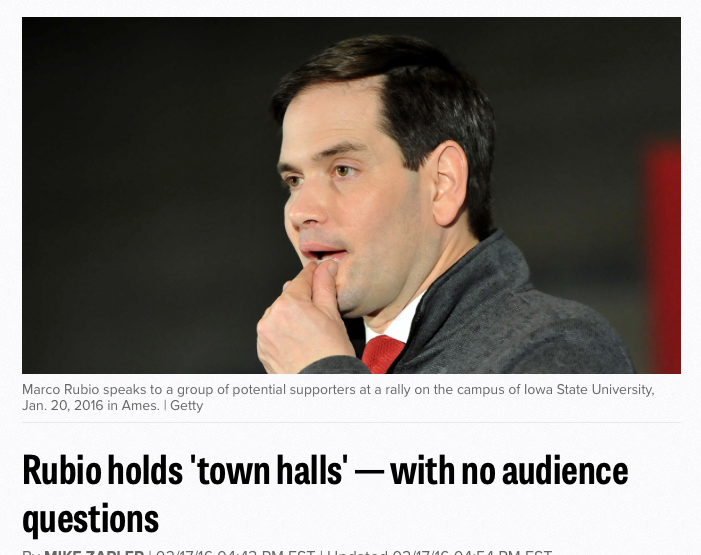
A couple of articles are posted today from sources that skew liberal.  They imply that Rubio is avoiding something difficult and that he would be unprepared, further implying that Rubio's repetition of a set speech at a recent debate revealed that he cannot answer questions.   This is an error.  

If Rubio only scheduled a 40 minute event so that he could squeeze in multiple rallies it was completely an issue of time.   People want to hear the speech and they want their selfies.   He dispensed with Q and A for time reasons. 

There is no trick to answering questions.

What questions are predictable?

1.  Something about guns.  Do you really, really support gun rights?  (Yes. . . .)
2.  Something about abortion.  Are your really against it?  (Yes. . . . )
3.  Something about the Middle East.  Will you keep us safe?  (Yes.. . . )
4.  Something about your opponents.  Are you better than them?  (Yes. . . )

Then the hard questions, the ones that the audience is afraid you will muff:

5.  You get money from donors.  Are you beholden?  (No.  They like me because they are patriots, like you.  I am independent.)

6.  You repeated yourself.  Do you have set speeches? (No.  There are points I want to emphasize so I chose my words carefully.  We really must dispel the notion that Barrack Obama doesn't know what he is doing. . . .)

7.  Are you old and mature enough? (Experience in Florida and the US Senate and people are demanding change. It is the 21st Century.)

Then a couple of oddball questions, where no answer is right or wrong but the candidate needs to know not to answer stupidly.  He needs to remember to stay in character as a presidential candidate.

8.  Do you wear boxers or briefs?   (Clinton actually answered this, which was a mistake.  The correct answer is a big smile and "whatever is in the drawer" or some other non answer.

9.  What is your favorite book?   (The Bible)

10. What do you hate about campaigning (away from my children), eat for breakfast (cereal), watch on TV ( football), favorite movie (quick: scan mental library for something not risqué, with a good message and a proper hero, consider a Disney film but dismiss it because there might be an old style Disney princess who is pretty, or a new one like Frozen that some people think in gay, quick, think of an old one maybe, "Its a Wonderful Life", or maybe some Charlie Brown Christmas special.  It turns out that this one is the only difficult question, and it is a the one that is silly and trivial.  Pundits and opponents could analyze to death your answer.   "I don't know, too many to say," is the safest.   

The questions and answers to those questions will take up 30 minutes and it is time for the candidate to end it and go shake hands and do selfies.

Guest Post: Citizens United Case

Guest Post by Thad Guyer

Peter Sage:   Thad Guyer, a litigator specializing in employee whistleblower cases looks closely at what messages are persuasive to judges and juries.  In today's guest post he describes how the Citizens United 5-4 decision in the Supreme Court changed American politics. The majority opinion included a prediction that unlimited corporate and special interest money would not create an appearance of corruption or undue influence.   In fact, the influence of money is a key component of the campaigns of the two candidates who are totally disrupting the 2016 election.   

But first, before you read his post, please look over to the upper right.   Please put your email address in the box to "follow" this blog.   Every morning you will get an email with the verbatim copy of whatever I have posted each day.  And don't worry, you can "unsubscribe" any time, immediately. 


Here is Thad Guyer's Comment:

Trump and Sanders Awaken Americans to Corrupt Party Establishments Fueled by Dirty “Citizens United” Money

The so-called “swing justice”, Anthony Kennedy, and his four Republican cohorts, get to behold in real time the legacy of their judicial love child, “Citizens United”. Scalia lived just long enough to see the evil spawn publicly scorned as a crook and criminal. The conservative cabal in the Supreme Court is now treated to frenetic and sneering ridicule for having splashed corrosive acid in the faces of the Republican and Democratic parties. 

The party elites were supposed to benefit from the merger of “big money” and “corporate speech”. But the Justices were able to delude only themselves with these words: 
“This Court now concludes that independent expenditures, including those made by corporations, do not give rise to corruption or the appearance of corruption. That speakers may have influence over or access to elected officials does not mean that those officials are corrupt. And the appearance of influence or access will not cause the electorate to lose faith in this democracy.”
Pool at Hunting Lodge where Scalia died

Shock yourself by clicking and reading it. https://goo.gl/HU20wo. With poetic justice, Scalia posthumously splashed around still more acid by being found dead in a “free” luxury suite owned by a millionaire to which he was flown in a private jet. 

Citizens United shows not just what feckless justices the Five were, but that they were idiot politicians as well. So now, reflect if you will on how Trump and Sanders, wielding bayonets forged of Citizens United aluminum, spill the blood of the “stupid” parties they each duped into hosting their 
independent campaigns. No single derision by these independent candidates has been more enduring than “The Donald” and “The Bern” brutally humiliating Hillary, Jeb, Marco, and Ted as money whores and puppets. Yes, smug in their life tenures, Kennedy, Roberts, Scalia, Alito, and Thomas had assured the candidates that taking the big money would not give the “appearance of corruption” to anyone. And Citizens United swelled donors' hearts with the hubris that their millions would “not cause the electorate to lose faith in this democracy”.
More questions about why Cruz really opposed ethanol support

The real clear politics here is that in attacking Citizens Untied as the common enemy, the bond and brotherhood between Trump and Sanders flourish. In every public appearance, in every debate, “the brothers of different fathers” launch their “hate speech” against the donors and the recipients of the corrupt money. Both  renegade candidates repeatedly and recently attack not just the money-sucking candidates, but the Republican National Committee and the Democratic National Committee, respectively. See, “Trump Targets RNC After South Carolina Debate” http://goo.gl/ByZoz1 (Newsweek 2/15/2016), and “Bernie Sanders Protests DNC's Lifting of Ban on Lobbyist Donations”, http://goo.gl/r3p1qt (Democracy Now 2/16/2016). Oh yes, the party bureaus themselves are the very face of the enemy.


More questions about Rubio's independence
UpClose wisely tells us to get “comfortable” with Trump projecting as a bipartisan strongman and tough guy. And if we should get comfortable with Trump for this, we should get comfortable with Sanders too. Both are tough guys who get in the face of the establishments and say with Clint Eastwood bravado “I don't need your stinking money”. The Donald, as UpClose says, does it with a Tony Soprano fist. Bernie does it as a ‘tough old bird’ with grand kids gathered at his feet. But both are “burn it to the ground” zealots. See, “Bernie Sanders Sues DNC for $600,000 a Day Over Removal of Data Access”, http://goo.gl/iTTxPq, and “Trump warns RNC Isn't Honoring 'Pledge,' Threatens to Sue Cruz”, http://goo.gl/4QKyWb


Questions about her Wall Street ties
Yes, indeed, 2016 is the year when a Dickensian young street thief named Citizens United mischievously opened the flood gates of that long lost quality we are taught to love-- bipartisanship. Now we must decide if we want to embrace bipartisanship with mutual spirit to topple the corrupt political establishments, Republican and Democrat.