Thursday, December 5, 2024

Health Insurance CEO targeted and Killed

Found inscribed on bullets at the scene: "Deny" "Defend" "Depose".


Brian Thompson, the CEO at United Health Care, was targeted, shot, and killed. For him and his family, it is a tragedy. 

The bell tolls for the rest of us, too.


This shooting will raise the cost of doing business. It raises the risk of fame. It may make corporate executives think twice about their business practices.


People wasted no time figuring out how to make money from the publicity surrounding the murder. A Deny Defend Depose meme coin, a form of cryptocurrency, has already been created and is trading. There made a fixed amount, so there is scarcity, and the price rose.


People in executive offices and board rooms are re-calculating what is prudent -- indeed required -- to create workplace safety. If executives are at risk of murder by angry customers, then bodyguards, company-paid security fences at private residences, and private jet travel aren't optional perks. They are matter-of-fact safety practices right along with rollover bars on heavy equipment. This murder will cost American businesses billions of dollars and it will get built into the price of everything.

A new risk became apparent, not just for famous executives like Jamie Dimon or stars like Taylor Swift. Executives who aren't famous can be targets. I liken this shooting to the December, 2001 incident where Richard Reid boarded a jetliner with shoes containing explosives.  We discovered a new point of vulnerability. Thereafter, hundreds of millions of passengers have needed to remove their shoes to have them examined before boarding airplanes.  


Insurance company executives -- and indeed customer-facing employees in local offices of insurance companies -- are long accustomed to angry customers. Insurance companies are infamous. There was a laugh line in the Jack Nicholson movie, As Good as it Gets, where the mother played by Helen Hunt describes to a sympathetic doctor the inadequate care her son received: 

Dr. Martin Bettes : [looking over Spencer's medical records] Have they done blood tests on him? 
Carol Connelly : [laughs bitterly] Yeah.

Dr. Martin Bettes : Only in the emergency room or when he was well?

Carol Connelly : Emergency room only.

Dr. Martin Bettes : Okay. And how about skin testing for allergies?

Carol Connelly : No.

Dr. Martin Bettes : [looks up] No standard scratch test, they poke him with a needle...?

Carol Connelly : No. I asked, they said my plan didn't cover it and that it wasn't necessary anyways. Why, should they have?

Dr. Martin Bettes : Well... [pause]

Carol Connelly : Fucking HMO bastard pieces of shit!

Beverly Connelly : Carol!

Carol Connelly : [smiles sheepishly] I'm sorry.

Dr. Martin Bettes : It's okay. Actually, I think that's their technical name.

The theater audience I was sitting amid burst out laughing at the shouted "Fucking HMO bastard pieces of shit!" 

A book is famous within the insurance industry for revealing the secret to profitability for insurance companies. Its title used two of the three words on the bullets:

Brian Thompson's wife, Paulette, said that she knew that threats had been directed against the company and her husband personally. She told NBC news, “Yes, there had been some threats basically I don’t know, a lack of coverage? I don’t know details. I just know that he said there were some people that had been threatening him.”

Law enforcement and the news media are treating this as a grave matter, as do I. But the instant creation of a tradable crypto token hints at the change in the zeitgeist. It is an occasion for another meme goof. Let's have some fun! After all, the killer is a bit of a Robin Hood, and he put the reason for his crime right on the bullets. Deny. Defend. Depose. 

Maybe he was angry and he wasn't going to take it anymore. Maybe he broke the rules because the insurance system is rigged by elites, and he is a patriot demanding justice. Maybe if he is caught, will we learn that his house is full of MAGA merchandise? Or maybe he believes the system is rigged because he is a leftist and anti-corporate. Or maybe it is entirely personal: He got delays, the runaround, claim denial, and lawsuits from United Health Care, and he felt angry.  What we do know is that he inscribed words on the bullets. 

The zeitgeist has opened up to the idea that winners don't take disappointment gracefully. The system is rigged, so don't be a patsy. Trump says so. Biden pardons his son. It's a swamp so treat it as such. Moderation, in the defense of order, is no virtue. Violence, in the defense of winning, is no vice. Winners take what they want, and if they want revenge, they go after it. Retribution is a good thing. Roll the word around in your mouth: retribution. Crowds cheer. 

I am not happy about this element of the zeitgeist, but I see it happening around me.


[Note: To receive this blog daily by email, go to: https://petersage.substack.com
Subscribe. The blog is free and always will be.]


Wednesday, December 4, 2024

Trump's economic inheritance isn't "carnage."

This time let's not let Trump get away with saying he is inheriting "carnage." 

Explaining to Americans the state of the country -- what's going on, how we are addressing problems -- is an essential job of a president. Joe Biden never had it in him to do that job. I don't blame Biden. Biden has skills, but not this one, and we knew it when we elected him. That created a vacuum.

Donald Trump fills it.

Trump will take office and start off with an inauguration speech that once again will accentuate the negative. Remember: He did that last time. He declared that he inherited carnage. Then, three months later, he cited economic statistics saying things were great and that the credit is his. He narrated this story with straight-faced conviction. He is a great salesman. A great many people bought the idea that Trump fixed a bad economy.

Here is a chart of the unemployment rate going back 20 years. 

Bureau of Labor Statistics

Note that back in George W. Bush's presidency the economy went into recession and the unemployment rate soared to 10 percent amid the mortgage debacle and Great Financial Crisis. Obama took office. The economy began recovering, and unemployment fell in a long steady trend for seven years. Trump took office inheriting that trend, a rising stock market, and rising GDP. Trump neither accelerated nor wrecked that trend line -- until Covid. Then Biden took office and once again unemployment fell, this time sharply, back to the best of the pre-Covid Trump years. This isn't carnage.

Lets look at how the world's investors consider the USA today.

Again, let me narrate. On the right is a pie chart showing the sized of the global GDP. The USA is 26 percent of the world's GDP. Now look at the left pie chart. The USA is 65.4 percent of the world's stock market capitalization. Investors around the world are putting their money here in the USA. This is where they made money and think they can make more of it. This isn't carnage. 

We have had the fastest GDP growth:


The fastest labor productivity growth:


Energy production is well above its level during the Trump era:


Income inequality is a problem, but progress is underway. Wages have grown faster than inflation while Biden has been president:

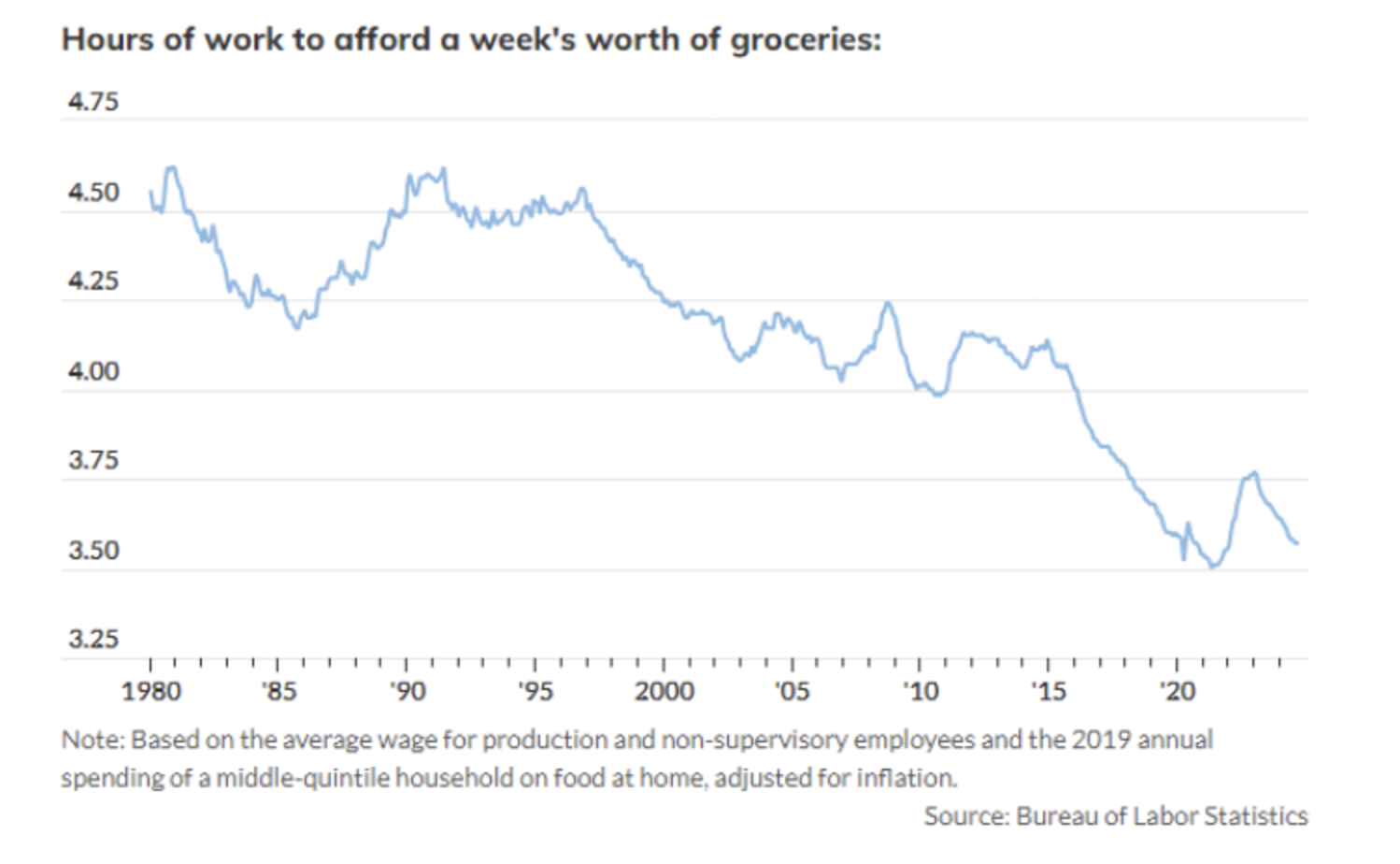
But what about inflation?  What about groceries? Let's get real with this 40-year chart. 


The price of groceries rose in the first two years of Biden's presidency as the Covid disruptions worked themselves out. Relative to the hours of work it took to earn a week's groceries it briefly spiked back to the level at the beginning of Trump's term, a level far below prior decades. Prices didn't go to the moon. They went back to prices during Trump's first two years in office. They are falling again now.

But consumers and voters don't feel and believe it. This is the power of narrative. Trump is the dominant voice describing what is going on. He says things are terrible and that we need a swashbuckling rule-breaker to fix the current misery. Biden and Harris never presented a powerful counter-narrative.

A Democrat -- or better, a half dozen of them -- needs to emerge to fill the void left by Biden and Harris. Don't wait until 2027. Do it now. There is a story to tell. If Democrats don't step up, Trump will be the one telling the story, and he will be loud and at center stage. Democrats don't need a pundit. They need a leader.


[Note: To receive this blog daily by email, go to: https://petersage.substack.com
Subscribe. The blog is free and always will be.]


Tuesday, December 3, 2024

Gut punch.

Joe Biden pardoned Hunter. It was another selfish decision to go along with his pretending to be fit to serve a second term.

What a disappointment. What a disaster for democracy.

He is Trump's greatest enabler.

      "For all Biden’s insistence that the rule of law was of paramount importance and his talk about restoring democracy, in the end he made it much harder for his own party to hold President-elect Donald Trump to account."
             Politico


     "Trumpers . . .  can now say: 'See, they’re all alike.' Meaning Trump’s not so bad, by comparison; politicians are crooks. . . . He has a bolstered rationale now to wreak havoc on American justice. Sure, they’re all alike—the Trumpers will say—but at least he’s strong."
               Joe Klein, Sanity Claus on Substack.

Joe Biden complained that the Republicans were out to "get" Hunter Biden. Of course they were out to get Hunter. 

After all, Hunter is the president's son, in and out of the White House, openly trading on his connection to his father. Hunter Biden was not living a private life. He was a "player" in the political game, making a handsome living from it. Hunter was chest-deep in the ugliest and most corrupted part of the political swamp, the crony-capitalist, influence-peddling, revolving door of favors and contracts and campaign contributions and regulatory capture. Hunter wasn't being picked on in some special way. He got exactly what judicial nominee Brett Kavanaugh got when Democrats examined what 16-year-old Brett did at that teenage party 30 years prior and what cabinet nominee Pete Hegseth is getting now as Democrats examine what he did at that conference that led to paying hush money to a woman. 

Hunter Biden wanted it both ways. He wanted to benefit from his close tie to his father's offices, but he also chose to misbehave with drugs, alcohol, sex, financial corruption and then gun laws. He videotaped himself! Joe Biden could have said he loved his son but kept him at arm's length. He didn't. The question was never whether Republicans would investigate Hunter Biden. The question was whether they would find he committed embarrassing and illegal acts. Hunter Biden did both. He wasn't falsely accused. He was correctly accused. He was guilty. His prosecution is the justice system at work. (He would probably have gotten a slap on the wrist from the judge because that is how most white collar crime is treated for first offenders, but at least it would have been the judicial system that did that, not the political system.)

Advice for people in public office: Don't do illegal stuff. Don't let family members do illegal stuff. If you can't be good, then get out of politics.

Democrats ask: How can good Christian Republicans ignore Donald Trump's flagrant bad behavior? Democrats think there is a clear moral distinction between Biden and Trump. Biden's supposed brand was America-the-good, the country of checks and balances and "no one is above the law." Biden blew that up. Biden showed that everyone is a swamp creature. At least Trump acknowledges that the system is rigged. Biden is the hypocrite who pretends it isn't, but then gets his son out of trouble.

Since the whole system is corrupt, voters are evaluating leaders on the scale of effectiveness, not virtue. Who is strong, not who is good. Biden couldn't solve problems: inflation, the border, transgenders in female bathrooms. Trump, however, is good at the lawless exercise of power. He bullies rivals. Trump will break eggs to make the omelet. Americans showed that they don't consider democracy to be a good in itself. Democracy is a tool to make a safe, prosperous society. Who better kicks ass and takes names than a strong narcissist bully?
Joe Biden just gave permission to Trump to do whatever he wants in the politicization of our justice system. Biden showed there was no lingering virtue to preserve. It is all rigged, just as Trump has claimed all along.


[Note: To receive this blog daily by email, go to: https://petersage.substack.com Subscribe. The blog is free and always will be.]


Monday, December 2, 2024

MAGA in Boston: 1974

No analogy is perfect.

History doesn't repeat. But the 1974-1976 populist revolt in Boston rhymes with MAGA.

Today's post is a follow-up on Saturday's guest post by Boston civic leader Larry DiCara. He wrote about the populist revolt against court-ordered busing of students to achieve racial integration of schools in Boston's racially and ethnically homogeneous neighborhoods.  

I illustrated Larry DiCara's post with these photographs:


The Boston revolt had ugly elements, including an angry White man using the point of a flagpole to stab at a restrained Black man. The photo is all-too genuine. But it is the worst, a caricature of the era, and one could draw an overly-simple conclusion. There was plenty of anti-Black racism, but outsiders would misunderstand the protest if they concluded it was mostly about race. It was as much or more about neighborhood. That wasn't phony or pretense. Neighborhoods were a tribe, although in part a racial or ethnic tribe. Busing broke the boundaries of neighborhoods.

I lived in the Dorchester neighborhood during this era. I took the Red Line subway spur into City Hall for work, a straight shot. There were zero Blacks in my neighborhood, nor along the one- mile walk to the subway station, nor getting onto the subway car with me, nor at the eight or so stops into the city center. I never entered "Black neighborhoods," not even when driving a car on a weekend, exploring the city. My then-wife, a woman of Polish ethnicity and a Boston native, warned me against going into them. They were "dangerous," and we risked some generalized menace if we entered their turf. I felt the same way about the ethnically-Irish neighborhoods of South Boston and Charlestown. White street-toughs might somehow sniff out that I was an outsider from Oregon and my wife Polish, not Irish. I would have been unwelcome, I thought, and it made me uncomfortable. I wasn't part of their neighborhood.

Part of the rhyme in this 50-year-old mirror is the sense of invasion by outsiders. Democrats scoffed at Fox News and Trump's characterization of uncontrolled immigration as an "invasion," but that is how a great many Americans feel about it. Too many of the wrong people, some of whom are dangerous, want in, and then they are conspicuous in their presence. Boston protesters thought they were defending themselves, their values, and their identity.

Another rhyme is the protest that rules and sensibilities of the managerial class were being imposed upon working people. The rules were burdensome and asymmetric. A financially and physically comfortable federal judge was making rules that working people were forced to live under. They were the deplorables, condemned for being "racist" when all they really wanted was to keep a safe neighborhood where their own kind of people could live their lives. Federal Judge W. Arthur Garrity Jr. lived in the wealthy Boston suburb of Wellesley. His neighborhood wasn't affected. He could afford that era's equivalent of "woke values." Two hours on a bus each day was not his problem; it was the kids'. A rich, educated guy with 24-7 security could impose disruption on others for the greater good of a social justice experiment that pushes new boundaries. Well-educated policy advocates who shape Democratic politics can defend, and even insist, upon pronoun-pronouncements, indigenous land recognition statements, mass-immigrant asylum claims, diversity statements as part of job applications, and trans "invasions" of traditionally women's spaces in bathrooms, locker rooms, and athletics. Those policies reflect elite sensibilities. 

MAGA doesn't have a single federal judge to blame, but it can blame the entire weight of modern culture and the people who read and write The New York Times and other "fake news" media -- educated, secular, cosmopolitan, diverse, and judgmental people -- which is to say Democrats.

Boston busing opponent Louise Day Hicks was elected to Congress. Mayor Kevin White, the moderate Democrats who tried to hold things together, lost his chance for higher office.

It rhymes.

Boston is a different, better place now. What fixed it? The simplest answer is prosperity. Boston's position in education, health care, and technology changed it from a working-class, blue-collar city to a magnet city for highly-paid educated people.  


[Note: To receive this blog daily by email, go to: https://petersage.substack.com Subscribe. The blog is free and always will be.]


Sunday, December 1, 2024

Easy Sunday. Mexican president to Trump, "No way, Jose."

The Mexican president tells Trump that Mexico is a neighbor, not a doormat.

President-elect Trump spoke on the phone with Mexico's president, Claudia Sheinbaum Pardo.

Trump promptly claimed "mission accomplished" on Truth Social:

    "Just had a wonderful conversation with the new President of Mexico, Claudia Sheinbaum Pardo. She has agreed to stop Migration through Mexico, and into the United States, effectively closing our Southern Border."
She disagreed, promptly "clarifying" on Twitter/X:

     “In our conversation with President Trump, I explained to him the comprehensive strategy that Mexico has followed to address the migration phenomenon, respecting human rights. We reiterate that Mexico’s position is not to close borders but instead build bridges between government and people.”


The following letter is a translation into English of her follow-up letter to Trump. It is a primary source, written in the measured, firm-but-polite manner of diplomacy, so there is no trace of emotion. No indignation. No accusation. It is a cool statement of facts and position. Within the genre of international diplomacy leader-to-leader communication, it is a sharp push-back. She is saying, in effect: Not so fast, fella. We aren't the problem, YOU are the problem. And if you impose new tariffs, it's going to bite you in the ass. 

Letter from Mexican President Claudia Sheinbaum Pardo

“Dear President-elect Donald Trump, I am writing to you regarding your statement on Monday, November 25, concerning migration, fentanyl trafficking, and tariffs. You may not be aware that Mexico has developed a comprehensive policy to assist migrants from different parts of the world who cross our territory en route to the southern border of the United States. As a result, and according to data from your country’s Customs and Border Protection (CBP), encounters at the Mexico–United States border have decreased by 75% between December 2023 and November 2024. Moreover, half of those who arrive do so through a legally scheduled appointment under the United States’ CBP One program. For these reasons, migrant caravans no longer arrive at the border. Even so, it is clear that we must work together to create a new labor mobility model that is necessary for your country, as well as address the root causes that compel families to leave their homes out of necessity. If even a small percentage of what the United States allocates to war were instead dedicated to building peace and fostering development, it would address the underlying causes of human mobility. On another note, and for humanitarian reasons, Mexico has consistently expressed its willingness to help prevent the fentanyl epidemic in the United States from continuing. This is, after all, a public health and consumption problem within your society. So far this year, Mexican armed forces and prosecutors have seized tons of various types of drugs, 10,340 firearms, and have detained 15,640 individuals for violence related to drug trafficking. Furthermore, the Mexican Congress is in the process of approving a constitutional reform to classify the production, distribution, and commercialization of fentanyl and other synthetic drugs as a serious crime without bail. However, it is publicly known that the chemical precursors used to produce this and other synthetic drugs are illegally entering Canada, the United States, and Mexico from Asian countries. This underscores the urgent need for international collaboration.
You must also be aware of the illegal trafficking of firearms into my country from the United States. Seventy percent of the illegal weapons seized from criminals in Mexico come from your country. We do not produce these weapons, nor do we consume synthetic drugs. Tragically, it is in our country that lives are lost to the violence resulting from meeting the drug demand in yours. President Trump, migration and drug consumption in the United States cannot be addressed through threats or tariffs. What is needed is cooperation and mutual understanding to tackle these significant challenges. For every tariff, there will be a response in kind, until we put at risk our shared enterprises. Yes, shared. For instance, among Mexico’s main exporters to the United States are General Motors, Stellantis, and Ford Motor Company, which arrived in Mexico 80 years ago. Why impose a tariff that would jeopardize them? Such a measure would be unacceptable and would lead to inflation and job losses in both the United States and Mexico. I am convinced that North America’s economic strength lies in maintaining our trade partnership. This allows us to remain competitive against other economic blocs. For this reason, I believe that dialogue is the best path to understanding, peace, and prosperity for our nations. I hope our teams can meet soon to continue building joint solutions.”


[Note: To receive this blog daily by email, go to: https://petersage.substack.com 
Subscribe. The blog is free and always will be.]


Saturday, November 30, 2024

MAGA : An early warning from Boston 50 years ago

Populist revolts are not new in America.

Boston revolted against desegregation in 1974-1976. 


Pulitzer prize winning photo by Stanley Forman, Boston Herald, 1976. 

Today's guest post is part one. Today college classmate Larry DiCara reminds us of the history of the populist uprising in Boston against busing to integrate Boston's public schools. He observed it up close. 

Part two comes Monday, when I draw parallels between the Boston revolt and the MAGA revolt we see around us.

Larry DiCara grew up in the working-class Dorchester neighborhood of Boston. He was a standout at Boston Latin School, then at Harvard. Then he became the youngest person ever elected to the Boston City Council, which then led to a long career as a lawyer helping shape the extraordinary turnaround of Boston. In the early 1970s, Boston was a ragged declining industrial city, part of America's "rustbelt" story. Now it is one of America's "star" cities, a hub of technology, education, and health care. The populist revolt of 1974-1976 was centered in working-class ethnic neighborhoods, at a time when Boston was at its lowest ebb. A federal judge had ordered that the public schools -- which were segregated by race due to the city's racialized ethnic neighborhoods -- needed to be desegregated by busing students into other neighborhoods.

Larry maintains a website, newsletter, and blog: https://www.larrydicara.com

Guest Post by Larry DiCara

               Desegregation in Boston 50 Years Later

Having read Death at an Early Age and many other books written in the 1950s and 1960s, it is no surprise to this observer that the desegregation of the Boston Public Schools in 1974 and subsequent years was an ugly chapter in the history of the city. I watched in the late 1960s and early 1970s while sitting in a dormitory across the river as the cauldron began to bubble. As J. Anthony Lukas and many others have written, the battles were significant, and the wounds remain. 
When I was running for Boston City Council in 1971 and 1973, there was an anticipation that something would happen; we were not sure what. I am not sure any of us anticipated the kind of resistance which we experienced. The anti-busing movement became, without any doubt, the most significant grassroots citizens movement that I have seen in Boston in my lifetime. 
 There was a city-wide organization which called itself ROAR – Restore Our Alienated Rights – which placed their signs in the windows of the City Council offices for all to see from City Hall Plaza. Because Louise Day Hicks was their chief patron, they held their meetings in the Boston City Council chamber. I never attended. I was the only member of the City Council or the School Committee who did not support the anti-busing movement, did not attend their rallies, did not give them money and, as a result, I barely survived in the 1975 election.
 
I sat next to Louise Day Hicks in 1974, 1975 and 1977. In those days the councillors had free-standing desks with chairs which rolled. That meant I could roll to my left and have a conversation with Louise. She would sometimes warn me of meetings to which I should not go, for my own safety. After a very ugly demonstration, when U.S. Senator Ted Kennedy was pushed into the Federal Building and then the demonstrators broke the glass doors – perhaps a premonition of what happened at the Capitol on the 6th of January in 2021 - she came back from the demonstration, and she was physically shaking. She said in so many words “I created it, and I can no longer control it.”
 
As happens in every movement, as we have all seen with the so-called MAGA movement, those who are the most extreme, the loudest, the crudest, the most bigoted, rise to the top. That was discussed in the recent PBS documentary, which featured Bobby Monahan from South Boston who went to Harvard and dropped some leaflets for me through the years and later rose to a major position at the Boys & Girls Clubs. Bobby almost breaks down on camera, suggesting that going to the demonstrations was what young people in Southie did, but he stopped going when a mob threw bricks through the home of a family across the street, since one of them, or both of them, were participating in a school council appointed by federal Judge W. Arthur Garrity Jr., who had ordered the desegregation.
The amount of money spent on transportation became a major topic of discussion. Today, it remains so.


Neighborhoods which were racially integrated, and we had a few in Boston at that time, although not as many as now, were, not surprisingly, more accepting. The Italians were more accepting than the Irish, but way down deep nobody really liked it. Nobody was satisfied that the education at the end of the bus ride was any better than it had been before. Large numbers of children quickly stopped going to school.

There were different groups in different neighborhoods. The one in Charlestown called themselves Powder Keg. There was concern that the group in East Boston led by Elvira “Pixie” Palladino would actually try to blow up the tunnels to prevent school buses from going through. To me, as a young man in politics, someone who had Robert Kennedy’s 1968 campaign poster on the wall, as I still do, it was a nightmare.

In the Black community, there was also significant organizing to protect the children who were being assaulted while riding buses on their way to South Boston High School and other places. Otto and Muriel Snowden had created Freedom House, which became an unofficial headquarters. The METCO Program, then in its early years, siphoned about 3,000 young people of color and brought them to school in the suburbs.

As for political leadership, other than me, the only city-wide elected official who did not participate in some way in the anti-busing movement was Kevin White. He saw his political future evaporate. Kevin had been quietly positioning himself to get on the Democratic ticket in 1976; he had emissaries working in different states. He hosted national reporters and national leaders at the Parkman House. All of that stopped when the desegregation order hit. He never really recovered politically. He barely survived in 1975; it was the closest of his four mayoral elections.

In 1976, after we had horrible violence with white people being assaulted in the Black community for no reason and a Haitian man delivering bread in South Boston almost being killed for no reason other than the color of his skin, Kevin White convened a march against violence. I remember I was giving a speech at Morgan State University in Baltimore, and I flew back early the next day so I could attend. As we gathered on the Boston Common, I saw that I was the only city-wide elected official other than Kevin.

That’s where we were when we bottomed out early in the summer of 1976. Luckily, on the 4th of July, the Queen of England appeared; I even attended a small lunch with her. A few weeks later, we opened Quincy Market and people carried on with their lives even though the school system of the late 1970s was nothing like the school system of a few years prior. It was significantly decreased in size from approximately 100,000 to some 65,000, and it was now a majority-non-white school system.


[Note: To receive this blog daily by email, go to: https://petersage.substack.com 
Subscribe. The blog is free and always will be.]


Friday, November 29, 2024

A Black Friday report on tariffs

Free trade makes America wealthier.

But it doesn't make every American wealthier. Some people lose their jobs.

The Upper Midwest turned red again.

College classmate Jim Stodder was dismayed by Trump's victory, but he is clear-eyed that some of Trump's proposed economic policies, including tariffs, have some value in dealing with the socioeconomic problems that have emerged in the past three decades. He sent me his perspective on tariffs, free trade, and the principle of comparative advantage. He taught international economics and securities regulation at Boston University and maintains research affiliations there. He received a Ph.D. from Yale in economics. He has his own website: www.jimstodder.com


Guest Post by Jim Stodder

                         Global Trade in a Post-Liberal World
For over a century, rich countries have pushed the attractive idea that Free Trade leads to Peace and Prosperity: less conflict and better living standards for all. As I will try to show, there is something to this idea. But like most things, it was wrong in its most extreme form.

For an example of how wrong it could be, consider the idea that free trade between countries improves everyone’s welfare. Free trade in cotton and textiles did benefit the U.S. and Britain in the 18th and 19th centuries – but not the slaves who picked that cotton.

Or take the Victorian belief that rapidly growing trade between the world’s richest countries meant war between them had become impossible. This "Pax Brittanica" ended with WWI.

Yet the basic idea behind free trade and its elder brother, the division of labor, is sensible. Take two people: you and your spouse. Let’s say you are married to the greatest basketball player on Earth. Let’s call them Steph Curry or Caitlin Clark, depending on your preferences.

Say you and your spouse must manage sneaker endorsements. Some division of labor is a no-brainer if you are better at, say, the business-accounting side. But what if he or she is better at both? Clearly, they are 1,000,000 times better shooting hoops or making endorsements. But what if they’re also 10 times better at the accounting?

Steph or Caitlin should still leave the accounting to you because their time is limited. Better than earning 10 times more than you in accounting is to have them earn a million times more in endorsements.

Accounting is what economists call your “comparative advantage.” Even a country that is bad at everything can do better by specializing in what it is comparatively less-bad, and trading for what it would be even worse at making itself.

Comparative advantage based free trade has led to huge increases in human well-being. Since the 1970s it has leveraged unskilled labor to pull 800 million people in China and 400 million in India out of poverty. That’s 1.2 out of 3 billion total – more than a third. Never have more lives been so improved in such a short time.

Of course, that same free trade led to closed factories and blighted communities across America. But economists never claimed free trade is good for everyone in each country – just good for each nation as a whole. It’s a potential gain for everyone, but only if each nation redistributes those gains. (Funny how conservative free trade advocates leave out that small detail.)

So that’s the good, bad, and the ugly of free trade. But let’s go back to your superstar spouse. What if they are super-human? What if, instead of an insanely high fixed level of productivity, they get better and better, and are nowhere near full capacity? An hour accounting doesn’t take away from their time on basketball -- they have more than enough time to do both, and they’ll be even better tomorrow. Then it's more efficient to let them do everything – if they’re still willing to support you! (A spouse may be, but a foreign country may not be so willing.)

This is what’s called “Increasing Returns”, the “New Trade Theory” associated with Paul Krugman, who won a Nobel Prize and writes for The New York Times. It can still lead to cooperation.

For example, the U.S. and the EU still sell each other things within the same industry, like different kinds of automobiles or pharmaceuticals. Germany gets better at BMWs while we get better at Teslas.

But it can also lead to greater conflict between countries, as we see with EVs. Both the U.S. and EU now put tariffs on EVs from China. They are way too cheap and too good – we’re not competitive. We think we can build world-class EVs, but not if China captures all the Increasing Returns.

The potential for conflict is even greater with a master-technology like AI, one that leads to dominance in all the others – like early U.S. advances in electricity. You want to be the country furthest up the hill of Increasing Returns. Tariffs against the other guys’ product may be part of this.

Do Increasing Returns mean we are doomed to Increasing Conflicts? No, but the easy optimism from the era of liberal free trade is over. Liberal optimists believed that market forces always right the global ship and made every country better off. This was always overstated. It ignored forces not usually subject to market forces, like pollution.

But free trade is dangerous for crucial technologies of the information age. Like AI, most show Increasing Returns. Most advances in AI have come from massive expansions of scale. Instead of the radical decentralization of a “perfectly competitive” market, master-technologies like money creation, weapons of mass destruction, climate control, and AI can be responsibly governed only if they are radically centralized and subject to democratic controls -- on a global basis.

This is not the message we want to hear, but such master-technologies require some form of world government. This must be much stronger than the weak consensus of the United Nations, as in “We can cooperate, but only if we all agree.”
Donald Trump is right that the old order of liberal free trade is broken, and tariffs may sometimes be needed in a dangerous new world. But we can't build a new order with tariffs on everything, Increasing Returns or not. Trump’s arrogance will only increase chaos and conflict. Recall Teddy Roosevelt’s advice on diplomacy: “Speak softly and carry a big stick.”.Trump seems to prefer the opposite.


[Note: To receive this blog daily by email, go to: https://petersage.substack.com
Subscribe. The blog is free and always will be.]